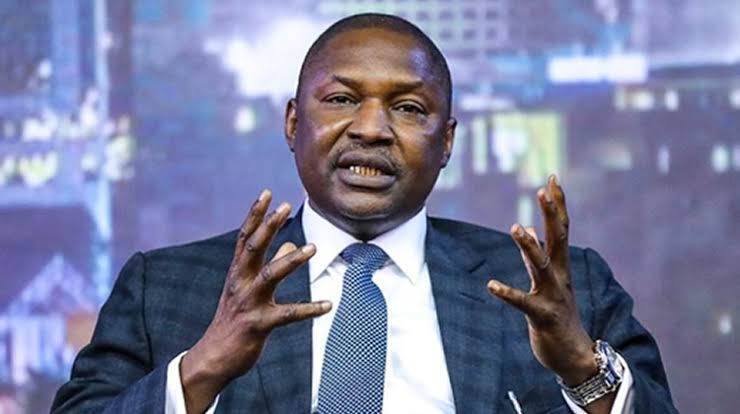
On Saturday, the 29th of November, 2025, the Economic Financial Crimes Commission (EFCC) confiscated the international passport of former Attorney General of the Federation and Minister of Justice Abubakar Malami SAN over alleged duplication of the $310 million Abacha loot.
The anti-graft agency reportedly seized the passport as part of stringent bail conditions imposed on the ex-minister, who has been restricted from leaving the country for a month due to ongoing investigations to scrutinize the movement and management of the repatriated funds.
ORIGIN OF THE MATTER?
Abubakar Malami, SAN, a Kebbi-born politician, served as the Attorney General of the Federation and Minister of Justice during the Buhari-led administration (2015 to 2023).
Malami reportedly played a major role in negotiations and coordination of various asset-recovery efforts during his tenure, which includes the infamous Abacha loot—a responsibility now under scrutiny.
WITHIN NIGERIA gathered that a part of Abacha’s loot was reportedly returned to Nigeria under an international legal cooperation during Malami’s tenure as AGF and Minister of Justice.
Recall that two tranches of Abacha loot recovered from Jersey and Switzerland were publicly disclosed by the Buhari-led administration in 2016 and 2018, respectively.
WHY IS EFCC INVESTIGATING?
WITHIN NIGERIA gathered that the Economic Financial Crimes Commission (EFCC) is investigating the ex-Justice Minister on the basis of allegations of deliberate duplication in the recovery process of the Abacha loot, abuse of office, and money laundering.
An EFCC official who spoke under anonymity disclosed that the anti-graft agency only needed his explanations on the whereabouts of the $490 million Abacha loot secured through Mutual Legal Assistance (MLAT).
WHY WAS THE PASSPORT SEIZED?
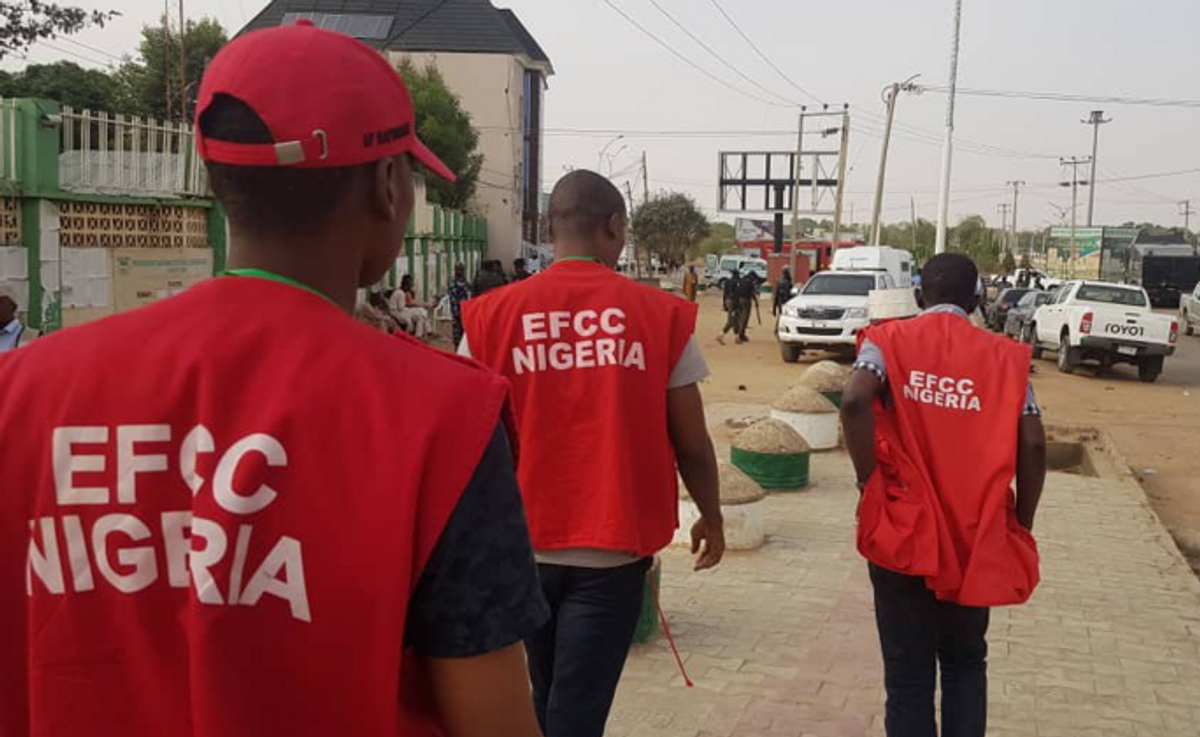
The Economic Financial Crimes Commission (EFCC) on Friday invited Abubakar Malami SAN, former Minister of Justice, for interrogation over alleged mishandling of recovered Abacha loot.
However, WITHIN NIGERIA gathered that he was released on administrative bail at about 1:00 a.m. on Saturday, but he is mandated to report daily to the EFCC headquarters in Abuja for 30 days.
Malami is expected to use the next 30 days to provide detailed explanations regarding the movement, utilization, and current location of the $490 million recovered through a Mutual Legal Assistance Treaty (MLAT).
The anti-graft agency disclosed that it was necessary to seize Malami’s international passport in order to restrict his travels considering the bogus amount of money, large volume of documents, and extensive sessions he has to go through with detectives during the probe.
The agency stressed that the former minister cannot leave Nigeria without EFCC approval or an order from a High Court—a standard procedure in high-level financial investigations.
MALAMI’S RESPONSE?
Former Attorney General of the Federation and Minister of Justice Abubakar Malami, SAN, has described the petition filed against him over the recovery of $310 million of Abacha loot as baseless and illogical.
This was contained in a statement signed and released by his special assistant on media, Mohammed Bello Doka.
Malami confirmed that he was queried by operatives of EFCC during the visit over alleged duplication in the recovery of the $310 million Abacha loot.
According to him, with the accrual of interest, the Abacha loot had risen to about $322.5 million at the time it was eventually recovered for the federal government.
Malami said the EFCC accused him of abuse of office and money laundering in the recovery of the funds.
EFCC, according to Malami, claimed that the recovery of the funds had already been completed by a Swiss lawyer, Mr. Enrico Monfrini, before he assumed office in 2015.
He said based on this premise, the anti-graft agency alleged that he merely duplicated an already concluded recovery process in order to introduce other lawyers who would, in turn, give him kickbacks.
“This allegation collapses immediately when subjected to facts and elementary logic. The facts, mostly documented, were referred to in my response to the interrogatories raised by the commission,” Malami said while faulting the claim.
Malami noted that recovery of illicit funds can legally be said to have been completed upon the actual lodgement of recovered funds into the Federation Account.
On the contrary, he noted that as of 2016, when the Buhari administration initiated the process of repatriating the $310 million (later $322.5 million with interest), there was no lodgement of any such funds into the Federation Account.
“There was therefore no complete recovery in existence, and nothing whatsoever to duplicate,” he said.
Further backing up his claim, Malami noted that in December 2016, several lawyers applied to be engaged for the recovery of these same funds—Mr. Monfrini himself included.
“It is entirely illogical for a lawyer to apply in December 2016 to be engaged to recover funds he purportedly recovered two years earlier. That singular fact exposes the internal contradiction and absurdity of the EFCC’s narrative,” he said.
Malami noted that in his application, Mr. Monfrini demanded an upfront deposit of $5 million and a success fee of 40 percent of the recovered sum.
The former AGF said Monfrini later unilaterally reduced his demand to 20% upon realizing the impossibility of the 40% demand flying.
“These terms were rightly rejected in line with the clear policy of the Buhari administration that no ‘on account’ deposits would be paid to recovery agents and that success fees must not exceed 5 percent of recovered assets,” he said.
He added that following this, a Nigerian law firm was engaged on a transparent, all-inclusive five percent success fee basis, with no advance on account deposit.
“By this decision, Nigeria was saved at least 15 percent of the recovered assets when compared to Mr. Monfrini’s 20 percent demand, and as much as 35 percent when placed against his earlier proposals. Nigeria was also saved by the upfront and unjustifiable $5 million deposit demanded by Mr. Monfrini.
“At an average exchange rate of ₦1,600 to the dollar, a 15 percent saving on $320 million amounts to approximately ₦76.8 billion, while a 35 percent saving translates to about ₦179.2 billion. These are concrete, measurable benefits to the Nigerian state.
“Accordingly, any claim or investigation suggesting abuse of office or money laundering in relation to the $322.5 million is not rooted in any reasonable ground for suspicion. It is supported neither by facts nor by logic.
“The constitutional discretion of the Honourable Attorney-General of the Federation in matters of recovery of illicit funds is exercised strictly in the public interest and in the interest of justice. In the circumstances of this case, that discretion was exercised transparently and responsibly, saving Nigeria between 15 percent and 35 percent of the recovered assets and avoiding unlawful or unaccounted expenditures,” he said.
Malami also added that there are two distinct tranches of Abacha loot he recovered as Attorney General of the federation.
He listed the recoveries to include $322.5 million repatriated from Switzerland in 2017–2018.
He noted that the recovery was deployed through the National Social Investment Programme for the Conditional Cash Transfers program and monitored by the World Bank and civil society organizations out of commitment of the Buhari government to entrench transparency and accountability.
Malami added that he was also instrumental in the recovery of another tranche of about $321 million repatriated in 2020 from the Island of Jersey, with United States and Swiss involvement.
He noted that the money was earmarked for major infrastructure projects, including the Lagos–Ibadan Expressway, the Abuja–Kano Road, and the Second Niger Bridge, under project-based monitoring arrangements.
Any attempt to conflate these distinct recoveries or to portray a lawful, cost-saving recovery process as duplication is misleading.
“In conclusion, the allegations of money laundering and abuse of office concerning the $322.5 million Abacha loot remain baseless, illogical, and entirely devoid of substance.
I remain confident that truth, law, and reason will ultimately prevail,” he said.