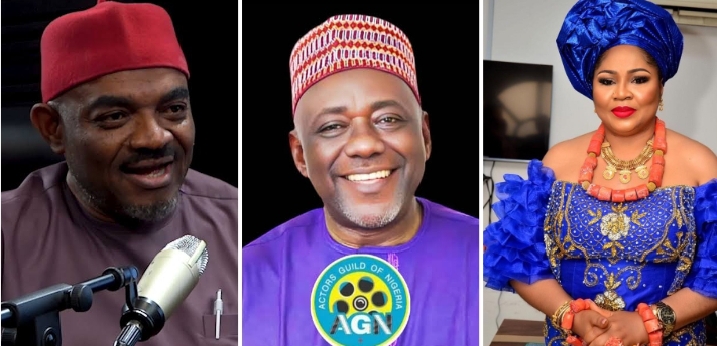
The Actors Guild of Nigeria (AGN) held its presidential election on Saturday, December 6, 2025, in Benin City. The contest ended with Abubakar Yakubu, the outgoing National Secretary, securing 116 votes. Rita Daniels followed closely with 113 votes, while three ballots were declared void.
The margin was razor-thin, just three votes separating the winner from the high-profile challenger. By numbers alone, it was one of the closest elections in AGN history, highlighting a deeply divided electorate within the guild.
Why Rita Daniels’ Candidacy Drew Attention
Rita Daniels’ bid for AGN presidency was significant because of her long-standing role in Nollywood and her connection to Regina Daniels, her daughter. Her celebrity visibility sparked widespread debate: could fame and industry influence translate into guild leadership?
Observers noted that ongoing controversies surrounding Regina Daniels, including marital issues and public scrutiny, may have influenced perceptions of Rita Daniels. Delegates were left to weigh her professional experience against potential reputational risks stemming from her family’s public profile.
Emeka Rollas’ Public Call-Out
In the weeks leading to the election, Emeka Rollas, then AGN president, issued statements directed at Rita Daniels and her daughter. Rollas urged Rita to prioritize her daughter’s well-being over guild leadership ambitions. He warned that those encouraging her candidacy could be “enemies” of the family and of the guild itself.
Rollas also denied claims that Ned Nwoko, Regina Daniels’ husband, had contributed funds to influence the election. He clarified that alleged donations, including ₦200 million, were meant solely for Regina’s personal film production. Rollas framed his comments as a defense of AGN’s moral integrity, emphasizing the risks of normalizing celebrity distractions in guild affairs.
These statements likely influenced delegates’ perceptions. By raising questions about personal and family matters, Rollas reframed the election as not only a leadership contest but also a test of values within AGN.
The Numbers Tell the Story
Vote counts alone reveal the tension of the 2025 election. Yakubu 116, Rita Daniels 113, three voided ballots. That’s razor-thin in AGN terms. Past elections rarely show such narrow margins.
The three invalid ballots are particularly notable. While small in number, they represent potential tipping points in a contest where every vote carried weight. Analysts note that a swing of even one ballot could have changed the outcome, underscoring how divided the guild was.
The margin also demonstrates that Rita Daniels commanded nearly as much support as Yakubu, reflecting her credibility, reputation, and influence in Nollywood circles despite external controversies.
Yakubu’s Victory: Continuity or Shift?
Abubakar Yakubu’s win is often described as a continuation of steady leadership. As outgoing National Secretary, he had deep experience with guild administration, internal procedures, and delegate relations.
His narrow victory suggests that delegates valued operational competence and stability, even over celebrity recognition. Yakubu’s win highlights the internal logic of AGN elections: trust and familiarity often outweigh fame and public visibility.
This is consistent with previous patterns, where elections favored candidates with strong internal networks and organizational knowledge over those relying primarily on high-profile reputations.
Historical Context — Previous AGN Elections
Understanding the significance of Rita Daniels’ narrow loss requires a look at past guild elections.
2022 Re-election of Emeka Rollas: In November 2022, Rollas was reelected during the Nollywood Actors Summit in Benin City. Approximately 120 delegates voted, confirming his continued leadership and reinforcing his influence within the guild.
2017 Election — Rollas vs Emeka Ike: On August 21, 2017, Rollas defeated Emeka Ike 42 votes to 12, ending a period of internal crisis and factional disputes.
Earlier Presidents: Prior to Rollas, AGN leaders included Zack Orji, Ejike Asiegbu (2005–2009), Kanayo O. Kanayo, Segun Arinze, and Ibinabo Fiberesima (2012, first female president). Precise vote counts for these earlier elections are unavailable.
2012 Election Crisis: Elections scheduled for April 27, 2012, were aborted due to procedural issues and unrest. Segun Arinze resigned amid the fallout, leading to a reconciliation conference and subsequent elections.
These examples show a pattern: AGN elections are often influenced by both organizational dynamics and public controversies. The 2025 vote, with only a three-vote margin, fits this trend of tightly contested leadership battles.
Close Contests and Historical Patterns
Looking back, AGN has seen other tight and contentious elections. The 2017 contest, where Rollas defeated Emeka Ike 42 to 12, marked the end of a factional crisis. The 2022 re-election of Rollas involved roughly 120 delegates, confirming the influence of continuity and existing leadership structures.
Rita Daniels’ three-vote loss in 2025 fits this broader pattern of high-stakes, closely contested leadership battles. It also emphasizes how personal reputation, past controversies, and external narratives can subtly tip results in an organization where every vote counts.
Implications of the Election Result
For Rita Daniels, the loss is narrow but significant. The vote demonstrates strong support across the guild, yet it also highlights the impact of Rollas’ public intervention and the broader influence of family-related perceptions on leadership contests.
For AGN, the election underscores the complex interaction between celebrity, governance, and internal politics. Members must navigate professional qualifications, personal reputations, and public opinion, balancing each factor in decisions that shape the guild’s future.
For Nollywood, the result sends a clear message: celebrity prominence alone does not guarantee leadership success. Aspiring leaders must combine industry influence with trust, credibility, and an ability to address questions about character and integrity.
What Comes Next
Rita Daniels’ near-miss leaves several potential paths. She could strengthen her support base within the guild, aim for zonal leadership positions, or prepare strategically for the next election cycle. Yakubu’s win signals continuity, but the closeness of the vote indicates ongoing divisions and the potential for future shifts in AGN politics.
The 2025 election may also prompt discussions about clearer rules on campaign conduct, conflict of interest, and the influence of personal controversies in guild elections. As Nollywood continues to evolve, AGN’s leadership dynamics will remain closely watched by both industry insiders and fans.
Final Reflections — A Guild at a Crossroads
The 2025 AGN election is more than a contest between two candidates. It is a reflection of how Nollywood is grappling with the balance between celebrity influence and organizational governance.
Yakubu’s victory ensures continuity and administrative experience at the helm, while Rita Daniels’ close loss signals the growing weight of celebrity participation in guild politics.
As Nollywood evolves, AGN elections may become increasingly competitive, and the role of personal narratives, public perception, and ethical framing will continue to influence outcomes. The guild’s future may well depend on how it navigates these intersections in the years to come.