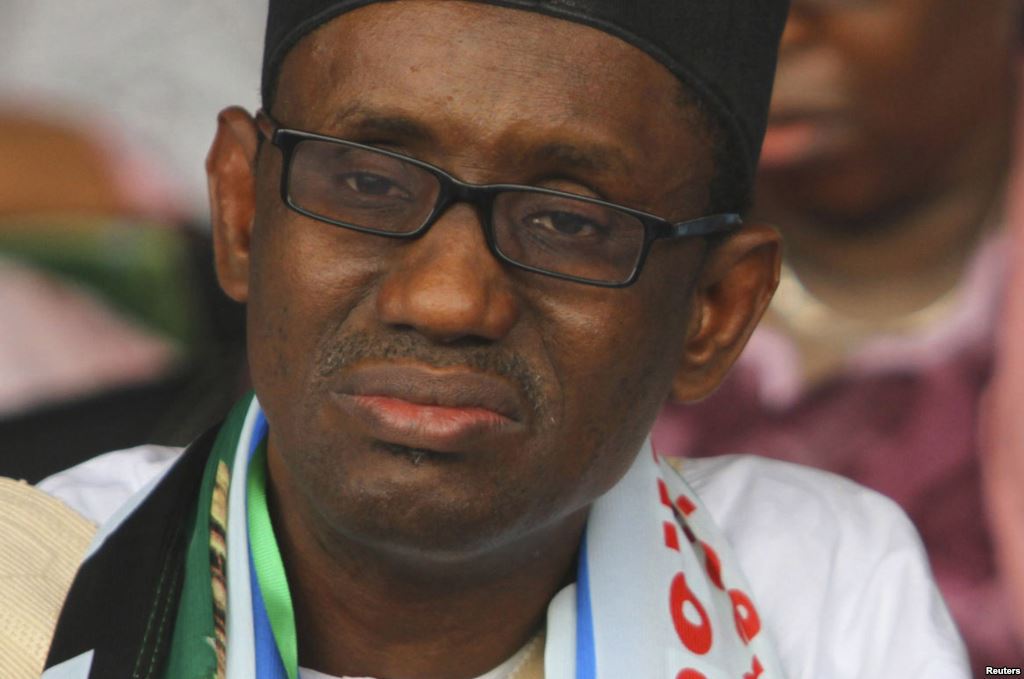
Nuhu Ribadu, the National Security Adviser, seems to have become a target. Ribadu, a name that once evoked respect and admiration, is now a target. Upon his appointment as NSA, numerous Nigerians praised President Bola Tinubu, referencing Ribadu’s prior achievements as a former boss of an anti-graft agency.
During the initial phase of his tenure, Nigeria experienced a period of relative tranquility. The Nigerian military, working with other security agencies, was winning the fight against insurgency until everything changed. The Northeast and Northwest were dominated by mass kidnappings, which spread to Kogi and Kwara states in the North-Central, with pockets of unrest in several Southwest states.
A military coup was allegedly prevented.In a dramatic action to combat insecurity, President Tinubu reportedly ordered Christopher Musa, former Chief of Defence Staff, and certain military leaders to quit and replace them.
Mohammad Badaru, the then-Minister of Defence, reportedly quit just six weeks following the appointment of new military chiefs. President Tinubu has nominated Christopher Musa, the former Chief of Defence Staff, as his replacement.
The purported dismissal of Mohammed Badaru as Minister of Defence and the subsequent selection of Christopher Musa as his successor received commendation from civil society organizations and notable figures, who characterized it as a fitting choice.
Civil society organizations and notable Nigerians have urged President Bola Tinubu to contemplate the dismissal of Bello Matawalle, the Minister of State for Defence, and Nuhu Ribadu, the National Security Adviser.
Recall that Bello Matawalle, the previous governor of Zamfara State, has been seriously and repeatedly accused of ties to banditry, terrorism, and mismanagement of security budgets. The EFCC accused him of diverting ₦70 billion from Zamfara’s coffers and being linked to stolen state assets, including 50 government-owned vehicles.
Youth groups such as the Northern Christian Youth Coalition and student organizations such as the National Association of Nigerian Students (NANS) have called for his resignation, claiming that his ongoing participation jeopardizes national security. Civil society organizations have accused Bello Matawalle of jeopardizing the integrity of the defense apparatus.
WITHIN NIGERIA gathered there were pressures in support of Nuhu Ribadu’s dismissal as President Bola Tinubu’s National Security Adviser (NSA).
The anti-graft chief, who was praised for freeing hostages and encouraging interagency cooperation, is now facing political and institutional pressure. Ribadu is allegedly caught between commendations and agitations.
Following the dismissal of Mohammad Badaru as Minister of Defence, notable Nigerians, including Osun East Senator Francis Fadahunsi, have publicly asked that Nuhu Ribadu be removed as National Security Adviser, stating that only a retired general should lead national security.
Some top military officers, including important cabinet members, have also expressed support for Senator Francis Fadahunsi, who is actively pressing President Tinubu to replace him.
However, other civil society groups endorsed the approach, while two notable groups, the Oodua Peoples Network and the Niger Delta Stakeholders’ Forum, argued that modern security requires strategic intelligence rather than just uniformed pedigree.
Columnist Abbah Modibbo also advocated for Nuhu Ribadu’s dismissal, citing a quote attributed to him that the Tinubu-led administration inherited a bankrupt treasury—a charge that enraged APC supporters.
He referred to the comment as dangerous and irresponsible. Many supporters of late President Muhammadu Buhari condemned the comment as sacrilegious and demanded Nuhu Ribadu’s dismissal.
In another development, Sahara Reporters, an online news platform, reported that intelligence agencies such as the National Intelligence Agency (NIA), the Department of State Security (DSS), and the Defence Intelligence Agency (DIA) now report directly to President Tinubu, bypassing the National Security Adviser (NSA). Many have seen the decision as a subtle downgrading of Ribadu’s role.
Recently, the admission from the office of the National Security Adviser that it supplied weaponry to vetted vigilante groups as part of a constitutionally mandated ‘hybrid-force’ strategy to handle terrorism, banditry, and other crimes in hard-to-reach, forested areas has generated a scandal.
Abu Micheal, head of Strategic Communications at the National Counter-Terrorism Centre (NCTC), an arm of ONSA, while reacting to rumors of a rifle linked to ONSA being discovered in Kwara State, made the statement.
In his defense, Micheal cited Part III, Sections 4–6 of the Terrorism Prevention and Prohibition Act, 2022, and the National Counter-Terrorism Strategy (NACTEST) as the legal and policy basis for the deployment of regular security forces alongside trained irregular auxiliaries—hunters, vigilantes, and former members of the Civilian Joint Task Force (CJTF).
Some observers have highlighted worries about the involvement of groups like Miyetti Allah, warning that arming non-state players could worsen communal tensions and pose new security threats.
However, Ribadu’s fate is still uncertain. President Tinubu remains the sole decision-maker and determinant. Will Tinubu succumb to pressure and remove Nuhu Ribadu as NSA? Will Tinubu maintain Nuhu Ribadu and change the country’s security architecture without dismissing him outright? Will Nuhu Ribadu survive as pressure grows to oust him as National Security Advisor?