In the midst of worsening water crisis in Enugu, the capital and other metropolitan cities like Nsukka, the Enugu state government has earmarked whooping N30 billion in the 2026 budget for the feeding of school pupils in the Smart Green Schools, yet to take off.
Appending his signature to the 2026 Appropriation Bill into Law, at the Executive Chamber, Government House, Enugu, on Wednesday,the governor of the state, Dr. Peter Mbah, reaffirmed his administration’s resolve to redouble the transformations recorded across every sector so far.

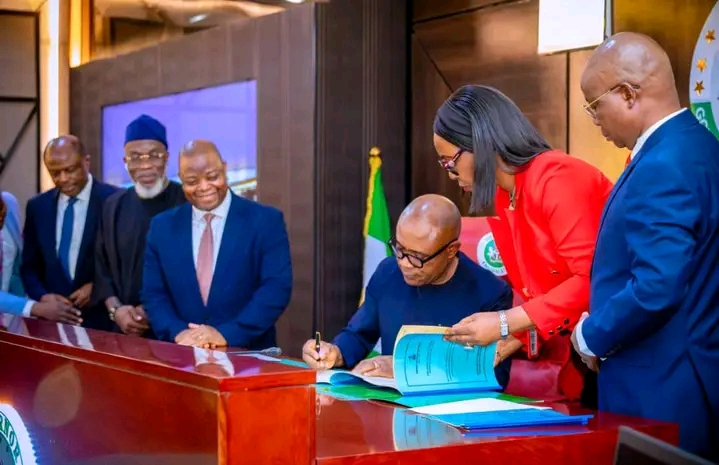
Gov. Mbah expressed his gratitude to the members of the Enugu State House of Assembly for their diligent and expedited consideration of the budget, promising to commence implementation immediately.
WITHIN NIGERIA gathered that out of the N1.62 trillion budget, the sum of N1,296,092,465,000, representing 80 per cent of the budget was allocated to Capital Expenditure, while N321,305,000,000, representing 20 per cent of the budget goes to Recurrent Expenditure.
Checks showed that this follows the established budgeting tradition under the Mbah Administration as the 2024 budget comprised 79 per cent Capital Expenditure and 21 per cent Recurrent Expenditure per cent, while the 2025 budget comprised 86 per cent Capital Expenditure and 14 per cent Recurrent Expenditure.

Further breakdown of the budget showed that the Economic Sector leads with N825.9 billion, which represents 51 per cent of the total budget while the Social Sector is next with N644.7 billion, representing 40.1 per cent of the budget, while Administration Sector, Justice Sector and Regional Sector follow with N128 billion, N15.8 billion, and N2 billion, respectively.
However, education got the lion’s share of 32.27 per cent, with N30 billion earmarked for schools feeding in the 260 Smart Green Schools, thus maintaining the administration’s tradition of over 30 per cent allocation to the sector in 2024 and 2025.
In any case, budget funding comprises N870 billion Internally Generated Revenue, IGR, N387 billion from Federal Account Allocation Committee, FAAC, and N329 billion from Capital Receipts.

Gov. Mbah explained that the 2026 budget was built on the philosophies of inclusivity, accountability, transparency, traceability, and strong institutions that assures that there is value for every kobo spent.
Mbah went further to explain that the projected N870 IGR target was realisable, saying it only required discipline, creativity, and hard work.
He cited the administration’s turnaround of the state’s IGR from below N30 billion it met in 2023 to over N180 billion in 2024 and N400 billion in 2025.
In his words, “We will be ending this year 2025 with an IGR of N400 billion, which is more than 83 per cent of our projected domestic revenue or IGR of N507 billion for this year.
“However, we are confident that we are not only going to achieve the over N800 billion revenue for next year, but we are also even going to overshoot it. We believe that with the unlocking of the different streams of economic potentials in Enugu State, we will realise our domestic revenue projection,” he explained.
Gov. Mbah said that he projected that the FAAC monthly allocation is to be saved for s rainy day in the state.
“If you also look at the ratio to our expected Federal Allocation, it would be barely 27 to 28 per cent. It means that if we stay the course and realise this projected revenue for 2026, we can effectively govern Enugu State without recourse to our FAAC allocation. FAAC allocation becomes something we may just save for our children and for the rainy days,” he stated.
“We have projected an IGR of over N800bn. It translates to generating over N70 billion every month. And if you push further, it translates to over N18 billion every week. Again, if you drill down even further, it means we have to make over N2.5 billion every day.
“It is something we have to work extremely hard to realise. So, we do not have the luxury of wasting even one day, because it will be our billions that are being wasted.
“We feel the weight of the expectations on our shoulders, and we are committed to it. We are going to suspend the Christmas for this year to ensure that we secure the future of our children,” he concluded
However, as robust and realisable the budget looks like, it has drawn some criticism across the spectrum of the state especially with regards to the feeding if school pupils with a whooping N30 billion when the state is facing huge water crisis.
Many residents have continued to react to the development. In a Facebook reactions, barely hours after the Governor posted the signing of the budget into law, some netizens have reacted especially with regards to the feeding of the school pupils.
Jones Brown wrote, ” Good morning sir , I wish to humbly advise on a particular area . In the aspect of feeding please sir redirect it to rural area roads. Please sir ,the rural community roads are too important at this time . Yes we know we are paying much taxes currently in enugu state than before but we are seen the positive impact in our various communities. GOD BLESS YOU SIR.”
Franklin Chukwuemeka also wrote, “Your Excellency sir,
“With respect for your outstanding achievements in our state, I wish to express concern about the ₦30 billion allocated for the school feeding project. While the idea is noble, such a huge sum could be better invested in urgent needs like clean water, housing, and support for SMEs, which directly empower families to provide for their children.
“Enugu needs an enabling environment where businesses thrive and households are strengthened, rather than handouts that risk mismanagement. Redirecting resources to these areas would deliver more lasting benefits for our people.
“Thank you, sir, for your continued commitment to Enugu’s progress.”
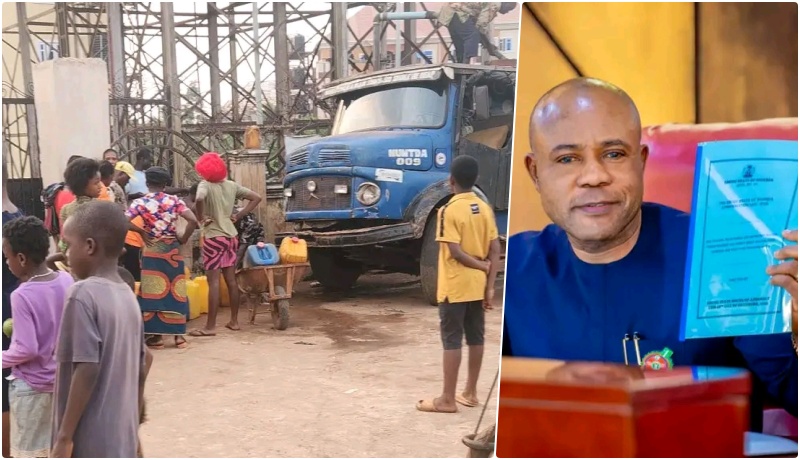
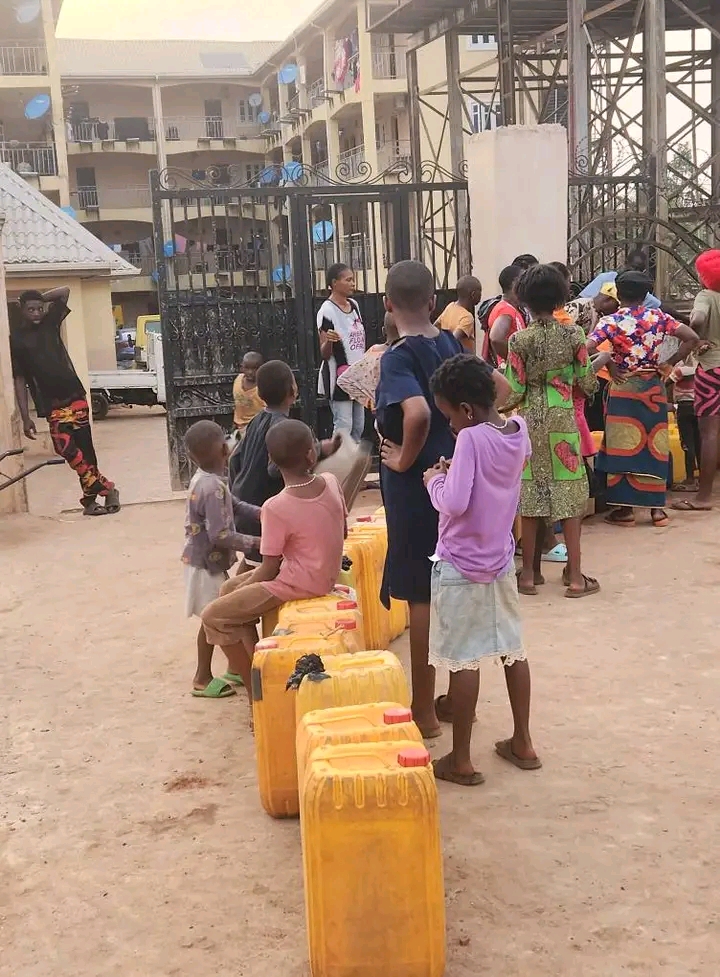
However, across Enugu state, commercial water tankers smile to their bank after selling thousands of litres of water to their customers who can afford it while poor household clutch their wheelbarrows and gallons in search of pipe borne water at boreholes, tens of kilometres away.
At the sound of the water tanks, children run out with buckets, each carrying as much water as they could, while the adults walked up and down the streets with their heavy pails and bowls.
The wealthy had water tanks ranging from 500 gallons, also waiting for the tanker to discharge. For the people of Enugu state and for as long as the oldest adult could remember, access to portable clean water has remained a constant gamble in the state even as successive governments use it as a campaign tool.
WITHIN NIGERIA gathered that government pipe-borne supply has proven unreliable, forcing families to gamble between boreholes, streams, and tanker water. This scarcity of potable water hardly affords residents the chance to inquire where the water comes from, or if it is purified, or what dangers it may carry thus potential health emergencies linked to water contamination looms in the state.
At the Enugu metropolis, it is a thug of war as many residents are usually seen with wheelbarrows and gallons, struggling to get pipe-borne water from private boreholes.
At Obiagu, a slum in the metropolis, one of the residents, Mr. Okafor Livinus told WITHIN NIGERIA that “for weeks now, we don’t know what is water supply. We buy water from tankers at an exorbitant price.”
Explaining further, Mr. Okafor stated that ” 750 gallons of tank is sometimes sold at N12000. A gallon of 25 litres is also sold at N50. We are appealing to the state government to do everything possible to restore the government pipe borne water.”
At the University town, Nsukka, more than half of the metropolis don’t have pipe borne water.
According to findings by WITHIN NIGERIA, only Onuiyi, Mbuke, Amukwa and some parts of Nru have access to government pipe borne water.
It was also gathered that even at that, less these areas have access to this amenity.
Aaron Ugwu is a resident of Onuiyi, few metres away from the University of Nigeria Nsukka second gate.
He told our reporter that ” we usually have two days of running water in this area for a week. After the two days schedule, no more pipe borne water again for the next week. That’s of nothing spoiled in their station. If anything spoiled, we may stay for a month without water.”
Narrating further, Mr. Ugwu stated that ” what we usually do is to buy rubber tank to store the water so that we can use it when the tap has dried up. It is not funny and that’s why we are appealing to the state government on the supply of water in this area.”
UNN warns of rising water shortage
It is based on this that the University of Nigeria, Nsukka on Tuesday, December 1, warned that Nigeria’s food and water systems are under severe threat from climate change, water scarcity, and worsening insecurity, calling for urgent policy action.
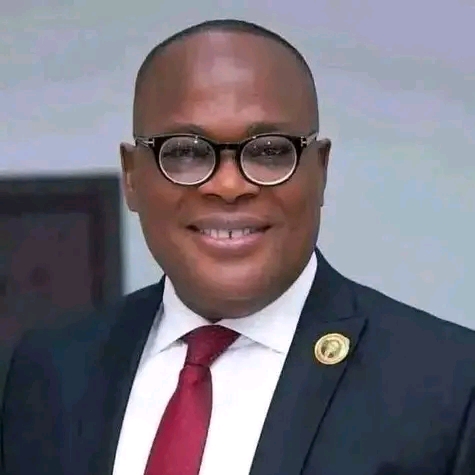
Speaking at the event organised by the Resource and Environmental Policy Research Centre–Environment for Development (REPRC-EfD Nigeria), the Vice Chancellor, Prof. Simon Ortuanya, said the nation’s food and water pillars “are facing unprecedented stress,” urging policymakers to act on new research presented by the university.
The event held in Enugu State capital was in commemoration of its annual Policy Day on sustainable natural resource management.
“Water scarcity threatens agricultural productivity and livelihoods across many regions.
“Climate change has disrupted rainfall patterns, and banditry continues to displace farmers and destroy farmlands. The result is a growing threat to food security and social stability,” the vice chancellor said.

WITHIN NIGERIA gathered that the policy day featured findings from three major studies on water scarcity in Enugu State, gender-differentiated impacts of climate-smart agriculture among cassava farmers, and the effect of armed banditry on agricultural productivity across Nigeria.
The VC, however stressed that the university is committed to research that directly informs national policy, adding “Research must lead the way in finding solutions to these intertwined challenges.”
He urged participants to “engage in robust discussion” to help chart a new course for water management, climate-smart agriculture, and food security in Nigeria.
Speaking in an interview, Director of REPRC-EfD Nigeria, Prof. Nnaemeka Chukwuone, said the event is designed to bridge research and policymaking.
“This policy day is an annual event where we present research findings to policymakers and engage them to draw out policy inputs,” he said.
According to him, “the water scarcity study was conducted with the Enugu State Ministry of Water Resources, while our study on climate for agriculture has already been accepted in a top journal.”
“These are stakeholders we want to influence with evidence so they can enhance policy outcomes,” Chukwuone said.
The event ended with calls for translating the research into concrete policy reforms that address Nigeria’s deepening water
and food security challenges.