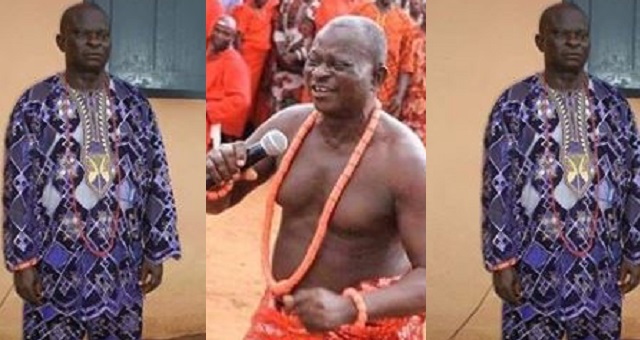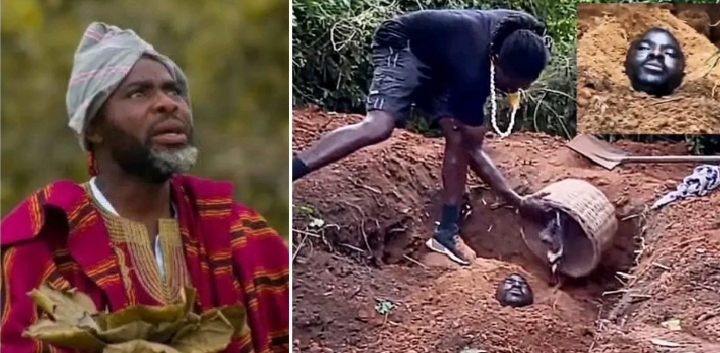
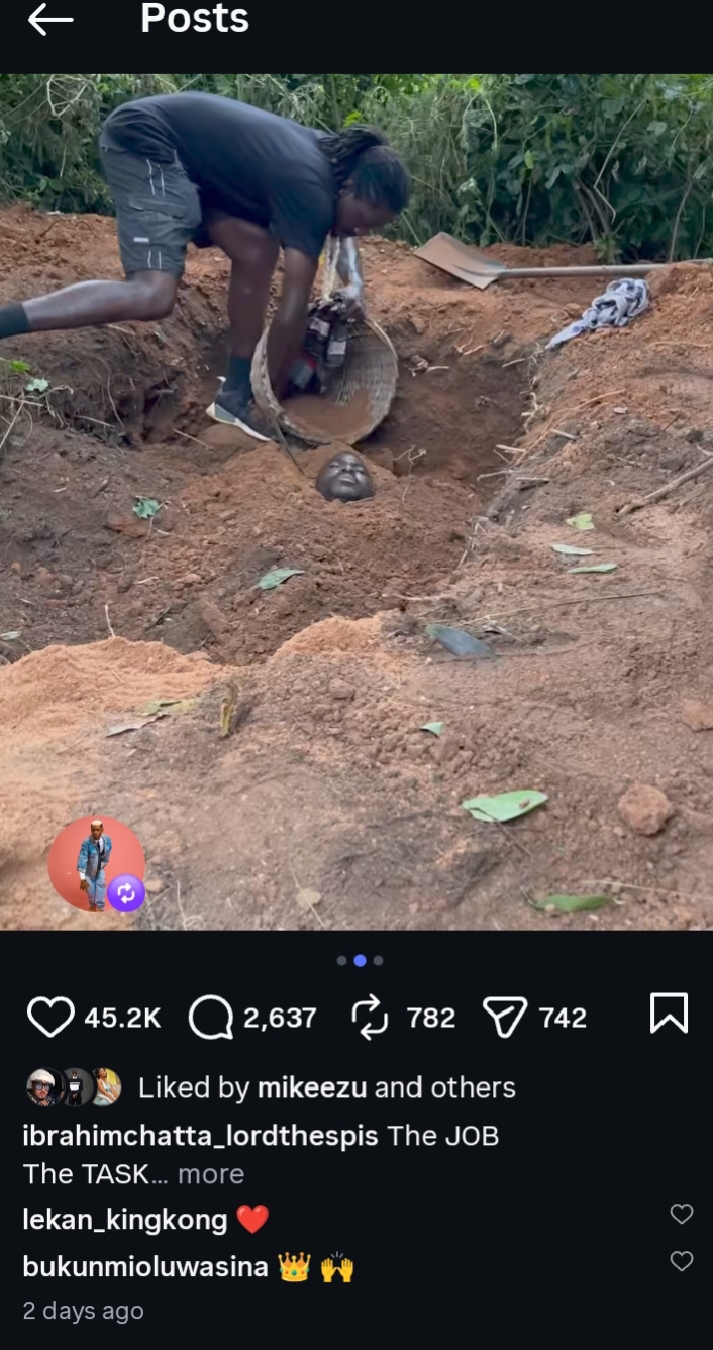
The image did not arrive with context, it rarely does in the age of endless scrolling. A man’s head emerging from red earth, his shoulders gone, his body surrendered to soil, eyes open, expression unreadable. For a few seconds, the image asked a dangerous question without speaking it aloud. What does it mean when a respected Nollywood actor appears buried alive, not in a movie frame but behind the scenes, not under studio lighting but raw daylight?.
Ibrahim Chatta is not an unfamiliar face in Nigerian cinema, his career long enough to earn him the word veteran without exaggeration. That familiarity made the image heavier. This was not a newcomer chasing shock value, it was an actor whose face already carried years of emotional memory for viewers. The soil looked real because it was real. The stillness looked alarming because it was stillness.
Within hours, the image detached itself from its origin. It moved faster than explanation. It invited speculation, concern, praise, fear, and in some corners darker interpretations that thrive where silence lives. The internet did what it always does best. It filled the gaps before facts could arrive.
The power of the image lay not in what it showed but in what it withheld. There was no script visible, no director in frame, no safety measures on display. Just a human head framed by earth. For many, that absence became the story.
What Actually Happened On That Set
The truth, when it arrived, was quieter than the panic. The video was shared by Ibrahim Chatta himself, not leaked, not exposed, not filmed secretly. It was a behind the scenes moment from a movie set, shared deliberately, framed as reflection rather than spectacle.
In the clip, crew members can be seen gently layering red soil around him. The soil is packed slowly, deliberately, stopping at the neck. The process is visible. This was not sudden. This was not chaos. It was preparation, rehearsal, execution. The kind that rarely trends because it lacks drama when seen fully.
Chatta’s caption did not sell fear. It spoke of endurance. Of the physical and mental toll that acting sometimes demands. Of continuing even when the body resists, even when exhaustion sets in, even when comfort disappears. His words framed the scene as labor, not danger, as craft, not recklessness.
This was a staged scene for a film, designed to look extreme because cinema often asks reality to bend. The burial was partial. The actor was conscious, monitored, surrounded by crew. The earth was not sealing him in. The shot was illusion built on cooperation.
Yet the calm facts struggled to compete with the raw power of the image once it escaped into public imagination.

The Phrase That Changed Everything
Language played its own role in the confusion. The phrase buried alive carries centuries of fear. It triggers a primal response. It suggests helplessness, suffocation, finality. When paired with a real human face, it becomes almost unbearable.
But the phrase was never meant literally in this case. It became shorthand, then headline, then assumption. The gap between cinematic description and real world interpretation widened quickly. Many viewers did not stop to ask what buried alive meant within the controlled environment of a film set.
There is a long history of cinema using language loosely while relying on visual cues to do the heavy lifting. A character can be shot without a bullet fired. A drowning scene can be filmed in waist deep water. A burial can be staged without danger. But when behind the scenes footage leaks into the public without framing, illusion becomes accusation.
The danger was not that people misunderstood a scene. The danger was that the misunderstanding hardened into belief. That belief then demanded outrage or fear. And outrage rarely pauses to verify.
This is how a phrase becomes heavier than reality.
No Accident, No Ritual, No Near Death
One of the fastest spreading assumptions around the footage was that something had gone wrong. That safety had been ignored. That Chatta had been placed at risk for art. None of these claims were supported by any credible report.
There was no accident. No emergency response. No injury reported. No production shutdown. No hospital visit. The actor did not raise alarm. The crew did not issue apologies. Silence from those closest to the set often signals normalcy, not cover up.
Equally important was what the scene was not. It was not a ritual. It was not symbolic in a spiritual sense. It was not tied to folklore, mysticism, or underground practices. The earth was a prop. The burial was a narrative device.
In Nigerian cinema, especially in indigenous language films, the visual language can be intense. Death, rebirth, punishment, endurance, all often take physical form. This scene fits within that tradition, even if stripped of context it appears shocking.
Removing myth from the moment was necessary. The film demanded realism. The realism demanded dirt. That was all.
Why Audiences Reacted The Way They Did
The reaction was not irrational. It was emotional. Many viewers responded as humans before responding as critics. Seeing a person submerged in soil triggers a visceral response. The mind imagines suffocation before logic steps in.
There is also a growing awareness of unsafe working conditions in creative industries worldwide. Stories of actors injured on set have trained audiences to be suspicious. When something looks extreme, concern feels responsible.
For fans of Ibrahim Chatta, the concern was amplified by respect. This was someone they valued. Fear often disguises itself as care. Social media simply gives it a megaphone.
Praise also flowed in equal measure. Many admired the commitment. The willingness to endure discomfort for authenticity. To some, the scene represented the uncelebrated labor behind films that audiences consume casually.
Both reactions existed because the image allowed them to. It was ambiguous enough to host multiple emotions at once.
Dedication And The Cost Of Realism
Acting at its highest level often demands surrender. Not recklessness, but vulnerability. Physical discomfort is not uncommon. Heat, cold, long hours, awkward positions, repeated takes, all quietly endured to capture seconds of believable emotion.
Ibrahim Chatta’s reflection touched on this truth. Acting is not always glamorous. Sometimes it is soil under fingernails, sweat in eyes, muscles locked in place longer than comfort allows.
This does not mean danger should be normalized. Safety matters. But it does mean that controlled discomfort is part of the craft. The difference lies in consent, planning, and supervision.
The burial scene was uncomfortable. That was the point. The discomfort translated into authenticity on screen. The crew did not hide the process. The actor did not dramatize the risk. He simply shared a moment of labor.
In a quieter media environment, that might have been the end of it.
How Social Media Distorts Process
Behind the scenes content was once reserved for DVD extras. Now it travels faster than the films themselves. Removed from narrative structure, production context, and explanation, such content becomes vulnerable to misinterpretation.
Algorithms reward intensity, not accuracy. A shocking image travels further than a measured explanation. By the time clarification arrives, the story has already solidified in many minds.
In this case, the clip became a symbol onto which fears about Nollywood safety, exploitation, and extremism were projected. The actual facts became secondary to the emotional journey of the audience.
This is not unique to Nigeria. It is a global pattern. But the consequences can be personal for those involved.
For Ibrahim Chatta, the image overshadowed the craft. The conversation moved from performance to survival. From storytelling to speculation.
The Actor’s Intent And Message
When Chatta shared the clip, his intention was reflective, not sensational. He spoke of discipline. Of the unseen effort behind films. Of the expectation that actors deliver regardless of personal discomfort.
It was a message to peers and audiences alike. That cinema is work. That performances do not emerge effortlessly. That dedication often looks unremarkable until a moment like this exposes it.
He did not frame himself as a victim. He did not ask for sympathy. He did not hint at danger. The tone was matter of fact.
This matters because intent shapes interpretation. The gap between what was meant and what was received reveals more about the environment than the act itself.
Nollywood And The Reality Of Physical Scenes
Nollywood has evolved rapidly. Budgets remain constrained compared to global industries, but ambition continues to grow. Practical effects are often favored over expensive digital alternatives. This places physical demands on actors.
Scenes involving burial, rain, mud, water, or confinement are not new. They are achieved through planning, trust, and experience. Veteran actors like Chatta understand their limits and negotiate scenes accordingly.
There is room for improvement in safety culture. There always is. But there is also professionalism that rarely makes headlines.
Reducing the industry to recklessness based on a single image does a disservice to those who work carefully behind the camera every day.
What This Moment Ultimately Reveals
This episode reveals how fragile truth becomes once visuals detach from explanation. It shows how quickly concern can morph into narrative. It highlights the tension between realism and perception.
Most importantly, it reminds us that images do not explain themselves. They require patience. They demand context. They ask us to slow down.
Ibrahim Chatta was not buried alive in the way fear imagined. He was participating in storytelling. The soil was real. The danger was not.
The moment was viral because it shocked. It was misunderstood because it traveled alone. When reunited with its facts, it becomes something quieter but more meaningful.
A reminder of craft, of endurance, of the space between what we see and what is true.