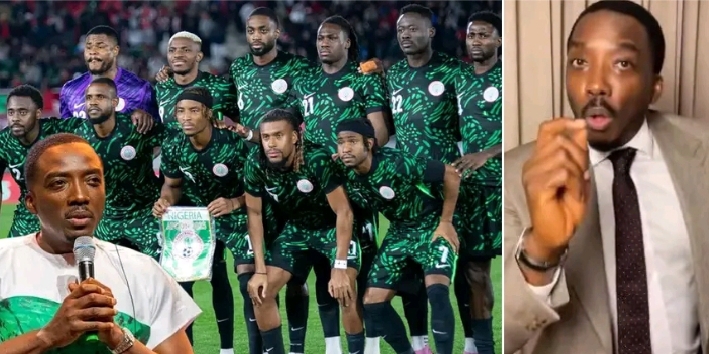
There is a peculiar tension in football when a team reaches the precipice of triumph and falls just short. Nigeria’s Super Eagles, a team celebrated for their audacity and flair, experienced such a moment in the semi-final of AFCON 2025 against Morocco. The scoreboard read nil for Nigeria over 120 minutes, only for fate to be decided in penalties.
In a nation where football is woven into the very fabric of identity, such defeats are never merely numbers; they reverberate through streets, hearts, and conversations in a way few other events can match.
Within hours, Bovi, the comedian whose voice often carries societal critique, stepped into the public discourse, offering more than humor; he offered reflection, admonition, and perhaps a blueprint for reclaiming focus.
To unpack Bovi’s commentary is to navigate multiple layers. It is an exploration of how history informs present failures, how mental resilience can determine outcomes even when skill is abundant, and how cultural pressures—from media to fan expectations—interact with professional responsibility. This article examines each of Bovi’s core points in detail, grounding them in fact, verifying claims where possible, and situating them in the broader narrative of Nigerian football’s modern challenges.
The purpose is not merely to recount his statements but to explore their meaning, implications, and potential lessons for the team and future generations.
Playing for the Badge: The Weight of Honor Over Incentives
Bovi’s first and perhaps most pointed observation centered on the symbolic power of the jersey itself. He urged the Super Eagles to play for the badge, for the honor of representing the nation, rather than for bonuses. The timing of his critique was not arbitrary. During the 2025 AFCON campaign, reports confirmed that bonus payments to players were delayed, leading to tension within the squad. Training boycotts were threatened ahead of the quarter-final stage, reflecting a tangible distraction from the competitive mission. These delays were documented by major Nigerian outlets, noting the involvement of the National Sports Commission, the Nigeria Football Federation, and the Central Bank in discussions over payment timelines. Such disputes, Bovi argued, underscore the precarious balance between financial reward and professional focus.
The badge, he implied, carries with it a psychological and cultural weight that surpasses monetary incentive. Playing for Nigeria is an act intertwined with national identity, a duty that commands respect regardless of compensation. Bovi’s caution was clear: overreliance on bonuses can divert attention, breed unrest, and transform what should be pure performance into negotiation. He framed this not as moralizing but as practical advice drawn from observation.
Elite athletes, he reminded, operate under intense scrutiny; any distraction, whether financial or social, can manifest on the field where consequences are irreversible.
While no official source confirmed that the bonus dispute directly influenced Nigeria’s penalty outcome against Morocco, Bovi’s argument holds conceptual validity. In professional sports, studies repeatedly demonstrate that off-field tension and perceived inequities affect concentration and execution. By urging players to prioritize the badge, he was emphasizing the cultivation of intrinsic motivation—a mindset where pride and responsibility to the team outweigh external rewards.
Echoes of 1994: Playing With Heart Against the Giants
Bovi’s second major point invoked the memory of Nigeria’s 1994 World Cup debut, a campaign widely regarded as a watershed moment in the nation’s sporting consciousness. That team, making its first foray onto football’s grandest stage, faced Italy in the Round of 16. Nigeria took the lead through Emmanuel Amunike, only to concede a late equalizer by Roberto Baggio and subsequently fall in extra time. Despite the loss, the team’s spirit, commitment, and audacity captured global attention, proving that courage and heart could elevate performance even in the absence of perfect results.
By referencing this episode, Bovi drew a parallel to the AFCON 2025 semi-final. He highlighted Samuel Chukwueze’s missed penalty against Morocco, framing it as a moment where technical skill alone was insufficient without mental commitment and focus. In his characteristic blend of critique and humor, he suggested that greater care was needed in these high-stakes moments, jesting that more attention should accompany execution, a metaphorical nudge toward conscientiousness under pressure.
This historical comparison was instructive. The 1994 team’s performance embodied the principle that preparation, courage, and collective resolve often determine outcomes as much as raw talent. Bovi emphasized that in contrast to historical successes, moments like Chukwueze’s miss reflect a gap in mental readiness, a vulnerability that can erode potential when the stakes are highest. The lesson extends beyond a single penalty or match: elite competition demands alignment of skill, discipline, and psychological fortitude.
In framing his advice through history, Bovi not only reminded the Super Eagles of their cultural legacy but also suggested a blueprint for navigating future adversity. The implication is clear: technical errors are forgivable when paired with committed heart and focus; casual or distracted performance, however, risks eliminating the team from competition and eroding the pride that comes from representing the nation.
Penalties and the Mental Game: Commitment Under Pressure
Penalties often serve as a magnifying lens on character, preparation, and mental resilience. Bovi’s third focus addressed precisely this, using Chukwueze’s and Bruno Onyemaechi’s missed penalties as illustrative points. Both attempts were saved by Morocco’s goalkeeper Yassine Bounou. Social media reactions widely described these penalties as lacking conviction, highlighting public perception that execution under pressure fell short of expectation. Bovi seized on these moments to emphasize the importance of care, attention, and psychological readiness when the margin for error is infinitesimal.
In his commentary, Bovi fused critique with humor, suggesting metaphorical adjustments to the technique. This served to underline a principle familiar in sports psychology: mental preparation and focus are inseparable from physical execution. Athletes in high-pressure environments must internalize commitment, mitigating distractions and ensuring that each action aligns with intention and precision. In this context, the missed penalties were more than mere technical failings; they represented the intersection of skill, pressure, and the human propensity to falter when stakes are immense.
This approach, blending fact and interpretation, reinforces a broader narrative about Nigeria’s AFCON campaign. While talent was abundant, moments of distraction and psychological vulnerability emerged at critical junctures. Bovi’s reflections underscore that elite performance is not solely measured by physical prowess but also by the capacity to perform consistently under scrutiny and emotional stress. For the Super Eagles, the penalty episode offers lessons not only for future shootouts but for cultivating sustained focus in all phases of competitive play.
Social Media: The Silent Competitor
Bovi’s final admonition concerned the pervasive influence of social media on performance. He advised players to limit their engagement during tournaments, particularly when early successes create a feedback loop of praise and attention. After the Morocco match, social media was saturated with commentary, analysis, and fan reaction, much of it celebratory.
While this does not provide causal evidence of diminished performance, it highlights an environment where distraction can easily compete with focus.
His warning aligns with common insights from sports psychology: external stimuli, including praise, criticism, or persistent connectivity to public platforms, can shift attention away from preparation and execution. For elite athletes, managing focus is as critical as managing physical training. Bovi’s commentary, though culturally framed and humorous at points, reflects a concern with the integrity of attention during moments of peak performance.
In broader terms, social media represents both opportunity and hazard. It enables connection with fans and public visibility but can also amplify pressure and alter perception of self-worth or accomplishment. Bovi’s point emphasizes that when focus falters in response to external feedback, the consequences are immediate and visible on the pitch. His advice encourages deliberate disengagement as a form of professional discipline, reinforcing that elite performance requires not only skill and strategy but also psychological containment.
Lessons for Future AFCON Campaigns: Beyond Talent, Beyond Tactics
Future AFCON campaigns demand that Nigeria’s Super Eagles integrate lessons not only from matches but from the broader cultural and psychological environment surrounding the team. Bovi’s commentary serves as a prism for this reflection. Playing for the badge, maintaining focus under pressure, and managing external distractions are not abstract ideals; they are practical strategies that can determine the outcome of a tournament. Historical moments such as the 1994 World Cup illustrate that a team operating with heart, commitment, and collective resolve can transcend expectations, even when facing technically superior opposition.
One of the most pressing lessons is the management of off-field incentives. Bonuses, while necessary, must be structured in a way that reinforces focus rather than undermines it. The disputes during AFCON 2025 revealed the fragility of preparation when financial uncertainty enters the locker room. A forward-looking approach requires clear communication, timely payment, and a culture where intrinsic motivation takes precedence. Teams that prioritize honor and pride over immediate reward tend to navigate pressure more consistently, a point Bovi emphasized by highlighting the symbolic importance of playing for the jersey.
Penalty-taking and other high-pressure scenarios remain a domain where psychology can outweigh physical skill. Future campaigns should embed mental preparation as deeply as tactical drills. This includes visualization exercises, focus training, and simulated pressure situations in practice. Chukwueze’s miss against Morocco illustrates the consequences of mental distraction at critical moments. Bovi’s advice underscores that preparation without attention to psychological resilience leaves talent vulnerable, regardless of technical proficiency or prior success.
Finally, the management of attention in a hyperconnected world is crucial. Social media, fan adulation, and constant scrutiny can elevate performance or erode it. The AFCON 2025 semi-final demonstrated how the allure of praise can distract even elite athletes. Future campaigns must foster environments where players are protected from external noise while still engaging meaningfully with fans and media. Bovi’s counsel encourages discipline in consumption of social feedback, reinforcing the idea that focus, concentration, and emotional regulation are indispensable tools for success at the continental level.