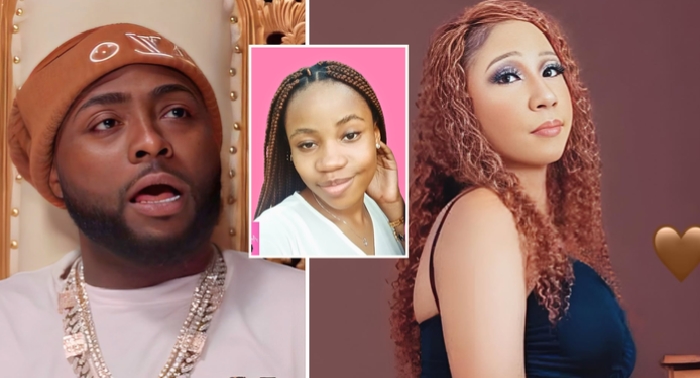
In the heart of Nigeria’s entertainment universe, some questions refuse to vanish. They linger in whispers, in online threads, in the pauses between interviews. One such question emerged quietly in 2013 after a night in Ibadan, only to resurface years later with an intensity few could have predicted. It is a question of bloodlines, of identity, of truth and doubt, framed by the brightest lights of fame and the shadows of uncertainty. In a country where celebrity lives are broadcast and dissected, the story of a young girl named Anu and one of Africa’s biggest music stars, Davido, began with a simple claim, yet the ramifications would ripple across years, legal statements, DNA tests, and social media storms.
Every public denial, every demand for a DNA test, every whisper of support and accusation forms part of a mosaic that defies simple resolution. This is not just a story about who fathered whom.
It is a story about identity, perception, belief, and the relentless pursuit of certainty. And like all stories that sit on the edge of truth and speculation, it begins in a moment that seemed ordinary at the time but became extraordinary in retrospect.
The Ibadan Encounter That Sparked the Claim
The saga traces its origin to February 2013 in Ibadan, a city whose streets are familiar with music, nightlife, and the hum of stories waiting to be told. It was after a major concert, an event pulsating with fans, performers, and the echoes of applause. According to public commentary, a young woman, Ayo Grace Labinjo, worked in a venue that night. Allegations surfaced years later, claiming that she crossed paths with Davido and members of his entourage following the concert. The specifics of that encounter are disputed, but the timing and location form the earliest reported frame of the ongoing narrative.
Allegations are never simple, and this one was layered with nuances that only complicated its retelling. Reports suggested that after the concert, the gathering shifted to a nearby club where social interactions blurred into claims of intimate encounters. This setting, repeated in social media narratives, created a backdrop for what would become a headline-grabbing story. In the shadows of the venue, the seeds of the paternity dispute were said to have been planted, though the facts themselves remain contested.
The narrative gained traction years later when journalists and commentators revisited the timeline. Some focused on the alleged movements of the entourage, others on the young woman’s accounts, while still others highlighted how these events intersected with Davido’s burgeoning fame. The story’s early stages were a mixture of allegation, hearsay, and public imagination, all amplified by the rapid spread of social media commentary.
Kemi Olunloyo’s Role and the Publicization of the Claim
Among the voices that carried the story into public consciousness, none was more controversial than that of journalist Kemi Olunloyo. Known for bold claims and fearless public commentary, Olunloyo positioned herself as an advocate for clarity and accountability in the paternity saga. She repeatedly urged that Davido undertake a DNA test to settle the matter definitively, framing the claim as a question not only of responsibility but also of the young girl’s right to know her origins.
Olunloyo’s involvement, however, did not come without controversy. In interviews, posts, and open letters, she described alleged encounters and suggested that multiple individuals were involved in the events following the Ibadan concert. These claims were framed as a rationale for why the paternity situation was complicated, yet they were never independently verified. Critics questioned the veracity of her statements, while supporters argued that her advocacy kept the child’s rights in public view.
Financial support and public pressure became part of Olunloyo’s narrative as well. She claimed to have assisted Anu and her mother with school fees and birthday gifts, and at times proposed organizing independent DNA tests should Davido consent. These actions, she said, were part of a broader effort to ensure that the dispute did not remain unresolved due to celebrity influence or social pressure.
Davido’s Camp and Early DNA Statements
Long before Davido himself responded on social media in January 2026, his legal team had already addressed the paternity claims. In early 2025, his former lawyer publicly stated that two DNA tests had been conducted and that both results showed conclusively that Davido is not Anu Adeleke’s biological father. According to the lawyer, one test was conducted at a facility selected by Anu’s mother, while the other was carried out at a hospital mutually agreed upon by both sides, including representatives of Davido’s family. The camp emphasized that these tests were performed in reputable facilities and reflected standard procedures, presenting what they considered definitive proof of the absence of a biological connection.
Anu’s mother, however, disputed the claims, questioned the authenticity and rigor of the tests. She suggested that the procedures were improperly conducted or that results could have been manipulated. This disagreement over the credibility of DNA evidence became a central point of contention, fueling speculation in both the media and social platforms. Even at this early stage, the tension between the legal assertions of Davido’s camp and the personal appeals of Anu’s mother set the stage for the dispute’s enduring public visibility.
The statements from Davido’s camp were intended to close the matter, framing the tests as conclusive and discouraging further public debate. Yet, these early denials did not end the discussion; instead, they became part of the narrative that resurfaced when Anu later made her Instagram appeal in 2026.
Public Resurgence and Social Media Spotlight
The paternity dispute that began years earlier in whispers and online comments reignited with ferocity in January 2026 when Anu Adeleke published a heartfelt message on her Instagram page directly addressing Davido. In her post, she described years of emotional pain caused by uncertainty over her identity and explained why clarity mattered as she entered her teenage years.
She wrote, “As I transition into a young woman, I am respectfully asking Mr David Adeleke, Singer @davido, for a DNA test to establish my identity. This test is between my dad and me. It is something I want. It is something that’s the right thing to do.”
Anu also noted that ongoing bullying at school left her emotionally distressed, saying classmates laughed at her whenever she mentioned Davido as her father and that she had endured “a lot of mental anguish” and even sought professional help to protect her mental health.
The Instagram appeal drew immediate public attention, going viral within hours. Social media users shared and debated the post, with many expressing sympathy for Anu’s emotional journey and others questioning the public nature of the appeal given that DNA tests had been discussed years earlier.
Online platforms became arenas for public engagement, with hashtags, reposts, and comment threads amplifying the story far beyond traditional news outlets. Some commentators praised her courage in speaking openly about her struggles, while others critiqued how a deeply personal matter had become fodder for widespread speculation.
Davido’s Public Response
When 13‑year‑old Anu Adeleke made a heartfelt public appeal for a fresh DNA test in January 2026, Davido’s response was swift, direct, and unambiguous. He took to social media platform X (formerly Twitter) to address the renewed paternity claims, rejecting them in blunt terms and asserting that the issue had already been settled.
In a widely shared post, he wrote that he had undergone multiple tests and that the results were conclusive. “After 5 DNA test … she dey crase … her and her mom better leave me the fuck alone and go find her papa …” he wrote, emphasising his frustration with the continued speculation.
Davido went further in his series of posts, elaborating on his stance and attacking the basis of the renewed claim. In response to questions about whether he had ever met Anu’s mother, he stated that he had “never met the bitch … except when went for the DNA.” He repeated his position that the tests, carried out at five different hospitals chosen jointly by both sides, had all returned negative, leaving no biological connection. “Yes I chose 3 hospitals and they chose their own two hospitals … all came out negative … this is the last time I’m speaking on this nonsense,” he wrote.
Davido’s comments did not also refrain from expressing his irritation with how the matter was being discussed publicly. Beyond asserting the negative test results, he implied that the ongoing claims were unwarranted, suggested legal consequences for the teenager’s mother, and reiterated that he had children of his own. “I’ve taken 5 DNA tests, all negative. I am not your father,” he wrote in a live comment under the viral post on her Instagram appeal, adding “Never met your mom. She’s an obsessed fan lying to you. This needs to stop.”
Reflections on Unresolved Outcomes
For Davido, this story is a reminder that influence and fame do not replace the human responsibility to see the impact of one’s actions on others. Beyond tests and statements, lives are shaped by acknowledgment, understanding, and compassion. Choosing to address uncertainty with care, even quietly, can transform a public dispute into a personal act of accountability that speaks louder than any denial ever could.
For Anu, the path is one of self-discovery and resilience. Identity is more than biology; it is the courage to claim your place in the world despite unanswered questions. Strength lies in holding your dignity and seeking support from those who guide with wisdom, remembering that clarity and acceptance can arrive over time, and that your value is never dependent solely on others’ recognition.
For Anu’s mother, the lesson is to balance advocacy with patience and foresight. Love and protection are vital, but so is ensuring that each action nurtures confidence and trust in the child’s life rather than amplifying uncertainty. Measured steps, empathy, and long-term thinking can create a foundation where a child grows secure in herself, and where family ties, however complex, can eventually rest on understanding rather than contention.