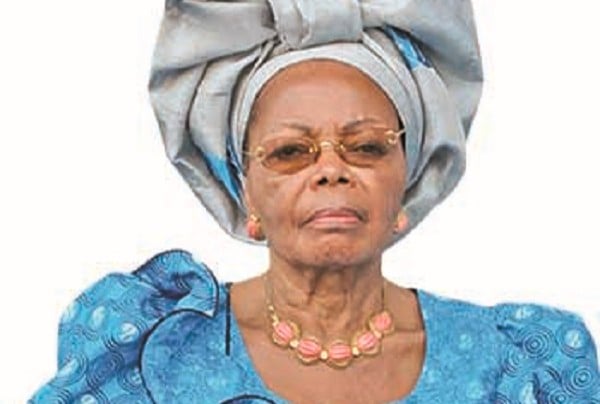
For days Lagos held its breath without quite knowing why, a name whispered across phones and private messages carried more weight than the rumours attached to it. Chief Opral Benson did not vanish with noise or spectacle, there were no sirens, no dramatic footage, no official bulletin at first, there was only absence, and in a city that moves too fast to notice most disappearances, this one lingered.
At 90 years old, the Iya Oge of Lagos represents more than a person. She is memory dressed in silk, a living archive of postcolonial Lagos, a woman whose public life has always unfolded in plain sight. When a missing report surfaced claiming she had not been seen since January 13, 2026, the silence around her whereabouts became unsettling precisely because it felt out of character.
The early hours of the story were filled with gaps rather than facts. Messages were forwarded without context, assumptions hardened into claims, yet beneath the noise lay a quieter truth, one that would only emerge after Lagos had already begun to imagine the worst.
This is not a story about disappearance in the literal sense, it is a story about perception, communication, and how quickly uncertainty can reshape reality when a public figure slips briefly out of view.
THE DAY THE RUMOUR FOUND ITS VOICE
The first message did not announce itself as speculation, it arrived framed as concern, written in the language of urgency and responsibility. It claimed Chief Opral Benson had not been seen since January 13 and urged the public to assist in locating her. In a city conditioned to react quickly to danger, the wording alone was enough to trigger alarm.
What made the claim powerful was not evidence but familiarity. Many Lagosians knew the name, the title, the image of regal composure that had remained unchanged for decades, the idea that such a figure could simply go missing unsettled people who associated her with stability and continuity.
Within hours the message escaped its original context. Screenshots replaced sources, social media posts repeated the claim without verification, each repetition stripped away nuance until the idea of disappearance stood alone, unchallenged.
By the time questions were raised about who authored the notice or why no formal police confirmation existed, the narrative had already taken hold, in Lagos momentum often outruns accuracy.
A CITY TRAINED BY PAST SCARES
Lagos does not respond to missing person stories in a vacuum. The city carries a long memory of unresolved absences involving public figures, activists, and traditional leaders, each new report reopens old anxieties, teaching residents to expect the worst even before facts emerge.
This collective memory shaped the reaction to the Iya Oge report. People filled informational gaps with emotional logic, if she was not seen she must be lost, if she was lost something must be wrong, the reasoning was flawed but understandable.
Media outlets approached the story cautiously at first, aware of the damage caused by premature reporting, yet even restraint could not stop the spread of fear driven by private sharing and word of mouth.
In this environment silence became suspicious, the absence of immediate official clarification did not calm nerves, it amplified them.
INSIDE THE HOUSEHOLD MISUNDERSTANDING
The truth began much closer to home than anyone expected. According to family sources, the missing report did not originate from an external threat or crisis, it grew out of a communication gap within the household itself.
Chief Opral Benson had travelled out of Nigeria on a private visit. Her movement was known to some family members and staff but not clearly communicated to everyone connected to her daily routine, what should have been a simple update became a point of confusion.
As concern spread internally, caution tipped into alarm. Someone acted with the intention of protecting her, unaware that the foundation of the fear was incomplete information rather than real danger.
Once the message escaped the private circle it took on a life of its own, detached from the original misunderstanding that produced it.
LIBERIA AS THE QUIET ANSWER
The location at the centre of the clarification surprised many. Liberia was not the dramatic reveal social media had prepared for, there were no rescue operations, no discovery narrative, there was only a visit.
Chief Opral Benson was in Liberia seeing relatives, accompanied by her daughter Precious and an assistant. The trip was voluntary, calm, and planned, though not publicly announced.
For those familiar with her history the destination made sense. Her life has long bridged Nigeria and Liberia, weaving together business, diplomacy, and personal ties that span decades.
Yet because this context was absent from early reports, Liberia briefly appeared as a mystery rather than a familiar chapter in her story.
AREF STEPS INTO THE LIGHT
Clarity arrived not through speculation but through institutional voice. The African Refugees Foundation where Chief Opral Benson serves as president issued a direct statement addressing the growing concern.
The message was firm without being defensive. She was alive, she was safe, she was not missing, the foundation stressed that her presence in Liberia was known and voluntary.
This intervention mattered because it reintroduced authority into a narrative drifting on uncertainty. It reminded the public that not every absence signals danger.
Once the statement circulated, the tone of the conversation began to shift, though the residue of confusion lingered.
THE DANGER OF BEING FOUND WITHOUT BEING LOST
Some reports attempted to close the story with a dramatic turn, claiming she had been found in Liberia after being declared missing, this framing distorted reality even further.
Being found implies loss, it suggests rescue, recovery, and prior danger, none of these applied to Chief Opral Benson’s situation.
The insistence on a discovery narrative revealed a deeper problem in how stories about public figures are told, resolution often demands drama even when truth requires restraint.
In this case correction did not travel as fast as alarm, the damage was not physical but reputational, introducing unnecessary worry into a woman’s life and legacy.
WHO THE IYA OGE REPRESENTS
Chief Opral Mason Benson’s public identity has always extended beyond fashion or social status. As the Iya Oge of Lagos she embodies elegance as cultural continuity rather than surface display.
Her influence spans education, entrepreneurship, and diplomacy. She served as Liberia’s honorary consul in Lagos, reinforcing ties that predate modern headlines.
Her Americo Liberian Nigerian identity places her at a unique intersection of West African history, migration, and elite social networks.
Understanding this context makes her presence in Liberia unsurprising, almost inevitable, yet that understanding was absent from the early conversation.
WHEN COMMUNICATION FAILS PUBLICLY
This episode exposes how fragile information channels become when private lives intersect with public expectations. Visibility creates assumption, familiarity breeds entitlement to updates.
When those updates do not arrive on schedule, imagination fills the void, concern escalates faster than verification.
For families of public figures the line between transparency and privacy remains difficult to navigate, too much silence invites panic, too much detail invites intrusion.
The Iya Oge incident shows how easily a misstep on either side can spiral.
WHY THIS STORY REFUSED TO DIE QUICKLY
Even after clarifications, the story lingered. Part of this persistence comes from affection, Lagos cares deeply about its cultural elders.
Another part comes from narrative addiction. Disappearance stories promise tension and release, ordinary explanations feel unsatisfying by comparison.
There is also distrust, a learned skepticism shaped by past cover ups and delayed truths in Nigerian public life.Together these forces kept the rumour alive longer than logic demanded.
THE COST OF UNNECESSARY ALARM
For Chief Opral Benson the cost was emotional rather than physical. At 90, peace and predictability matter more than public reassurance.For her family the episode brought stress and unwanted scrutiny during a private visit.
For institutions associated with her it required urgent clarification to protect credibility.For the public it reinforced how easily care can morph into chaos.
LIBERIA AS CONTEXT NOT TWIST
Liberia did not resolve a mystery, it contextualized a life.Chief Opral Benson’s relationship with the country is rooted in heritage and service, not secrecy.
Treating her presence there as a plot twist diminished the ordinary dignity of elder travel.Understanding this reframes the entire episode as a lesson rather than a scare.
WHAT THIS MOMENT TEACHES LAGOS
Lagos thrives on information yet struggles with patience. This incident invites reflection on how the city consumes news about its icons.
Urgency must be balanced with verification, concern must be paired with restraint.Public figures are not public property even when they carry cultural titles.
Respect begins with waiting for facts.
A STORY THAT ENDS QUIETLY
There was no dramatic return announcement, no triumphant appearance, life simply continued.
The Iya Oge of Lagos remained what she had always been, present, accounted for, and dignified.
The noise faded, the lesson remained.Sometimes the most responsible ending is not a headline but a correction.
CONCLUSION
The reported disappearance of Chief Opral Benson was never about being lost, it was about how quickly certainty collapses when communication falters.
Liberia became the turning point not because she was found there but because truth finally caught up with speculation.
In the end the episode stands as a reminder that absence is not always danger and silence is not always secrecy.
For Lagos, learning that difference may be the most valuable outcome of all.