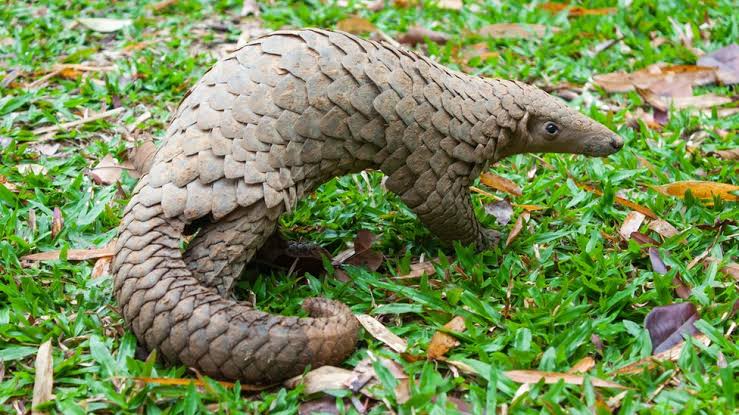
Pangolins are nocturnal mammals covered in scales that are frequently mistaken for reptiles. They are the only mammals that have scales, which they utilize to defend themselves against predators. Pangolins also curl up into a ball, exposing their spiky scales to predators.
These nocturnal mammals are mostly found on two continents, Africa and Asia. However, Africa is home to four pangolin species. They are described as sharp diggers with powerful claws for excavating holes. They also eat ants and termites with their lengthy, sticky tongues.
Pangolins in Nigeria?
Pangolins are found in some African countries, including Nigeria. It is recognized by several names based on the region and language in which it occurs in the country.
Pangolins are known as ‘Akika’ in Yoruba, which stems from their ability to coil up into a tight ball as a fast protection strategy. Some sections of Nigeria also referred to it as ‘Ipi’, a name derived from its long tail.
Nigeria is home to three distinct pangolin species. They are known as the white-bellied pangolin (Phataginus tricuspis), black-bellied pangolin (Phataginus tetradactyla), and enormous pangolin (Smutsia gigantea).
Pangolins – most trafficked mammals globally, especially in Nigeria?
According to the findings, pangolins are regarded as a delicacy and their scales can be utilized for traditional medicine in several cultures, particularly in Asia.
Pangolin scales are used to produce jewelry, accessories, and decorative objects, and some pangolins are sold to private collectors, zoos, and other entities.
Additional findings indicated that pangolins are utilized for a variety of illegal purposes, including the black market pet trade, in which some people maintain pangolins as luxury pets, driving up demand for wild-caught animals.
Pangolins are also trafficked or sold to traffickers under false pretenses. These creatures are occasionally smuggled into zoos or private collections, posing as wildlife experts or activists. These are reported to have resulted in widespread poaching and trafficking of pangolins and their scales, with Nigeria becoming a significant hub for the illegal trade.
Killing or trafficking pangolins now an offence?
WITHIN NIGERIA discovered that there are current regulations in the country to prevent endangered species from being killed or trafficked, but violators can only face three months to five years in prison or fines as low as N100,000 ($68).
The findings revealed that Nigeria has become a key hub for pangolin trafficking, accounting for 55% of global seizures between 2016 and 2019.
Terseer Ugbor, deputy chairman of the House Committee on Environment in 2024, sponsored a measure named Endangered Species Conservation and Protection, which was prepared by the Ministry of the Environment.
The measure intends to combat wildlife trafficking, safeguard endangered species, and ensure Nigeria complies with worldwide conservation treaties. The 2025 bill imposes tougher punishments, including fines of up to ₦12 million ($8,200) and jail terms of up to 10 years.
However, in October 2025, the Nigerian Senate introduced the Endangered Species Conservation and Protection Bill, which is currently awaiting President Bola Ahmed Tinubu’s signature.
Pangolins’ killing or trafficking an offence?
WITHIN NIGERIA discovered that pangolins are categorized as endangered species in Nigeria due to catastrophic population declines caused by poaching, habitat destruction, and trafficking.
Nigeria is a signatory to CITES, which governs the international trade of endangered species, and pangolins, as an endangered species, serve an important role in preserving ecosystem balance by eating insects and ants and decreasing pest populations.
In addition to pangolins contributing to the preservation of Nigeria’s biodiversity and natural heritage, enforceable regulations seek to disrupt, restrict, or curtail illegal wildlife trading.
Actions so far?
The Nigeria Customs Service (NCS) and the Wildlife Justice Commission (WJC) have conducted multiple arrests and prosecutions involving pangolins.
Findings revealed that 34 individuals had been detained since July 2021, with four arrested in connection with the seizure of 9.4 tons of pangolin scales in August 2024.
Additional findings revealed that 12 convictions were made, including a high-ranking Vietnamese wildlife trafficker and his colleagues.
19.4 tonnes of pangolin scales and more than one tonne of ivory have been seized since July 2021, with a major seizure of 9.4 tonnes of pangolin scales in August 2024.
In November 2025, a man was convicted of illegally possessing and selling pangolin scales and sentenced to one year in prison.
A suspected pangolin scale broker was detained in December 2024, along with 2.179 tonnes of pangolin scales. In July 2025, 433 kg of Giant pangolin scales were recovered and a leading suspect arrested.