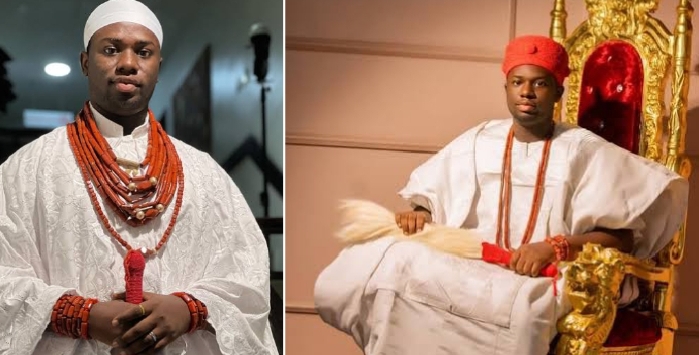
In the heart of Ondo State, where winding roads lead to the sacred land of Okeluse, a young monarch sits on a throne that has carried generations. At just 22 years old, Oba Oloyede Adekoya Akinghare II commands a kingdom older than his age can grasp in years but not in legacy. His crown glimmers under the sun, a symbol of authority, reverence, and a heritage that demands more than casual acknowledgment. Every word spoken about him carries weight, and in recent days, a warning has spread through the town like ripples in a quiet pond, stirring curiosity, debate, and a subtle tension among the people.
The young king’s directive was simple yet striking. He instructed the public to stop referring to him with casual slang, terms such as “bro” or “blood,” words that once flowed freely among peers but now collide with the solemnity of his office. To outsiders, the order might seem unusual, even playful, but in the chambers of Okeluse Palace, it resonates with centuries of tradition and authority. It is a reminder that respect for the crown is not negotiated, regardless of age.
This is a tale of youth and heritage colliding, a story where familiarity meets formality, where modern social habits brush against deep-rooted customs. The issue is more than a choice of words; it is a reflection of culture, identity, and the boundaries of respect in contemporary Nigeria. Okeluse, a kingdom that balances tradition with evolving times, now stands witness to a young ruler asserting his authority in a manner both firm and symbolic.
The message is clear yet unspoken in many hearts. There is power in titles, and in a kingdom where words shape perception, the line between casual friendliness and disrespect can determine how a reign is remembered. The kingdom waits, watching, questioning, and adjusting to the young king who claims his space in history while reminding the world that respect does not age lightly.
The Young Monarch of Okeluse: A Crowned Teenager
Oba Oloyede Adekoya Akinghare II assumed the throne at 16 years old, an age when most adolescents are confined to classrooms and teenage uncertainties. The death of his father thrust him into a world of responsibility that would challenge even the most seasoned adults. His ascension was not ceremonial alone; it was a test of wisdom, patience, and the ability to carry a lineage that speaks to centuries of Yoruba leadership. The people of Okeluse watched carefully, some doubtful, others hopeful, as a boy transformed into the embodiment of tradition.
At twenty-two, he is widely regarded as the youngest monarch in Yorubaland, a fact that invites both admiration and scrutiny. His youth is remarkable, not only in chronological terms but in the way he navigates the responsibilities of rulership. From palace administration to community development, his age is a lens through which every decision is interpreted, every statement analyzed, and every gesture observed. The kingdom is learning that maturity is not only about years but about vision, conviction, and the courage to define one’s reign.
His upbringing was marked by a blend of modern education and immersion in cultural norms. The palace ensured that even as he grew, he understood the nuances of Yoruba monarchy, the symbolism of his office, and the protocols expected of a ruler. Respect is taught, observed, and enforced in subtle ways, and Oba Oloyede absorbed these lessons while navigating the complex landscape of adolescence under public scrutiny. His ability to merge youthful insight with ancestral wisdom positions him uniquely among Nigerian monarchs.
The young king embodies a paradox of presence. While his peers may indulge in casual social interactions, he must always measure his words and actions against the weight of the crown. Every greeting, every address, every casual remark directed toward him becomes a matter of protocol, a reflection of how seriously a society values its leadership. This context explains the necessity and urgency behind his warning against casual terms, a directive rooted in centuries of tradition and modern expectations.
The Warning That Stirred Conversations
The formal warning issued by Okeluse Palace captured immediate attention across Ondo State and beyond. Citizens were advised to refrain from calling the king informal nicknames, specifically “bro” or “blood,” expressions that once symbolized camaraderie but now, under the lens of royal expectation, signal disrespect. The palace clarified that this was not a matter of ego but a safeguard for the dignity of the institution, a reinforcement of the idea that the crown transcends friendship and casual familiarity.
The Chief of Staff emphasized that the monarch must be addressed only as “His Royal Majesty,” a phrase steeped in cultural weight and authority. Any deviation from this established norm would no longer be tolerated, signaling a shift in how citizens interact with their ruler. The declaration struck a chord on social media, sparking debates about the relevance of tradition in a rapidly modernizing society, and testing the public’s understanding of respect and hierarchy.
Observers noted that the young age of Oba Oloyede adds complexity to the situation. Many initially assumed that youth might warrant leniency, that informal expressions could bridge the gap between ruler and subjects. The palace’s insistence on formality, however, upended these assumptions, illustrating that authority is not determined by age but by office and legacy. This warning became a subtle, yet potent, assertion of leadership, reminding the populace that the monarchy commands reverence irrespective of generational differences.
The ripple effect of the warning is felt in every corner of Okeluse Kingdom. Conversations in markets, schools, and local councils now incorporate a newfound caution, a recognition that the young monarch’s words carry tangible consequences. The issue extends beyond semantics; it is a reflection of cultural identity, a test of collective memory, and an examination of how society negotiates respect in the face of evolving social norms.
The Cultural Significance of Yoruba Royal Titles
In Yorubaland, titles are not mere labels but living symbols of history, authority, and spiritual responsibility. Each name carries centuries of cultural expectation, a web of ancestral knowledge, and a social contract that binds ruler and people. To address a king casually is not simply a matter of language; it is an intrusion into a centuries-old dialogue between past, present, and future. Oba Oloyede Adekoya Akinghare II, though young, embodies this continuum. His warning against casual nicknames is a reminder that language shapes perception, and respect is foundational to leadership.
The weight of a royal title in Yoruba society extends beyond ceremonies. It dictates etiquette, informs social interactions, and reflects the broader community’s understanding of hierarchy. “His Royal Majesty” is more than words; it is acknowledgment of lineage, responsibility, and accountability. The young monarch’s insistence on formal address underscores a cultural philosophy that authority is maintained not through fear alone but through collective recognition of symbolic order. In every greeting, every conversation, the legacy of generations resonates through proper articulation.
Yoruba kings are often seen as custodians of morality, justice, and social cohesion. Casual language, such as “bro” or “blood,” though innocuous in everyday contexts, undermines this custodianship by flattening the distinction between ruler and citizen. Oba Oloyede’s message challenges modern tendencies toward informality, highlighting the tension between evolving social norms and enduring cultural frameworks. The palace’s directive is not merely about words; it is about preserving the integrity of the monarchy and ensuring that respect remains tangible, consistent, and culturally anchored.
Oba Oloyede’s Broader Role in Okeluse: Development, Diplomacy, and Governance
Beyond the warning about casual nicknames, Oba Oloyede Adekoya Akinghare II is steadily establishing himself as a leader with tangible influence in Okeluse Kingdom. His responsibilities extend far beyond ceremonial appearances. The young king plays an active role in guiding development initiatives, from infrastructure improvements to education programs. Roads, schools, and community centers are often points of discussion in palace meetings, with the monarch engaging directly with local chiefs and stakeholders. This involvement ensures that his reign is not only symbolic but also transformative for the daily lives of his subjects.
In matters of diplomacy, Oba Oloyede demonstrates an awareness of both local and regional politics. He participates in meetings with neighboring kingdoms, mediating disputes and fostering alliances that strengthen communal security and economic collaboration. His youth does not diminish his credibility; rather, it brings a fresh perspective, blending modern approaches to negotiation with deep respect for traditional protocols. In doing so, he establishes a reputation as a mediator whose voice carries weight beyond Okeluse, positioning him as an emerging figure in broader Yoruba leadership networks.
Governance under the young king emphasizes accountability and inclusion. He engages council members, palace aides, and community representatives in decision-making processes, ensuring that policies reflect the aspirations of the populace. Social issues, such as youth engagement, healthcare access, and cultural preservation, are frequently on the agenda. By prioritizing dialogue alongside authority, Oba Oloyede demonstrates that governance is a balance between command and collaboration, tradition and innovation.
The warning against casual nicknames fits within this broader framework of leadership. By asserting the importance of respect, he signals that governance and authority are intertwined with cultural literacy. The palace directive reinforces social hierarchies, encourages civic responsibility, and nurtures a culture of respect that underpins the effectiveness of his development and diplomatic initiatives. In this sense, the warning is not isolated; it is part of a larger vision of responsible and culturally grounded leadership that seeks to transform Okeluse while preserving its heritage.
Historical Context: Teen Rulers in Yorubaland and Africa
Oba Oloyede’s ascension at sixteen is not without historical precedent. Across Yorubaland and broader Africa, teenage monarchs have often assumed thrones under extraordinary circumstances, frequently after the death of a parent or predecessor. While youth presents challenges in decision-making and public perception, history demonstrates that such rulers can shape legacies that endure far beyond their years. The Okeluse case reflects this lineage of youthful sovereignty, where the crown demands maturity, wisdom, and cultural adherence irrespective of age.
In Yoruba history, adolescent kings were often guided by senior chiefs and palace councils. These structures ensured continuity while allowing the young ruler to gradually assume full authority. The balance between mentorship and personal agency allowed teen monarchs to cultivate political acumen while maintaining the respect of their subjects. Oba Oloyede’s early experiences in secondary school, combined with palace tutelage, mirror these traditional practices, illustrating a continuity of leadership pedagogy that has survived centuries.
Across Africa, similar patterns emerge. Teen rulers have historically navigated complex political landscapes, often under scrutiny from rival factions and external powers. Their youth sometimes invited doubt, yet it also enabled adaptive leadership, innovative approaches, and long-term vision. In this broader continental context, Oba Oloyede’s assertive stance on titles and respect positions him within a lineage of rulers who combine youthful energy with adherence to traditional authority, reinforcing that legitimacy is derived from role and responsibility rather than age alone.
Understanding the historical context clarifies the significance of the nickname warning. When adolescent kings have previously faced challenges to their authority, enforcement of formal titles served as a mechanism to stabilize power, foster compliance, and educate subjects. Oba Oloyede’s directive aligns with these historical lessons, ensuring that even in a modern, digitally connected era, the symbolic and practical authority of the monarchy remains intact. The past informs the present, and the palace warning is both a contemporary measure and a historically resonant assertion of leadership.
Predicting the Legacy: How This Warning May Define His Reign
The warning against casual nicknames is likely to become a defining moment in Oba Oloyede’s reign. Public perception is shaped not only by policy and development but also by the symbolic acts of authority that signal a ruler’s seriousness and vision. By asserting the importance of formal address at a young age, the monarch establishes a tone of discipline, respect, and cultural literacy that will influence both his immediate governance and how history remembers him.
Future historians may view this warning as emblematic of a broader commitment to cultural preservation. It reflects a ruler unafraid to merge tradition with modernity, a young leader who understands the stakes of symbolic authority in maintaining social cohesion. In a society increasingly influenced by globalized norms and casual speech, this insistence on respect highlights the enduring value of cultural literacy, suggesting that the effectiveness of leadership is intertwined with the preservation of heritage.
The long-term effects extend beyond protocol. By setting boundaries for interaction, Oba Oloyede communicates that leadership is earned and maintained through deliberate practice. Citizens, especially youth, internalize lessons about respect, responsibility, and the weight of authority. The warning may therefore serve as an educational tool, shaping the behavior of future generations and reinforcing the significance of monarchy as a living institution rather than a relic of the past.