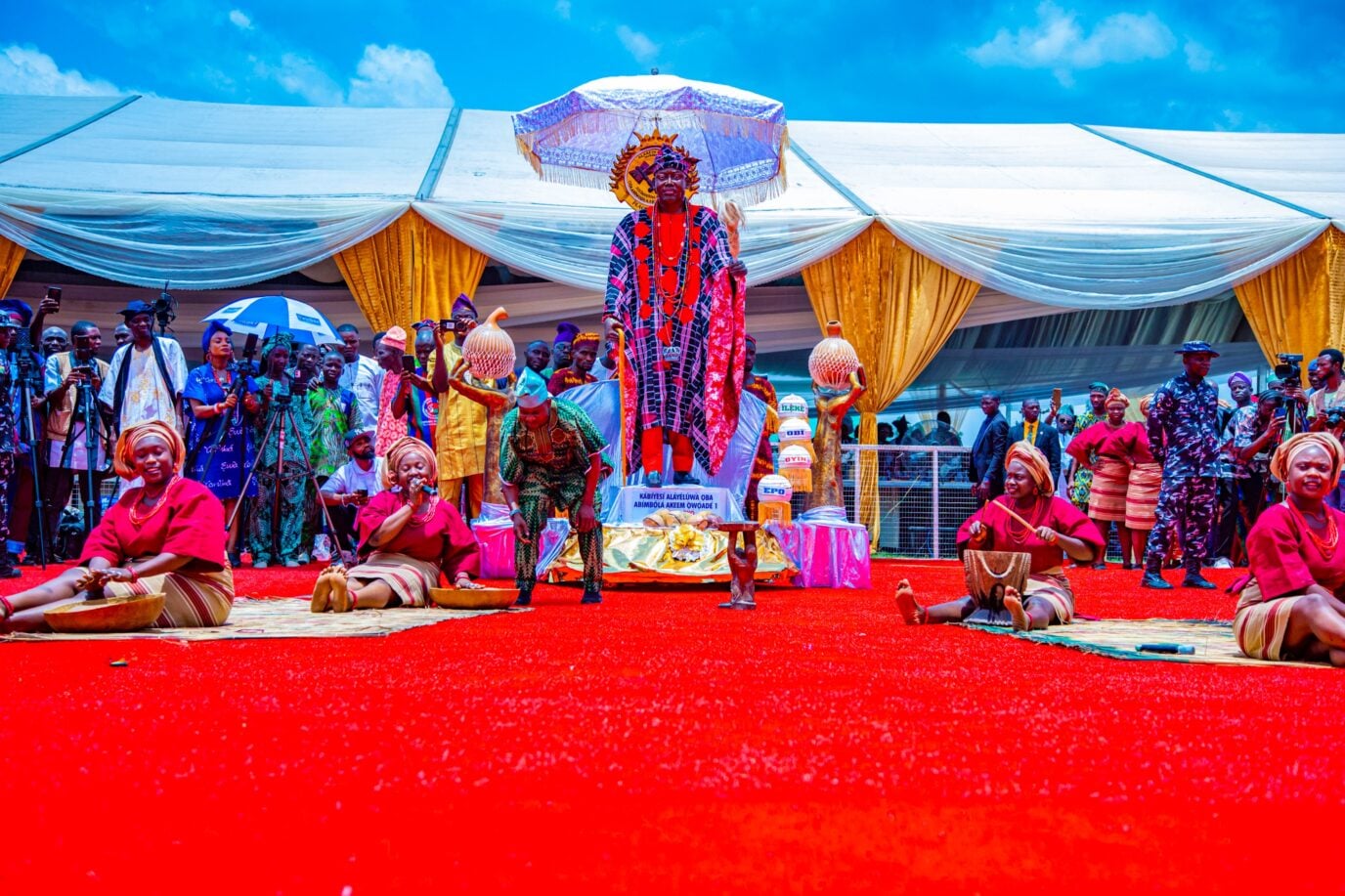
For centuries, the old Oyo empire occupied a central place in the political history of Yorubaland, exercising authority that extended across large swathes of what is now south-western Nigeria and beyond.
Between the 17th and early 19th centuries, the Alaafin of Oyo presided over a complex political system supported by military strength, tribute networks and administrative institutions that sustained imperial influence.
Historical records show that the empire’s power enabled it to shape regional trade, diplomacy and warfare across a wide geographical area.
Over time, however, internal rivalries, succession disputes and external pressures weakened the foundations of the Oyo state.
Scholars have often compared the decline of Oyo to the trajectories of other global empires that expanded rapidly before fragmenting under structural strain.
By the early 19th century, the once-dominant empire had lost much of its territorial control, leaving the Alaafin’s authority confined largely to Oyo town and surrounding areas.
The political contraction of Oyo coincided with broader instability across the region, including the advance of Fulani jihadists from Ilorin.
During this period, historical accounts credit Ibadan warriors with playing a decisive role in halting further incursions and restoring a measure of stability to Oyo and neighbouring Yoruba towns.
This intervention, documented in oral traditions and colonial-era writings, contributed significantly to the survival of Oyo as a cultural and political entity.
In contemporary Nigeria, the Alaafin’s domain is administratively limited to four local government areas within Oyo State.
Despite this reduced territorial scope, the Alaafin retains cultural significance as one of the most prominent traditional rulers in Yorubaland.
The position continues to command respect rooted in history, ritual authority and symbolic leadership.
Recent public discourse has, however, revisited questions about the evolving role of traditional institutions in a modern, democratic society.
The reign of the Alaafin of Oyo, Owoade, has drawn attention to these debates, particularly regarding relationships among Yoruba monarchs.
Observers note that traditional hierarchies established during the era of empire coexist today with constitutional governance and elected political authority.
Within this context, interactions among obas across Yorubaland are shaped by protocol, mutual recognition and cultural diplomacy rather than formal political control.
The Alaafin’s influence, like that of other first-class traditional rulers, now operates primarily within advisory, ceremonial and community-development spheres.
Public interest has also focused on Alaafin Owoade’s personal background, including his time spent living abroad.
The experience of residence in countries such as Canada has been cited by commentators as part of a broader exposure to multicultural governance systems.
Such experiences are often viewed as shaping perspectives on leadership, community engagement and institutional relevance.
In Nigeria, traditional rulers increasingly engage with development initiatives, conflict mediation and cultural preservation.
Their authority is frequently measured by their ability to mobilise support for education, healthcare, infrastructure and economic activity within their communities.
Oyo town, like many historic centres, faces modern challenges related to urban development, employment and social services.
Local stakeholders have identified agriculture, tourism and small-scale enterprise as potential drivers of economic growth in the area.
The preservation of historical sites associated with the old Oyo empire also presents opportunities for cultural tourism.
These initiatives typically require collaboration between traditional institutions, local governments and private investors.
Across Yorubaland, cooperation among monarchs has become a defining feature of contemporary traditional leadership.
Regional councils of obas and cultural associations often provide platforms for dialogue and joint advocacy on matters affecting their communities.
This approach reflects broader shifts in how traditional authority adapts to Nigeria’s constitutional framework.
Analysts note that while historical legacies remain important, present-day relevance depends on responsiveness to social and economic needs.
The Alaafin’s role is therefore situated at the intersection of history and modern governance.
Discussions about kingship in Oyo increasingly centre on how tradition can support development without reviving imperial-era rivalries.
Cultural historians emphasise that Yoruba political culture has long balanced hierarchy with consultation and collective decision-making.
This balance continues to influence expectations of traditional rulers in the 21st century.
As Nigeria evolves, traditional institutions face ongoing questions about continuity, reform and public accountability.
In Oyo, these conversations highlight the enduring significance of the Alaafin’s stool alongside changing realities.
The future of kingship in the ancient city is thus framed not only by its past glory but by its capacity to align heritage with contemporary aspirations.