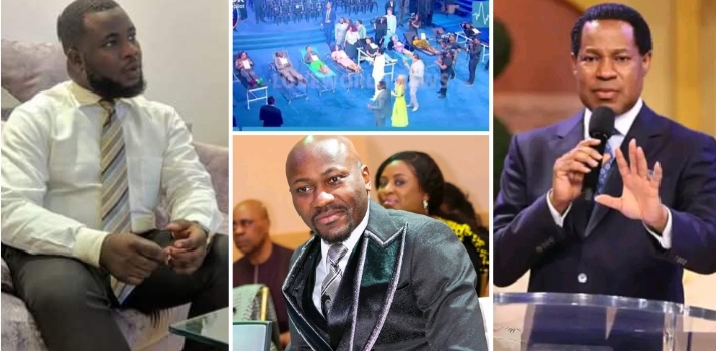
No one could have predicted how a few minutes of prayer would ignite a storm of scrutiny, admiration, and disbelief across the nation. Ten figures lay on stretchers, still and motionless, until an outstretched hand seemed to alter everything. Movement appeared, hesitation vanished, and walking followed almost instantly. The camera captured what seemed impossible, yet the screen alone could not settle the argument that had begun to pulse through comment sections, living rooms, and even professional circles.
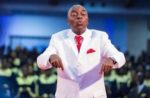
The images in Pastor Chris Oyakhilome’s videos were unambiguous in one sense: bodies moved, steps were taken, and reactions were immediate. Yet ambiguity thrived where certainty was expected. Was this divine intervention in real time or a carefully framed illusion designed to inspire belief and draw attention? Each frame became a point of investigation, a silent question posed to viewers about faith, evidence, and the human impulse to believe in miracles.
Within hours, two distinct currents of opinion formed. A Nigerian medical doctor, scrutinizing the video with the precision of a clinician, insisted that what the camera captured could not be classified as medically verifiable healing. In contrast, Apostle Johnson Suleman, a spiritual figure of influence, argued that the footage reflected the very essence of faith, where logic and human understanding rarely apply. The debate transcended the video itself, touching on theology, culture, perception, and the tension between the material and the spiritual.
The viral footage was only the beginning. Every sequence, every movement, every angle carried the weight of interpretation. Some saw miracles, others saw questions left unanswered, and both sides claimed truth in the same set of images.
Doctor’s Frame-by-Frame Analysis: Evidence or Illusion
The medical doctor, identified online as Dr Sina, approached the footage with deliberate caution. He slowed the video, zoomed in on each individual, and analyzed their postures and limb movements in detail. His goal was not to attack faith but to determine whether the physical evidence supported claims of instantaneous healing.
Key observations included:
Leg Movements: Some individuals displayed leg motion inconsistent with true paralysis or long-term immobility.
Muscle Tone: The tension and flexibility in muscles suggested prior control, not sudden recovery.
Balance and Coordination: Immediate upright walking was unlikely to align with nervous system retraining required after chronic immobility.
Unexpected Patterns: Certain postures and transitions appeared atypical for patients who had experienced long-term disability.
From a purely medical perspective, Dr Sina concluded that the footage did not provide sufficient evidence to classify the events as miraculous or medically verifiable. However, he was careful to clarify that his analysis did not negate the possibility of divine intervention in general. It was strictly an examination of what the camera captured.
His review, shared online and quickly circulated by news outlets, emphasized that these were his professional observations, not an official statement by any medical board. The opinion sparked debate because it combined medical scrutiny with a willingness to acknowledge faith.
Public reaction was polarized. Some social media users praised the doctor’s detailed breakdown, noting inconsistencies in the movements. Others condemned the skepticism, arguing that spiritual experiences often defy physical explanation and cannot be captured fully on camera.
Apostle Suleman’s Defence: Faith Over Evidence
While medical scrutiny dissected the footage, Apostle Johnson Suleman responded publicly, framing the events in theological and spiritual terms. He maintained that miracles are real, citing the fundamental principle that Christian faith encompasses the supernatural and often transcends human logic.
Suleman emphasized that attempting to evaluate miracles purely with rational, clinical methods misses the essence of faith. He argued that believers are invited to experience and witness miracles rather than analyze them, and that spiritual understanding cannot always be measured or verified by science.
Drawing from biblical references, Suleman suggested that skepticism is often a result of spiritual blindness. Some minds, he said, cannot grasp divine works until they personally encounter them in a way that transforms understanding. The statements reinforced the idea that public debate over miracles often confuses the nature of spiritual experience with empirical verification.
He also contextualized the footage within Pastor Chris’ ministry, which has a long history of reported healings and “signs and wonders.” According to Suleman, the video aligns with longstanding traditions of miraculous experiences in Pentecostal churches, where documentation and spiritual impact are distinct from medical proof.
Suleman further discouraged critics from mocking or demanding physical evidence for miracles, asserting that divine acts are not subject to laboratory conditions or controlled trials. Faith, he contended, is validated through experience, testimony, and personal revelation rather than by frames per second.
Public Reaction: Between Awe and Skepticism
The moment the video went viral, social media became a courtroom, a gallery, and a pulpit all at once. Comments poured in from every corner of Nigeria and beyond. Some users expressed sheer amazement at the footage, describing it as “unmistakable proof of divine intervention” or “the power of God captured for the world to see.”
Each new share carried the potential to sway opinions, and every frame was analyzed, debated, and dissected in ways the original cameraman could never have anticipated.
At the same time, skepticism found its voice. Many viewers, recalling past viral claims of miracles or sudden healings, cautioned against taking the video at face value.
Questions about framing, editing, and prior preparation emerged. Could the people already have partial mobility? Was the timing of the video intentional to create the appearance of instantaneous healing? These questions circulated relentlessly, turning even casual observers into self-appointed analysts.
Historical Perspective: Miracles in Nigerian Pentecostalism
Claims of miraculous healings and supernatural interventions have long been part of the Nigerian Pentecostal landscape. Across decades, ministry leaders have shared dramatic stories of sudden healing, deliverance, and miraculous change. These narratives have shaped spiritual identity for many believers, while also attracting public scrutiny and debate about authenticity.
One of the most widely discussed figures in this context was the late Prophet TB Joshua, founder of the Synagogue Church of All Nations (SCOAN). Joshua became a global televangelist whose televised healing services and resurrections drew millions of viewers. Yet he also attracted intense criticism and skepticism. Former church insiders alleged that the “miracles” were staged, that people were selectively chosen and coached, and that video editing was used to create the impression of instantaneous healing — claims that were part of a broader BBC investigation into his ministry. In that reporting, insiders said that so‑called miracle clips were filmed at different times and spliced together to make recoveries appear immediate and dramatic, raising questions about how visual proof was presented to the public.
Apart from procedural critiques, there were also voices within the broader Christian community who questioned the spiritual basis of certain miracle claims. For example, some accusations went beyond the authenticity of healing and into theological territory, labeling certain practices as occultic or misleading. Decades ago, Bishop Kayode Peller publicly accused both TB Joshua and Chris Oyakhilome of using practices he described as hypnotism or mesmerism. These claims were rooted in his own interpretation of their ministry styles and the dramatic nature of apparent healings, though such accusations were controversial and not universally accepted.
Even outside televised ministries, other prominent pastors have spoken out about the problem of exaggerated miracle claims within the Nigerian church. Pastor Matthew Ashimolowo, a well‑known leader in Kingsway International Christian Centre in London, cautioned against charlatans who claim supernatural power without accountability, saying that some individuals “fake it because the nation wants to see the supernatural.” Critics interpreted his comments as a warning against misleading or opportunistic miracle narratives within and beyond Nigeria’s borders.
These examples illustrate a long‑running tension in Nigerian Pentecostalism: miracles are deeply cherished by many believers as tangible evidence of divine power, yet they repeatedly face external scrutiny when they are shown publicly and interpreted outside the pews. When a healing is broadcast, it becomes not just a spiritual moment for those present but also a subject for public interpretation, social media debate, and, at times, investigation. This dynamic helps explain why the controversy over Pastor Chris’ recent viral healing video did not emerge in isolation, but rather as the latest iteration of a broader cultural conversation about faith, evidence, and the role of public miracles in contemporary religious life.
What the Debate Reveals About Modern Faith
The controversy over Pastor Chris’ viral healing video highlights how faith operates in modern Nigerian society. Miracles are central to many people’s spiritual lives, yet contemporary audiences are also exposed to scientific reasoning and critical scrutiny. Nigerians often navigate between belief in the supernatural and the expectation of evidence, creating a space where faith and reason intersect.
The debate shows that collective belief is both personal and social. For many, witnessing or viewing miracles strengthens faith and provides hope. Social media amplifies this effect, letting people experience spiritual moments even from afar. At the same time, professionals like Dr Sina urge caution, emphasizing that extraordinary claims deserve careful examination.
Modern faith in Nigeria also carries a public dimension. Viral miracle videos become talking points, prompting discussions about authenticity, ethics, and social influence. People celebrate, question, and debate these events simultaneously, showing that belief is active, not passive.
Ultimately, the discussion reveals a society negotiating meaning between devotion and reason. Miracles are more than spiritual experiences; they are moments where faith, perception, and cultural expectations converge, reflecting how Nigerians balance belief with critical thinking in everyday life.