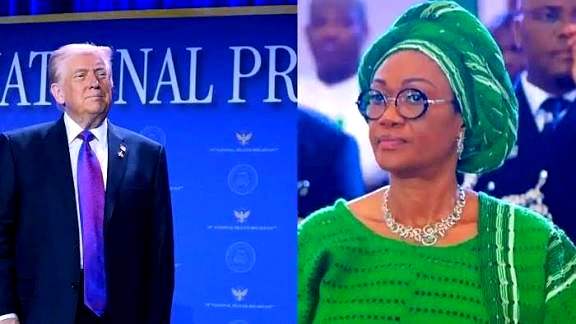
In a world where politics, faith, and public life often intersect, moments of recognition on international platforms can carry significance far beyond the applause they receive. On Thursday, in Washington, D.C., at the 74th Annual U.S. National Prayer Breakfast, Nigeria’s First Lady, Oluremi Remi Tinubu, stood among global leaders and faith figures, drawing attention for her dual role as a political leader and an ordained pastor.
The event, known for bringing together lawmakers, faith leaders, and international dignitaries for prayer, reflection, and ethical discourse, offered a platform for global visibility and recognition. During the gathering, former U.S. President Donald Trump publicly acknowledged her presence, describing her as a respected Christian leader and praising her service to one of Nigeria’s largest churches.
The recognition highlighted both her spiritual influence and her position as First Lady, giving the moment resonance for audiences in Nigeria and around the world.
The Event and Its Significance
The National Prayer Breakfast is more than a ceremonial gathering. It has a long tradition of convening leaders to engage in dialogue that blends faith and governance, offering a space for moral reflection and ethical discourse. Unlike formal diplomatic meetings, the event focuses on prayer and contemplation, yet its high-profile attendees often use the occasion to cultivate networks and foster international connections. The gathering includes lawmakers, religious leaders, diplomats, and international figures, making it a subtle yet powerful arena for influence.
For Remi Tinubu, attending this event was an opportunity to position herself as both a spiritual and political leader on the global stage. Her presence signaled engagement not only in faith-based reflection but also in conversations that touch on leadership, moral responsibility, and ethical governance. By participating, she demonstrated that leadership can encompass multiple spheres, bridging spiritual authority and public service in ways that resonate far beyond formal ceremonies.
Donald Trump’s Public Acknowledgment
A defining moment of the gathering came when Donald Trump addressed the assembly and specifically recognized Remi Tinubu. He referred to her as a highly respected woman who serves as a Christian pastor, noting her contributions to the Redeemed Christian Church of God, one of Nigeria’s largest Pentecostal denominations. The audience responded with applause, a gesture that reflected both respect for her personal achievements and recognition of her moral and spiritual authority. This public acknowledgment elevated her international visibility and highlighted her dual identity as a political figure and faith leader.
While the moment may appear ceremonial, it carries symbolic weight, illustrating the ways in which moral leadership and public service are intertwined. The recognition underscored her ability to represent the values of faith-driven leadership on a global platform, reinforcing the importance of ethical guidance in both national and international contexts.
The Role She Played at the Breakfast
Remi Tinubu’s attendance was primarily ceremonial, but her presence carried deeper meaning. She did not attend as an official representative of Nigeria, nor did she engage in formal diplomatic discussions. Her role was that of a respected faith leader and guest, demonstrating the influence of moral and spiritual authority in public life. In a space focused on prayer and reflection, her participation reflected the broader significance of ethical guidance in leadership.
High-profile gatherings like the National Prayer Breakfast often allow for informal dialogue between nations, but her presence was explicitly centered on faith, moral responsibility, and ethical discourse. It highlighted the potential for spiritual leadership to intersect with public service in ways that influence both national and international audiences. Her attendance sent subtle signals about Nigeria’s engagement in global discussions on leadership, ethics, and faith without necessitating formal policy exchanges.
Understanding Remi Tinubu
To fully appreciate her presence, it is important to consider her personal and professional journey. Remi Tinubu served as a Nigerian Senator before assuming the role of First Lady, giving her substantial experience in governance and public service. Beyond politics, she is an ordained pastor of the Redeemed Christian Church of God, a role that places her at the heart of one of Nigeria’s most influential faith communities. This dual identity allows her to navigate spaces where governance and spiritual guidance intersect.
Her ministry emphasizes moral guidance, pastoral care, and the cultivation of faith in communities across Nigeria. By blending political experience with spiritual leadership, she embodies a multidimensional approach to influence that resonates both domestically and internationally. Her recognition at the Prayer Breakfast illustrates the value of combining ethical reflection with public service, a principle that informs her broader work in Nigerian society.
Women in Leadership and Global Visibility
The recognition of Remi Tinubu also carries important implications for women in leadership. Female figures in politics and religion often navigate heightened scrutiny and complex societal expectations. By publicly acknowledging her contributions, Donald Trump highlighted the broader significance of female leadership in both political and religious contexts. Her visibility at an international gathering demonstrates how women can serve as bridges between spheres of influence, embodying moral authority while exercising political responsibility.
The applause she received was more than a ceremonial gesture; it reflected recognition of her capacity to inspire, guide, and model ethical leadership. Her presence contributes to the ongoing narrative about women shaping public life with a combination of integrity, vision, and spiritual insight.
Media and Public Perception
Media coverage of the event in both Nigeria and the United States amplified the significance of her attendance. Headlines and commentary emphasized her dual role as First Lady and religious leader, presenting her as a figure who blends public service with faith-based leadership. Such coverage reinforces the idea that leadership is multidimensional and that ethical considerations can complement political influence.
In a global environment where leaders are often defined by policy outcomes alone, highlighting moral and spiritual contributions offers an alternative narrative that emphasizes character, integrity, and societal impact. For audiences observing the event, Remi Tinubu’s visibility illustrates the ways in which personal conviction and ethical engagement can shape public perception and inspire broader respect for leadership grounded in values.
The Intersection of Faith and Politics
While the National Prayer Breakfast is not a venue for formal diplomacy, it demonstrates the subtle ways in which faith can intersect with political influence. Leaders who bring moral authority to international gatherings contribute to conversations about ethics, leadership, and responsibility. Remi Tinubu’s presence highlighted the potential for faith-based perspectives to inform global understanding of governance and public service.
Her recognition suggested that leadership is not solely measured by political achievements but also by the capacity to model ethical principles, provide guidance, and inspire communities. The event underscores the importance of integrating faith, morality, and leadership in shaping both domestic and international perceptions of effective governance.
Symbolic and National Implications
Remi Tinubu’s participation carries broader symbolic meaning for Nigeria. At a time when the country is scrutinized for issues such as security and religious tolerance, her acknowledgment highlights the contributions of Nigerian leaders to global conversations on ethics and morality. Her presence reflects Nigeria’s engagement with international faith and leadership communities and reinforces the message that moral authority and political responsibility can coexist.
The moment offers a counterbalance to narratives that focus solely on challenges, emphasizing the value of principled leadership. Her visibility at the Prayer Breakfast serves as a reminder that Nigeria contributes meaningfully to global discourse on leadership, values, and faith-driven governance.
Reflections on Leadership and Influence
The event provides an important reflection on the nature of leadership. Remi Tinubu exemplifies how political authority can be complemented by moral and spiritual guidance, offering a model for multidimensional influence. Her acknowledgment at the Prayer Breakfast demonstrates that recognition on international stages can be as much about ethical stature as political power.
Leaders who integrate faith and public service into their work gain credibility, inspire trust, and contribute to global dialogue in ways that extend beyond formal policy outcomes. In attending and being publicly recognized, she showcased the ability to merge moral conviction with leadership, creating an example for future leaders to emulate.
Concluding Thoughts
In the final analysis, Remi Tinubu’s presence at the 74th Annual U.S. National Prayer Breakfast and the public acknowledgment by Donald Trump illustrate the intersection of faith, leadership, and international recognition. Her dual role as First Lady and ordained pastor represents the multidimensional nature of modern leadership, where public service, moral guidance, and spiritual influence coexist.
The event highlights the significance of ethical engagement in governance, the importance of women’s leadership, and the subtle ways in which international platforms can amplify moral authority. Through her participation, she demonstrated that influence is not solely a function of political office but is enhanced by the integration of values, integrity, and a commitment to guiding communities toward ethical and principled living.