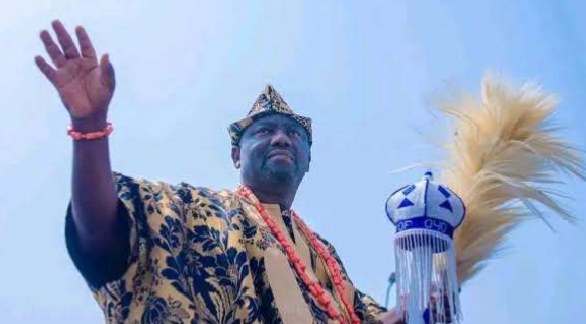
In the early months of 2026, the ancient city of Oyo once again found itself at the center of a legal and cultural storm that speaks to the delicate balance between tradition, authority, and modern constitutional order. The lawsuit filed by four princes of the historic Oyo royal lineage against the reigning Alaafin, Oba Akeem Abimbola Owoade, has stirred conversations not just within Oyo Town but across Yorubaland and Nigeria at large.
At stake is more than a disagreement over conduct or ceremonial hierarchy, because the matter touches on the dignity of an institution that has existed for centuries and continues to command reverence in the twenty first century. Filed at the Oyo State High Court in Oyo Town and listed as Suit No HOY 18 2026, the case represents the latest chapter in a broader series of disputes that have followed the emergence of a new Alaafin after a period of transition in the ancient throne.
The development is significant for several reasons that go beyond the courtroom. The Alaafin of Oyo is not simply a traditional ruler presiding over a town council or local customs, he is widely regarded as one of the most historically influential monarchs in Yoruba history, a symbolic custodian of a powerful pre colonial empire whose political and military reach once extended across large parts of present day southwestern Nigeria and beyond. Therefore, when princes of the same royal bloodline take legal action against a sitting Alaafin, it sends ripples through the cultural and political fabric of the region. It forces elders, historians, lawyers, and ordinary citizens to ask difficult questions about tradition, dignity, authority, and the evolving place of monarchy within Nigeria’s constitutional democracy.
The Filing of the Suit in Early 2026
According to court records and media reports published in February 2026, four princes of Oyo initiated legal proceedings against Oba Akeem Abimbola Owoade at the Oyo State High Court sitting in Oyo Town.
The four Oyo princes who initiated a lawsuit against the Alaafin of Oyo, Oba Akeem Owoade, are:
Ladigbolu Moshood Adegboyega (also referred to as Ladigbolu Adegboyega)
Owoade Olaide Tesleem (also referred to as Owoade Tesleem)
Adeyemi Sikiru Adesina (also referred to as Adeyemi Adesina)
Adeyemi Akinade Adebayo (also referred to as Adeyemi Adebayo)
The suit was officially registered as Suit No HOY 18 2026, a detail that anchors the dispute firmly within the formal judicial system of Nigeria rather than the informal channels of palace mediation or council arbitration. The filing of the case in early 2026 marks a decisive step, because it reflects the choice of the aggrieved princes to seek constitutional adjudication rather than relying solely on traditional mechanisms of dispute resolution.
The fact that the matter was taken to the High Court is itself instructive, since it highlights how traditional institutions now coexist with the structures of modern governance. In pre colonial times, disputes over royal conduct or succession might have been handled entirely within the palace or by kingmakers, yet in contemporary Nigeria such issues often intersect with statutory law and constitutional rights. The princes’ decision to approach the court suggests that they believe the questions they are raising are justiciable and capable of determination by a judge under Nigerian law. It also places the Alaafin in the position of a defendant who must respond in accordance with legal procedures rather than purely cultural expectations.
What the Princes Are Asking the Court to Declare
Central to the lawsuit are specific reliefs sought by the four princes, which have been reported in national media including Punch in February 2026. The claimants are asking the court to issue a perpetual injunction restraining the Alaafin, whether directly or through agents and representatives, from participating in public engagements or functions that they consider not befitting the symbolic status of the throne. In their view, certain appearances or forms of conduct risk diminishing the stature traditionally associated with the Alaafin of Oyo, whose office has long been regarded as paramount within Oyo Town and influential across Yorubaland.
Beyond the request for restraint from particular public engagements, the princes are also asking the court to prevent the Alaafin from acting in ways that, in their estimation, make him appear inferior or subservient to other Obas within Yorubaland. This aspect of the suit touches on the delicate hierarchy among Yoruba monarchs, where historical claims, colonial administrative arrangements, and modern state recognition intersect in complex ways. By seeking judicial affirmation that the office of the Alaafin is of great historical and cultural importance in Nigeria and beyond, the princes are effectively inviting the court to pronounce on the symbolic rank of the throne. Such a declaration, if granted, would not merely affect one individual but could shape perceptions of inter traditional relations for years to come.
The reliefs sought therefore can be broken down into the following key points:
• A perpetual injunction restraining the Alaafin from participating in public engagements considered unbefitting of the throne
• A restraint against conduct that presents the Alaafin as inferior or subservient to other Obas in Yorubaland
• A judicial declaration affirming the historical and cultural significance of the office of the Alaafin of Oyo
• A declaration that the holder of the office is paramount in Oyo Town and its environs
Each of these requests reflects a concern not about private disputes but about public symbolism and the collective memory of a people whose identity is deeply intertwined with their traditional institutions.
The Historical Weight of the Throne
To understand why this case has generated intense interest, one must appreciate the historical weight carried by the title Alaafin of Oyo. The Oyo Empire, which flourished between the fifteenth and nineteenth centuries, was one of the most powerful Yoruba states and exercised influence over vast territories through a sophisticated political system that balanced royal authority with councils such as the Oyo Mesi. The Alaafin was not merely a ceremonial figure, he was both a spiritual and political leader whose decisions could shape alliances, wars, and trade networks.
In the colonial era and after Nigeria’s independence in 1960, the powers of traditional rulers were significantly curtailed, yet their moral and cultural authority remained intact within their communities. The Alaafin continued to be regarded as a custodian of history and tradition, even as elected officials assumed executive and legislative functions under the Constitution of the Federal Republic of Nigeria 1999 as amended. When the princes in Suit No HOY 18 2026 ask the court to recognize the office as paramount and historically significant, they are drawing on centuries of legacy that extend far beyond contemporary politics.
The Emergence of Oba Akeem Abimbola Owoade
The present legal dispute cannot be separated from the broader context of the appointment of Oba Akeem Abimbola Owoade as Alaafin, a process that unfolded amid public scrutiny and reported disagreements among contenders. Following the passing of the previous Alaafin in April 2022, the throne remained vacant for a significant period as kingmakers and relevant authorities navigated the complex selection procedures rooted in custom and regulated by state law. By the time Oba Owoade emerged and was installed, debates had already surfaced about the fairness and transparency of the process.
Fact based reports indicate that some aspirants and claimants had previously approached the courts to challenge aspects of the selection and coronation process. Although those earlier cases were distinct from Suit No HOY 18 2026, they form part of the atmosphere in which the present lawsuit has arisen. The perception of controversy surrounding the installation has made every subsequent development more sensitive, because it reinforces the sense that the throne is undergoing a period of redefinition in a rapidly changing society.
The Court’s Procedural Requirements
In line with standard judicial practice, the High Court has required that the Alaafin enter an appearance either personally or through legal representatives. This involves submitting the appropriate forms at the court registry or by registered post within the stipulated time frame under the applicable rules of court. The requirement is procedural rather than substantive, yet it carries symbolic significance because it places a traditional ruler within the framework of civil litigation.
The obligation to respond through counsel underscores the principle that no individual, regardless of status, is beyond the reach of judicial scrutiny when a matter is properly brought before a court of competent jurisdiction. At the same time, it highlights the delicate balance between respect for traditional authority and adherence to constitutional norms. The courtroom thus becomes a space where ancient titles and modern legal doctrines meet, sometimes uneasily but inevitably.
Cultural Hierarchy and Inter Oba Relations
One of the most sensitive dimensions of the lawsuit concerns the allegation that certain actions by the Alaafin have made him appear inferior or subservient to other Obas in Yorubaland. Yoruba traditional structure is not monolithic, because different towns and kingdoms possess their own histories, lineages, and claims to prestige. Titles such as the Ooni of Ife, the Alaafin of Oyo, and others each carry distinct historical narratives that shape contemporary perceptions of status.
By inviting the High Court to rule on whether the Alaafin should be restrained from conduct that implies subservience, the princes are effectively raising questions about symbolic ranking among monarchs. This is a terrain fraught with emotion and identity, since it touches on pride, memory, and collective heritage. Any judicial pronouncement in this area must tread carefully, because it risks being interpreted not only as a legal determination but also as a statement about the hierarchy of Yoruba civilization.
Public Reaction and Community Sentiment
Since news of the lawsuit became public in February 2026, discussions have unfolded in Oyo Town, across Oyo State, and on national platforms. Elders within the community have reportedly expressed concern about the spectacle of royal family members confronting their monarch in court, arguing that internal mechanisms should ideally resolve such disputes. Younger voices, however, have pointed out that recourse to the courts is a legitimate exercise of constitutional rights and may provide clarity where tradition alone cannot.
The human dimension of the case should not be overlooked, because behind legal documents and media headlines are individuals bound by blood ties and shared ancestry. The four princes are not strangers to the throne, they are part of the same extended royal lineage that produced the current Alaafin. Their decision to sue is therefore likely to have been weighed carefully, knowing that it would attract scrutiny and perhaps criticism. For the Alaafin himself, the experience of being challenged by members of his own royal house must carry emotional as well as institutional implications.
Extended Ramifications for Royal Heritage Systems
The showdown between the Alaafin and the four princes reflects a broader tension facing traditional institutions in contemporary Nigeria. On one hand, monarchs are expected to embody dignity, continuity, and cultural authority. On the other hand, they operate within a constitutional framework that subjects public actions to legal standards and public opinion. When disputes arise over conduct or status, the line between custom and law can become blurred.
This case may set important precedents, not necessarily in terms of binding authority on other courts, but in shaping how similar disputes are perceived and handled. If the court grants the declarations and injunctions sought, it could embolden other royal family members elsewhere to seek judicial clarification of traditional roles. If it declines, it may reinforce the principle that courts should be cautious in adjudicating symbolic hierarchies. Either outcome will contribute to the evolving relationship between Nigeria’s judiciary and its traditional leadership structures.
What Comes Next
As of February 2026, the matter remains before the Oyo State High Court, with procedural steps expected to unfold in accordance with the court’s calendar. Hearings, submissions, and possible interlocutory applications may shape the pace and direction of the case. Legal analysts anticipate that arguments will revolve around questions of locus standi, justiciability, and the scope of judicial power in matters touching on tradition.
The eventual judgment, whenever delivered, will likely be scrutinized not only for its legal reasoning but also for its sensitivity to cultural history. For the people of Oyo and the broader Yoruba community, the hope may be that clarity emerges without deepening divisions. The throne of the Alaafin has survived wars, colonial restructuring, and political transitions, and many believe it will endure this legal challenge as well.
Final Reflection
The High Court showdown between the Alaafin of Oyo and four aggrieved princes is more than a lawsuit recorded as Suit No HOY 18 2026, it is a moment that encapsulates the complex interplay between history, identity, and modern law. Filed in early 2026, the case seeks judicial intervention in questions of dignity, hierarchy, and symbolic authority that have deep roots in Yoruba civilization. By breaking the matter down into its sequences from filing to reliefs sought, historical context, procedural requirements, and broader implications, one sees that the dispute is not merely personal but institutional.
As proceedings continue, the eyes of many will remain fixed on the Oyo State High Court in Oyo Town, where arguments grounded in centuries of tradition will be tested against the principles of a contemporary legal system. The outcome will shape not only the immediate relationship between the Alaafin and the four princes but also the evolving narrative of how ancient thrones navigate the realities of twenty first century Nigeria.