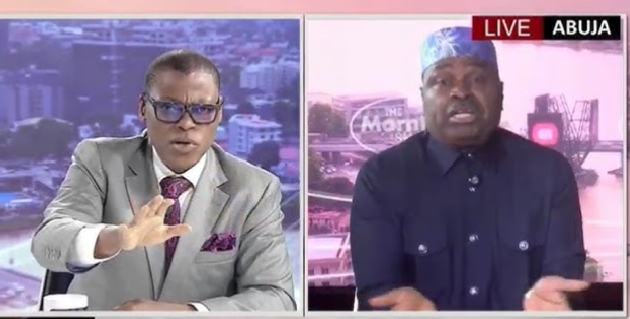
On Monday, March 2 2026, Nigerian political discourse was electrified by a heated exchange between actor-turned-politician Kenneth Okonkwo and veteran journalist Rufai Oseni on Arise TV during a segment focused on the Electoral Act 2026 and the country’s political landscape ahead of the 2027 general elections. The confrontation has since gone viral across social media platforms, with video clips showing a passionate, and at times, tense interaction that has sparked national discussion.
Beyond the surface level of a verbal clash, the incident reflects the intersection of political frustration, journalistic accountability, and the growing polarization in Nigerian political conversations. Both figures came to the discussion carrying their own experiences reputations, and expectations, which set the stage for a confrontation that would resonate with viewers nationwide.
The Context of the Discussion
The program aired on Arise TV, a channel known for tackling political and socio-economic topics with a panel of experts and commentators. The segment on March 2 2026 focused on the recently passed Electoral Act 2026, highlighting provisions regarding result transmission, voter registration, and party membership criteria. Kenneth Okonkwo, a chieftain of the opposition African Democratic Congress (ADC), appeared on the panel to critique aspects of the law and raise concerns about its potential manipulation to favor the ruling party. His presence was deliberate, aimed at articulating the opposition’s perspective on transparency, electoral fairness, and the integrity of the democratic process.
Rufai Oseni, who is widely regarded as a forthright and probing journalist, moderated the discussion with his trademark directness. Oseni’s approach is often confrontational, designed to challenge panelists while uncovering nuances in their positions. On this occasion, the tension was intensified by the high stakes of the debate, as the implications of the Electoral Act 2026 are poised to shape political contests leading up to the 2027 elections. From the outset, it was clear that both men approached the discussion with firm positions and deeply held convictions, making the eventual escalation unsurprising in hindsight.
The Trigger Comment
The catalyst for the confrontation was Oseni’s characterization of the opposition, including Okonkwo’s party, as “jokers.” This comment, captured in several widely shared clips, implied that opposition figures were not approaching political issues with the seriousness required to address national challenges. Oseni, consistent with his journalistic style, framed the comment as an observation on political behavior rather than a personal attack. However, the use of the word “jokers” carried an immediate weight that resonated emotionally with Okonkwo and other opposition members.
In Nigeria’s charged political climate, where opposition figures already contend with allegations of marginalization, the term struck as dismissive and insulting. It also underscored the role of media framing in shaping public perception, with language choices carrying both symbolic and tangible consequences. For many viewers, the comment was the moment that transformed a policy discussion into a confrontation, as the interaction shifted from technical analysis of the law to a debate about respect, representation, and legitimacy in political discourse.
Kenneth Okonkwo’s Response
Okonkwo responded strongly to the “joker” label, insisting that the characterization was “intellectually fraudulent” and an undermining of serious political debate. He emphasized that opposition politicians, including himself, are motivated by genuine policy concerns, particularly regarding sections of the Electoral Act 2026 that, according to him, could compromise the fairness of the electoral process. Okonkwo argued that instead of dismissing opposition figures as clowns, journalists should provide context, explain legal and procedural implications of the law, and educate the public on potential impacts.
His response was passionate, reflecting a mix of personal indignation, professional political engagement, and a desire to defend the credibility of his party. Okonkwo’s interjections highlighted his frustration with media portrayals of the opposition and underscored the tension between journalistic scrutiny and political representation. By framing his argument as a call for informed discourse, he shifted the debate from personal offense to systemic concerns about governance, media responsibility, and the safeguarding of democracy. Observers noted that his reaction, while emotionally charged, articulated a broader argument about the importance of fairness and seriousness in public debate.
How the Exchange Escalated
Video footage of the live segment shows both men raising their voices, frequently talking over each other, which marked a clear departure from a standard panel discussion. The exchange was punctuated by visible impatience and heightened emotion, as both individuals defended their respective stances with intensity. Other panelists, including Reuben Abati, attempted to moderate the conversation and maintain order, yet the tension remained palpable.
The escalation can be understood as a combination of factors: the high stakes of the topic, prior frustrations among opposition figures regarding media treatment, Oseni’s confrontational style, and Okonkwo’s insistence on defending the integrity of his position. The overlap of raised voices and interjections, while appearing chaotic, reflected deep-seated anxieties about political marginalization, governance accountability, and the framing of public discourse. For viewers, the visual and auditory cues conveyed a clash not only of opinion, but of underlying political narratives and personal pride.
Broader Political Frustrations
Beyond the televised moment, the clash embodies broader opposition frustrations in Nigeria. Kenneth Okonkwo and other opposition leaders have repeatedly voiced concerns that the Electoral Act 2026 includes mechanisms that could be manipulated in favor of the ruling party, including specific result transmission rules and party membership requirements. These concerns are particularly sensitive in a nation with a history of contested elections and perceptions of systemic bias.
Okonkwo’s reaction was not merely about a single comment; it was emblematic of a deeper tension between opposition actors seeking fair representation, and media figures who, intentionally or not, frame narratives that may shape public opinion in ways that affect political fortunes. The clash on March 2 2026 reflects the convergence of legal scrutiny, political strategy, and media influence, highlighting the challenges opposition parties face in both policy advocacy and public perception management.
Journalistic Style and Public Role
Rufai Oseni’s approach as a journalist is widely recognized for its bluntness, persistence, and sharp questioning. His interviewing technique has both admirers and detractors: supporters argue that his style holds leaders and political figures accountable, ensuring that critical questions are asked in public forums, while critics contend that it can verge on disrespect or dismissal, especially when loaded labels such as “jokers” are deployed.
In the context of the March 2 2026 exchange, Oseni’s style amplified the tension. While his objective may have been to challenge Okonkwo and highlight perceived inconsistencies in opposition arguments, the framing had an unintended consequence of provoking an emotional response. The incident raises questions about the role of journalists in politically sensitive discussions: should media figures remain neutral facilitators, or can they take assertive positions that expose weaknesses and stimulate debate? Nigerian viewers were divided in their assessment, reflecting broader debates on media ethics, responsibility, and influence in shaping public discourse.
Public and Online Reaction
Social media reacted almost immediately after the broadcast, with hashtags, clips, and commentary circulating widely. Many Nigerians framed the moment as symbolic of the broader struggle between government critics and powerful media voices, viewing the exchange as a flashpoint in a charged political atmosphere leading up to the 2027 elections.
Supporters of Okonkwo praised his assertiveness and his insistence on defending the credibility of opposition figures, while others criticized him for raising his voice and appearing combative. Observers of Oseni’s style similarly had polarized reactions: some applauded his rigor and willingness to challenge political actors, while others condemned the perceived dismissiveness and belittlement implied by the “joker” remark. Across online forums, the incident sparked debates on how journalists should engage with political figures, the ethics of labeling in public discourse, and the responsibilities of opposition leaders in responding to criticism.
Implications for Nigerian Political Discourse
The March 2 2026 clash between Okonkwo and Oseni illustrates a larger phenomenon: the intersection of media influence, political accountability, and public perception in Nigeria. It highlights the precarious balance between rigorous questioning and respect, between defending political positions and maintaining decorum, and between providing factual analysis and engaging in emotive dialogue.
Okonkwo’s strong response underscores the sensitivity of opposition leaders to public characterization, particularly in a media environment where language can shape narratives and influence voter perceptions. At the same time, Oseni’s approach highlights the challenges journalists face in maintaining authority, credibility, and relevance while navigating the complex terrain of Nigerian politics. The incident is illustrative of the evolving dynamics of televised political discourse, and the power of media moments to ignite national conversations about fairness, representation, and democratic engagement.
Summary of the Incident
The live TV confrontation on March 2 2026 can be summarized as follows:
Issue on Air: Discussion of Electoral Act 2026 and political debate in Nigeria.
Oseni’s Claim: Opposition politicians, including Okonkwo, are “jokers.”
Okonkwo’s Response: Strong rejection, labeling the characterization as “intellectually fraudulent,” and emphasizing the seriousness of opposition concerns.
Tone: Heated, with raised voices, overlapping remarks, and visible tension.
Broader Debate: Raises questions about media style versus political critique, the responsibility of journalists, and the defense of democratic principles.
The clash represents not only a moment of televised confrontation, but a lens into the political and media dynamics shaping Nigeria as it approaches the 2027 elections. It demonstrates how language, framing, and emotional responses can amplify underlying tensions, and underscores the need for both political actors and journalists to navigate discourse responsibly, even in highly charged settings.