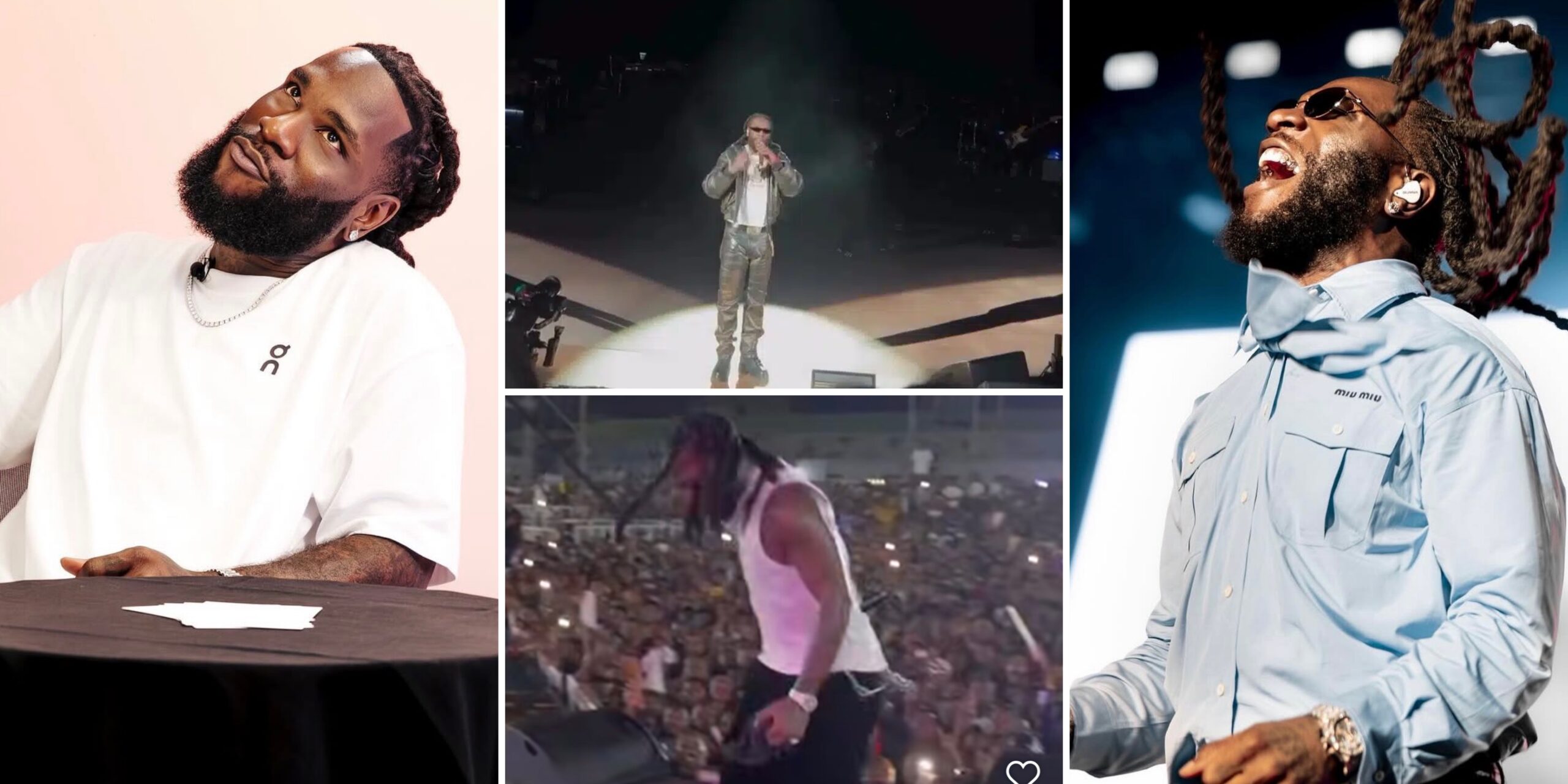
It was a crisp November evening at Red Rocks Amphitheatre in Denver, Colorado. The sandstone ridges framed the stage, the LA-based crowd had leaned in for Burna Boy’s “No Sign of Weakness” tour, but what unfolded next wasn’t just music and applause.
Midway through his set, Burna Boy froze. He raised his voice, pointed at a couple in the front row, and demanded sharply, publicly, that the man escort his apparently sleeping partner out of the venue. The singer slammed down the weight of his presence. He stated:
“When I stand up here and see you over there with your girl sleeping in the front of me, it pisses me the fk up.
So, please, take her the fk home… Walahi I’m not performing another song till you go home.”
The reaction was electric. Some in the crowd cheered as security approached. Others looked stunned. Eventually, the couple left after other fans urged them to. Burna Boy then resumed performing, but the moment lingered on social media. This seemed like another chapter in a pattern of confrontations between the “African Giant” and his audience. See clip below:

Setting the Stage: Burna Boy, Aura, & Intimacy


To understand these clashes, it helps to grasp who Burna Boy is as a performer, and what his shows are meant to feel like.
Damini Ogulu better known as Burna Boy has built a persona rooted in authenticity, boldness, and a refusal to sugarcoat. His music, drawing on Afrofusion, dancehall, reggae, and R&B, often leans into loud passion and raw emotion. On stage, he invites engagement like dancing, shouting and even physical closeness.
But that intimacy comes with risk, for the performer and the crowd. The “front row,” for Burna, seems less like a barrier and more like a zone of accountability. He doesn’t just perform to spectators, he demands energy. And when that energy isn’t there, he intervenes. Just like in his latest concert where the said couple sat in the front row.
Earlier Incidents: A History of Clashes


To see the bigger picture, it’s important to look back at prior episodes and times when Burna’s stage met the crowd in friction.
Greater Lagos Concert / Countdown Fest, Lagos (January 2025)
One of the most talked-about clashes happened during the Greater Lagos Countdown (New Year) concert. A fan breached security and ran onto the stage. Video footage shows Burna Boy reacting physically by kicking the intruder, then abruptly ending his performance.
He did not just stop singing, he walked off, signaling his backstage singers to end the performance. The intensity of that moment raised questions like if it was done out of self-defense, exasperation, or both.
A couple of days later, Burna Boy addressed the incident on social media, framing his reaction through the lens of trauma. He said his response was rooted in PTSD. In his words:
“It was a free show.
I was supposed to do 10mins and did almost an hour.
Everybody knows my rule about getting on stage and startling me when I’m performing. I had an amazing time with Lagos State last night.
Don’t jump on my stage like that! I got PTSD. I love you all. Happy new year.”
That revelation added another layer to how fans interpreted his behavior as not only protective, but deeply personal. See clip below:

The “Omah Lay” Moment (March 2024)
It was one of those nights where Burna Boy seemed to be playing not just to the crowd, but with them, by testing the room, reading faces and searching for energy. Midway through the set, as the band eased into a groove, Burna stopped and locked eyes with a man in the front row. The fan stood stiff, unsmiling, his expression unreadable against the chaos around him.
Burna tilted his head, stepped closer, and with a mischievous grin asked the question that instantly electrified the crowd:
“Do I pull an Omah Lay on your girl? Because I can.”
The audience erupted. Burna wasn’t angry this time, he was provocative, leaning fully into the swagger that has come to define his stage persona. The reference was unmistakable. It was a nod to the 2024 viral moment when Omah Lay danced intimately with a fan’s girlfriend onstage, leaving the boyfriend stunned and the internet buzzing.
Burna’s tease was half-joke, half-warning. It was that familiar razor edge he performs on. He didn’t touch the woman in question, didn’t dance with her, didn’t even gesture for her to join him. He didn’t need to. The threat alone was its own kind of spectacle.
The fan laughed nervously, the girlfriend hid her face, and Burna moved on, satisfied that he had shifted the energy to where he wanted it. It wasn’t a fight, or a shove, or a dramatic removal like Atlanta or Denver. But it still revealed something essential: Burna Boy’s instinct for control. He doesn’t just command a stage, he commands the room. He tests boundaries with charisma, humour, and a quiet insistence that everyone present perform their role.
This moment showed a different shade of conflict, not physical, but psychological. A lighter clash, but still unmistakably Burna.
Lagos Concert (2023)


In a performance earlier reported around 2023, Burna Boy physically kicked a fan off his stage after the person tried climbing onto the podium. The episode was captured on video and shared widely.
According to observers, the fan’s attempt was sudden and uninvited, and Burna’s reaction was swift. Some defended the move as self-defense; others saw it as excessive. Across social media there was a debate on if artists should forcibly remove fans in moments like this, or if they should rely on security and de-escalation?
This incident appears not to have prompted a public apology, but it became part of the lore around Burna Boy’s stage presence, reinforcing his zero-tolerance policy for unexpected intrusions. See clip below:

Zambia: Lusaka Showgrounds (April 2019)
During a packed concert at the Lusaka Showgrounds, a man made his way onto the stage and grabbed Burna Boy’s hand. Video footage widely circulated at the time shows the man pulling at his fingers as Burna performed. In response, Burna Boy kicked him off. The crowd erupted, and Burna continued performing after the brief disruption.
A day later, Burna Boy publicly apologized to Zambian fans, saying the man was not a fan but someone who, according to him, had tried to steal from him multiple times that night.
He said the individual had made “the tenth attempt to rob me on stage” and that he reacted defensively because the man kept reaching for his jewelry and pockets. Burna also emphasized that he respected his Zambian audience and regretted how the footage looked out of context.
This incident became one of the earliest internationally documented examples of Burna Boy’s aggressive on-stage boundary enforcement. It is also significant because it predates his recent global tour controversies. Although Burna framed the altercation as a safety and theft issue, and not fan misconduct, it is still one of the few incidents where he apologized publicly.
African Giant tour: Atlanta, Georgia (2019)


It remains one of the most unusual moments from Burna Boy’s African Giant tour, not a fight, not a security breach, but a clash of energy.
Midway through his Atlanta performance, Burna Boy suddenly paused the band and pointed at a man in the front row. The arena quieted as Burna addressed him directly. According to the singer, the fan had been motionless through most of the performance which was a stark contrast to the feverish crowd around him.
Burna Boy walked to the edge of the stage, looked the man in the eye and said something that immediately went viral:
“Your face is not encouraging me.”
He reached into his pocket, pulled out cash — roughly the amount of a ticket which was reportedly a $100 and handed it to the man, telling security to escort him out of the premium front-row space. The crowd screamed in disbelief, half shocked, half amused. It was a deeply Burna Boy moment: dramatic, confrontational, and rooted in his belief that audience energy must match performer intensity.
But the story didn’t end there.
Later in the night, in a gesture that softened the earlier tension, Burna invited the same fan back on stage. The two danced together as the band played “Gbese,” and the crowd roared. It became a moment of reconciliation and full-circle arc from public embarrassment to shared spotlight.
For Burna Boy, it was another example of his uncompromising philosophy about performance. That the vibe of the room is sacred, and he will confront anything that disrupts it, even if that “disruption” is silence. See clip below:

Phyno Fest: Enugu, Nigeria (2016)
During Phyno Fest 2016 at the Nnamdi Azikiwe Stadium in Enugu, which was one of the largest concerts in Nigeria that year, Burna Boy’s performance became chaotic when multiple fans surged toward the stage.
Video clips from the event which was shared widely at the time across Twitter and Instagram show Burna Boy kicking at fans who attempted to pull or grab him as he performed near the edge of the stage.
This wasn’t an isolated grab; several fans repeatedly reached for him but when it seemed like he would lose his balance, the singer kicked a particular fan. Burna Boy continued performing while fending them off with defensive kicks.
The moment caused some online chatter in late 2016, but it didn’t become a major scandal partly because Burna Boy wasn’t yet at the global visibility level where every action went viral.
Still, among longtime fans and Enugu attendees, the memory is part of the lore of early Burna Boy performances. It was energetic, chaotic, and marked by aggressive self-protection when crowds overwhelmed the stage line. See clip below:

Why These Moments Hit So Hard: Power, Respect & Trauma
What makes Burna Boy’s clashes with fans especially combustible isn’t just the physical interventions, but it’s the emotional and relational power dynamics.
1. Power dynamics on stage: Burna is not just a singer; he asserts moral authority when he performs. By calling out audience behavior, he re-centers power on his terms, telling people how to behave even after they’ve paid for a ticket. Whether it is right or not is at the discretion of fans.
2. Expectation of respect: To Burna, performing isn’t a passive act. He expects energy, attentiveness, maybe even reverence. And when he doesn’t feel that, he holds people accountable.
3. The trauma factor: His reference to PTSD after the Greater Lagos incident was a turning point. Trauma isn’t a typical justification in artist-fan confrontations, but once Burna invoked it, his critics had to contend with the possibility that his aggressiveness wasn’t just ego or anger, but was from personal pain.
4. Social media magnification: In the age of smartphones, even a brief pause or scolding goes viral. Clips of his calls to action or his exits spread fast. That accelerates how these moments are debated globally, not just in Lagos or Denver.
Voices on the Stage: What People Are Saying
Fans / Critics:
• Some on social media have lambasted him for “kicking paying audience members out,” especially when those audience members likely spent money and time to be there.
• Others defend him, often pointing out that stage invaders are a real security risk. And also, if a person is going to pay their hard earned money to go to a concert, they should participate to encourage their fave.
The Human Side: Burna Boy in the Crossfire


Beyond the flames of criticism and defense, there’s a deeply human story. Burna Boy is not simply a performer, but someone who clearly cares about his art and his contribution. He perhaps feels exposed when the crowd grows complacent or inattentive. His stage demands are not purely performative; they feel personal.
At the same time, fans matter. They pay, they travel, they bring energy (or lack of it). When they fail to meet Burna’s expectations, he does not always ignore it. He pushes back.
This push-pull is what makes his performances electric and fragile. For all the controversy, there’s something compelling about an artist who won’t just gloss over a moment of disconnection. He confronts it. Sometimes he escalates. Sometimes he pauses. And when things spiral, he calls for a reckoning.
What’s Next: Reflection and Responsibility


As Burna Boy continues to tour globally, these moments are likely to recur. But there are lessons and possible paths forward for him, for his team, and for promoters:
• Proactive security protocols: More robust barrier control, closer monitoring of front-row behavior, better training for staff to intervene before battles reach the stage.
• Clear performance standards: Burna could consider communicating more explicitly what he expects from his audience (e.g., “I appreciate good vibes, but front row energy matters to me”), without necessarily demanding removal of fans or getting physical.
• Mental health framing: If PTSD or trauma is genuinely part of his reactions, Burna could leverage that more intentionally. He could shed more light on it through interviews, public statements, or even on-stage moments of reflection, in a bid to humanize his boundary-setting.
• Fan communication: After high-profile confrontations, Burna (or his team) might engage more directly with his fans by offering apologies, explanations, or creating spaces for dialogue. That could build understanding without undermining his authority.
Burna Boy’s most viral moments like when he stops singing, demands removal, or walks off, are not just stunts. They are boundary markers. They tell his audience ‘this space is mine’, and I will defend it.