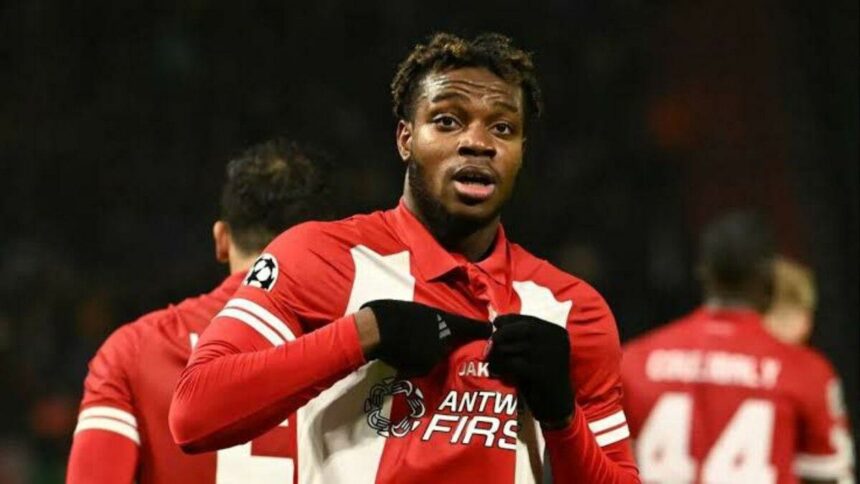
In February 2026, AS Monaco confirmed what European football had been building toward for nearly three years: George Ilenikhena, still just 19 years old, was sold to Al-Ittihad of Saudi Arabia for a reported fee of 30 million euros. For a player who only cost six million euros when he moved from Amiens to Royal Antwerp in 2023, the jump in valuation is almost surreal. But for anyone who had been watching him, it made complete sense.
- From the Suburbs of Paris to Ligue 2: The Early Years That Built the Foundation
- The Belgian Chapter: Royal Antwerp and the Champions League Moment That Changed Everything
- The Monaco Transfer and What a Move to the Principality Signalled
- What Makes Ilenikhena Different: The Playing Style Behind the Transfer Fees
- The Record-Breaking Al-Ittihad Move and What the 30 Million Euro Price Tag Reflects
- The Decision to Move to Saudi Arabia: Development Trade-offs and What Comes Next
- The Broader Context: African Football’s Record Transfer Economy
- George Ilenikhena and the Question of What His Story Means for Nigerian Football
- Conclusion
The sale made Ilenikhena the most expensive teenager in Nigerian football history, overtaking Kelechi Iheanacho, who cost Leicester City roughly 28 million euros from Manchester City in 2017. It also placed him in a broader conversation about African football economics, one that raises a straightforward question: how did a boy from Lagos, raised on the outskirts of Paris, become worth this much before his twentieth birthday?
The answer runs through youth academies in the northern Paris suburbs, a relegated second-division club, Belgian champions, and the Champions League stage at Monaco’s Stade Louis II. Ilenikhena’s path to becoming Africa’s most expensive teenager is not a story of hype preceding substance. The substance came first, often in the most dramatic circumstances imaginable.
George Ilenikhena and the Making of Nigeria’s Most Expensive Nigerian Teenager


George Ilenikhena’s rise from amateur youth football in Antony, Hauts-de-Seine, to a nine-figure valuation is a study in how quickly elite talent compounds when the right environments line up in sequence. Born in Lagos on 16 August 2006, he relocated to France with his family at three years old and spent his formative years at the amateur club Antony Football Evolution, where he learned the game before joining Amiens ahead of the 2021-22 season. By the time he was 15, clubs from France and abroad were already sending scouts to watch him.
From the Suburbs of Paris to Ligue 2: The Early Years That Built the Foundation
Amiens SC had just been relegated to Ligue 2 when they brought Ilenikhena into their youth setup in 2021. For most teenagers, dropping into the second tier of French football would signal the wrong direction. For Ilenikhena, it turned out to be the ideal environment to develop without the pressure of a top-flight club demanding immediate results.
He scored 24 goals for Amiens at under-17 level during the 2021-22 season, a tally that is extraordinary regardless of age. He also featured in the Coupe Gambardella, France’s premier youth cup competition, where his form continued to attract wider attention. These were not goals against uncompetitive opposition. They were the kind of numbers that force the football industry to sit up.
His professional debut came on 19 November 2022 in a Coupe de France tie, and then on 10 January 2023, he made his Ligue 2 debut. Three days later, against Bordeaux, Ilenikhena scored to become the youngest goalscorer in Ligue 2 history, at just 16 years and 150 days old. That record had significance beyond the statistics. It meant that at an age when most players are still navigating youth football, Ilenikhena was already competing and contributing at professional level.
His Ligue 2 performance that season generated interest from clubs across Europe. The physicality was already obvious, as was his pace and his ability to play across the front line rather than being limited to a single position. By the summer of 2023, the question was not whether he would leave Amiens, but where he would go and for how much.
The Belgian Chapter: Royal Antwerp and the Champions League Moment That Changed Everything
The fee was six million euros when Ilenikhena signed for Royal Antwerp in June 2023 on a four-year deal. Antwerp had just won the Belgian Pro League title and were preparing for their first-ever Champions League campaign. For a 16-year-old striker from Ligue 2, walking into a Champions League squad is a significant jump, and Ilenikhena spent the early weeks of his tenure at Antwerp finding his footing, often coming off the bench rather than starting.
That role as an impact substitute, far from limiting him, became the context for one of the most remarkable individual moments any teenager had produced in European football in years. On 13 December 2023, Antwerp hosted Barcelona in the final group stage match of the 2023-24 Champions League. Barcelona needed a result to confirm top spot in the group. Antwerp, with nothing to lose, played with an aggression that unsettled their visitors from the first minute.
The match went back and forth, with Antwerp leading 2-1 before Barcelona equalised through Marc Guiu in the 91st minute. Then, straight from the kickoff, the ball was played through to Ilenikhena, who had come on as a substitute. Alone through on goal, he finished calmly past Inaki Pena to win the match 3-2 in stoppage time, giving Antwerp their first-ever Champions League victory in the club’s history.
At 17 years and 119 days old, Ilenikhena became the youngest French scorer in Champions League history, breaking a record set just minutes earlier by PSG’s Warren Zaire-Emery, who had scored in the same round of matches. The previous record had been held by Karim Benzema since 2005. In the Guardian’s annual ranking of the best players born in 2006, Ilenikhena was named as one of the finest worldwide, published in October that same year.
He finished the season at Antwerp with 14 goals in 50 appearances across all competitions. For a teenager who was essentially still finding his professional footing, those numbers demonstrated a consistency that went beyond his dramatic Champions League cameo.
The Monaco Transfer and What a Move to the Principality Signalled
Monaco paid approximately 18.75 million euros to bring Ilenikhena to the principality in July 2024. The club had finished second in Ligue 1 the previous season and were targeting the Champions League as a genuine competition rather than a stage appearance. Bringing in a 17-year-old striker at that fee was a statement of intent, not just for the transfer window but for the kind of club Monaco were trying to build.
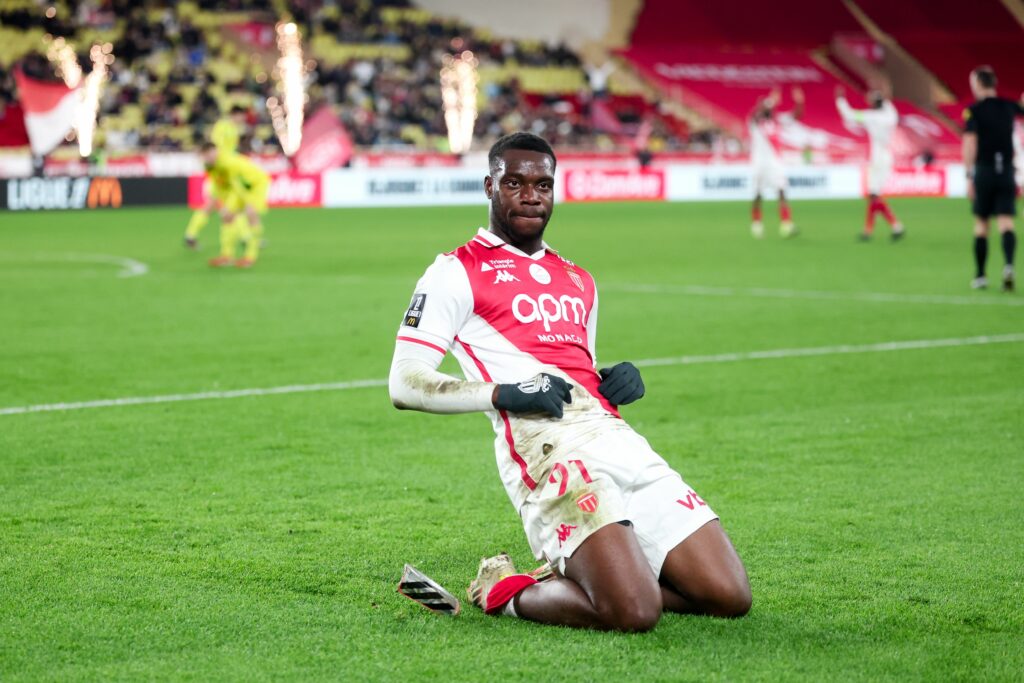
He was handed the number 21 shirt and given time to integrate under coach Adi Hutter. His debut season at Monaco was not without its complications, including an injury period, but the moments of quality were undeniable. By September 2024, he had already written himself into the Monaco record books.
On 19 September 2024, Monaco faced Barcelona in the Champions League. Ilenikhena came on as a substitute with the score level at 1-1 and, twelve minutes after entering the pitch, finished a long ball from Vanderson past Marc-Andre ter Stegen to give Monaco a 2-1 win. In doing so, he became Monaco’s youngest-ever Champions League scorer at 18 years and 34 days, breaking a record previously held by Kylian Mbappe, who had set it at 18 years and 63 days in 2017.
He also became the first player in Champions League history to score against the same opponent in successive seasons but for different clubs, having scored against Barcelona for Antwerp in December 2023 and now for Monaco in September 2024. These are the kinds of details that fuel transfer valuations. By the time the January 2026 window opened, UEFA confirmed that Ilenikhena had become the youngest African player to reach 15 Champions League appearances, achieving the milestone at 19 years and 157 days during Monaco’s 6-1 defeat to Real Madrid.
Over his full spell at Monaco, he made 51 appearances in all competitions, scoring 10 goals and providing 2 assists. The goals-to-minutes ratio across that stint was not elite-tier, but the stage on which many of those goals arrived and the age at which he was doing it told a more complete story than raw numbers.
What Makes Ilenikhena Different: The Playing Style Behind the Transfer Fees
Ilenikhena stands at 185 centimetres and combines that physical presence with pace that makes him effective both centrally and out wide. He is predominantly left-footed, which gives him an unpredictability that defenders find difficult to read, particularly when he cuts inside from the right channel. His first touch under pressure tends to create space rather than simply control the ball, which is a quality associated with forwards who have developed genuine striker instincts early.
In conversations with Transfermarkt in late 2023, Ilenikhena cited Erling Haaland as his primary footballing inspiration. The reference is instructive. Like Haaland, Ilenikhena positions himself to be in the right place rather than manufacturing chances through extended individual brilliance. His Champions League goals against Barcelona, across two separate clubs and two separate seasons, shared a common thread: clinical execution when the opportunity arrived, rather than creative dribbling to manufacture it.
His adaptability is another significant factor. At Amiens he was primarily a youth striker. At Antwerp he functioned as an impact substitute who maximised limited game time. At Monaco he had to manage a more varied role across a longer season. The ability to perform across those different demands, particularly while still a teenager, is part of what drove the eventual transfer fee to a level that made European clubs take notice.
French football analyst and talent expert commentary at the time of his Monaco signing noted his capacity to operate in high-pressure defensive lines and his movement off the ball as two qualities that set him apart from other teenage strikers in the market. The comparison to Victor Osimhen, who also developed through Belgium before becoming one of the world’s elite strikers, was made repeatedly. Osimhen’s own trajectory from Wolfsburg to VfL Bochum to Lille to Napoli provides a template that Monaco had clearly studied.
The Record-Breaking Al-Ittihad Move and What the 30 Million Euro Price Tag Reflects
The sale to Al-Ittihad was confirmed on 3 February 2026, with transfer expert Fabrice Hawkins reporting the agreed fee at 30 million euros. The Saudi club, planning for their long-term future beyond Karim Benzema, identified Ilenikhena as a forward capable of leading the next phase of their project. He signed a contract running to 30 June 2029.
That 30 million euro figure made Ilenikhena the most expensive Nigerian teenager in history. The record it surpassed was Kelechi Iheanacho, who was barely 20 when Leicester City paid around 28 million euros for him from Manchester City in 2017. Before Iheanacho, the marker was John Obi Mikel at around 20 million euros, then Yakubu Aiyegbeni at 4.75 million euros, Nwankwo Kanu at roughly 3.93 million euros, and Sunday Oliseh at 1.5 million euros.
The progression across those figures reflects both inflation in the global transfer market and the growing visibility of African players on the European stage. But Ilenikhena’s fee stands apart even within that context. He was sold as a teenager, before the peak of his career, off the back of 51 Monaco appearances and two Champions League goals rather than a full season of sustained elite output.
That tells you something about how the market prices potential in 2026, and also about the specific appeal of a player who has already demonstrated big-game capability on repeated occasions. Transfer committees are buying the evidence of those Barcelona goals and the trajectory they represent.
The Decision to Move to Saudi Arabia: Development Trade-offs and What Comes Next
The move raised questions that will follow Ilenikhena’s career for some time. European clubs including Bayer Leverkusen, Eintracht Frankfurt, VfB Stuttgart, and Lille had all been linked with him ahead of the window, representing competitive Bundesliga and Ligue 1 environments where development alongside elite European football is guaranteed week-to-week. Saudi Arabia’s Pro League, for all its financial growth and squad-building ambition, is not that environment.
The counterargument is that at 19, securing a contract of this magnitude is difficult to dismiss. Football careers are defined by injuries and circumstance as much as ability, and the financial certainty of a move at this level is not something any player can ignore. Al-Ittihad also have genuinely ambitious plans, boasting players like Steven Bergwijn and Moussa Diaby alongside their project with Ilenikhena.
Super Eagles coach Eric Chelle acted quickly after the transfer was confirmed. According to OwnGoal Nigeria’s reporting from 2 March 2026, Chelle made contact with Ilenikhena last week with a view to including him in Nigeria’s March international window. The situation regarding his international future is nuanced. He represented France at youth level from 2021, but according to OwnGoal Nigeria, he has never played for France at any level that would prevent him from switching allegiance to Nigeria, and he currently holds only a Nigerian passport. That means no formal switch of allegiance process is required.
For the Nigeria Football Federation, the timeline is a critical one. The 2026 World Cup is approaching and Nigeria, having qualified for the tournament, needs to secure the commitments of its most talented young diaspora players before those commitments become irreversible. Ilenikhena in green and white would represent one of the most significant coups Nigerian football has managed in the post-Osimhen era of rebuilding.
The Broader Context: African Football’s Record Transfer Economy

Ilenikhena’s fee fits into a broader pattern of African players commanding increasingly significant transfer sums. Victor Osimhen’s move to Napoli was eventually followed by his world-record loan to Galatasaray and the ongoing interest from elite European clubs. Ademola Lookman’s performances for Atalanta have placed him among Europe’s most valued attackers. Samuel Chukwueze, Wilfried Zaha, and others have demonstrated consistent demand for African talent at the top level.
Within the Nigerian context specifically, the conversation about who could become the country’s most expensive player of all time is one that circles Osimhen’s 75 million euro move to Napoli in 2020. Ilenikhena’s 30 million euro fee at 19 invites a direct question: if he continues developing, could he eventually command a fee that challenges or exceeds that benchmark?
The honest answer is that nobody knows, particularly given that he has chosen Saudi Arabia rather than a peak European development environment at this stage of his career. But the evidence of his rise so far suggests a player with the physical attributes, the big-game composure, and the adaptability to build on what has already been a remarkable start.
Former Nigerian international Victor Ikpeba has been among the most vocal advocates for Ilenikhena’s inclusion in the Super Eagles setup, arguing consistently that the NFF needs to act before his international window closes. The involvement of European clubs in the summer of 2025 prior to his eventual January move suggests that the industry had already factored Ilenikhena into the category of players who will define the next decade of African football economics.
George Ilenikhena and the Question of What His Story Means for Nigerian Football
Talent pipelines are imperfect things. Players who look like certainties at 17 sometimes plateau; players who look modest at the same age sometimes emerge as generational. Ilenikhena’s trajectory is not a guarantee of anything beyond what he has already done, which is substantial enough on its own terms.
But the structural lessons of his development do matter for Nigerian football specifically. He was born in Lagos, moved to France at three, and built his game through an amateur club in the Paris suburbs and then a relegated Ligue 2 side. None of those environments are prestige institutions. Antony Football Evolution is not a famous academy. Amiens are not a marquee name. Yet the foundation he built there was solid enough to hold up under Champions League pressure against Barcelona at 17.
That points to a consistent reality in African football development: the formal elite pathways that European academies provide are not the only routes to the top, but they help enormously once a player is ready to access them. The Nigerian football ecosystem’s challenge is not primarily about finding talent, which the country produces in abundance. It is about creating more consistent bridges between that talent and the professional environments where it can compound.
Ilenikhena made that bridge himself, aided by family and circumstance. The next generation of Nigerian players will need either similar luck or better institutional support to make the same journey. His example provides evidence that the journey is possible. Whether Nigerian football builds systems to make it more common is a different question entirely.
Conclusion
George Ilenikhena is now the most expensive Nigerian teenager in history and the holder of multiple Champions League records that most players twice his age will never match. He scored against Barcelona for two different clubs in two different seasons. He broke Kylian Mbappe’s Monaco record for the club’s youngest Champions League scorer. He holds the record as the youngest African player to reach 15 Champions League appearances.
These are not minor achievements padded out for effect. They are the kind of benchmarks that define how a player is remembered long before their career is over. At 19, with a contract running to 2029 and the Saudi Pro League as his new stage, Ilenikhena has time and uncertainty in equal measure.
The most interesting chapter of his story may yet be the one that involves Nigeria’s national team. If Eric Chelle succeeds in his reported pursuit, the Super Eagles could gain a striker whose big-game credentials are already built into his biography. If Ilenikhena eventually chooses France or leaves the decision too long, Nigerian football will be left to wonder what might have been with a player who was born in Lagos, moved to Paris at three, and became Africa’s most expensive teenage footballer by 19.
The record fee is the headline. The story behind it is where the real significance lies.