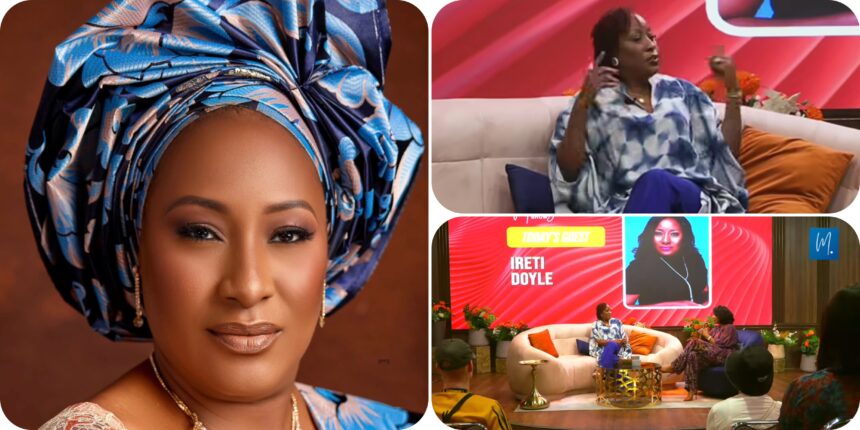
A recent interview between TV host Morayo Afolabi-Brown and Ireti Doyle has sparked controversy, following the actress’s firm response to questions about her past marriage.
“It was none of your business,” Ireti said, pushing back on public curiosity about her divorce. She also offered broader reflections on career longevity, reinvention, personal boundaries, life after separation and the discipline required to navigate both fame and private life in the digital age.
Beyond the viral exchange, the conversation offered insight into Ireti’s three-decade career in Nollywood, her approach to navigating public and private life, and her views on an evolving industry shaped by global exposure and digital culture.
A career still in motion


With more than three decades in Nollywood, Ireti Doyle signalled she is far from slowing down. Responding to a question from Morayo Brown about whether she is entering a quieter phase of her career, the actress dismissed the idea, pointing instead to the nature of the industry itself.
“Fortunately for me, I’m in an industry where you never retire… there will always be a need for an 80-year-old actor, a 90-year-old,” she said. “So no, I’m not slowing down. If anything, I’m spreading my wings.”
From early television success in productions such as Fuji House of Commotion and Tinsel to films like Fifty and more recent projects including Son of the Soil, Ireti’s career has been marked by consistency and reinvention. In the interview, she suggested that longevity in the industry is less about endurance and more about evolution. She mentioned embracing new roles, new audiences and new opportunities as they come.
On information, social media and critical thinking
Beyond her work on screen, Ireti Doyle also used the interview to speak on the impact of information consumption in the digital age, particularly among young people.
Referencing a recent post on her social media, she stressed the link between information, decision-making and overall quality of life.
“Your life, the quality of your life is only as good as the quality of the decisions that you make,” she said. “And the quality of the decisions that you make is dependent on the quality of the information that you have.”
She warned that the absence of gatekeeping in today’s media landscape has made it easier for misinformation to thrive, urging audiences to be more intentional about what they consume.
“Anybody with a smartphone and a microphone can say anything. You need to be careful who you hand over your critical thinking to,” she added.
Ireti also linked mental clarity to information intake, noting that constant exposure to unfiltered content can affect emotional stability and judgment. “If you’re not calm… you cannot function optimally,” she said, emphasising the need to consciously filter digital consumption.
Reinvention through roles


As her career has progressed, Ireti Doyle said she has become more deliberate about the roles she takes on, particularly after years of being cast in similar characters.
Speaking during the interview with Morayo Brown, she revealed that she had begun to step away from repetitive roles, especially as a law enforcement figure.
“I had made a mental decision to stay away from policeman roles for a bit… unless it comes with something extra, unless it’s a multi-layered character,” she said.
That strategy informed her decision to join Son of the Soil, despite it featuring yet another police character. According to Doyle, the project’s scale and international appeal made it difficult to pass up.
“It was starring Raz Adoti… and it was being directed by a globally recognised director. I said, you have to… this is strategy. There’s going to be a lot of eyes on this one,” she said.
The film, which has circulated internationally and earned critical attention, reflects what Doyle described as a shift toward more calculated career decisions. This is by balancing creative fulfilment with global visibility and long-term relevance.
The ‘none of your business’ moment

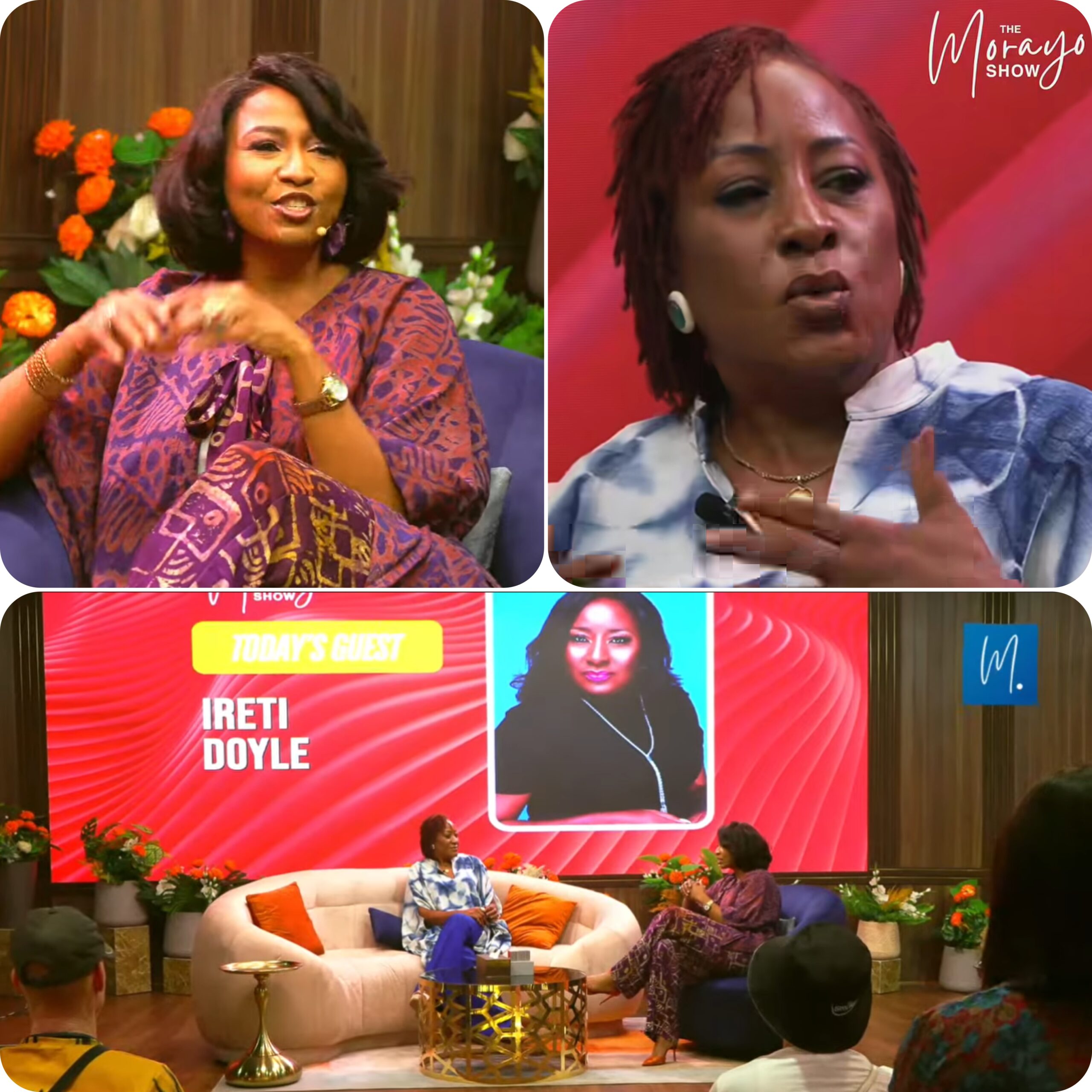
The most striking moment of the interview came when Morayo Brown asked about Ireti Doyle’s past marriage and divorce. This is an aspect of her life she has largely kept out of the public eye.
Ireti’s response was immediate and unequivocal.
“First of all, You didn’t hear anything because it was none of your business,” she said. Expanding on her stance, the actress questioned the expectation that public figures must explain personal decisions to a wider audience, describing such demands as misplaced.
“The only people you owe any explanation to, if at all, are those small family and friends that gathered on day one,” she added. She also pushed back against what she described as a culture of turning private pain into public content.
“I personally will never knowingly give myself up as clickbait… You’re not going to win,” Doyle said, cautioning against “bleeding all over the internet” in an attempt to satisfy public curiosity.
Divorce, healing and responsibility
Beyond asserting her right to privacy, Ireti Doyle also reflected on the personal realities of separation, describing the end of a marriage as a deeply painful process that requires introspection rather than public performance.
“The end of a relationship… talk less of a long-term marriage, is painful,” she said. Rather than seeking validation from a wider audience, Doyle emphasised the importance of turning inward.
“You need to spend all that energy… to sit down, go deep within, understand what went wrong for the sole purpose of not making the same mistakes again,” she said.
“All that energy… you need to focus it on where you are going,” she added.
Motherhood and blended family realities


Ireti Doyle also spoke candidly about the impact of separation on children, particularly within a blended family structure.
“That was one of the reasons why it took me a tad longer to arrive at the decision… because I factored in the children,” she said. She described the aftermath as difficult, especially in the early stages. “The first year was rough… there was a bit of resentment. Understandably so,” she added.
Despite this, Doyle said she remained committed to maintaining those relationships. “I actively pursued, sustained and maintained a relationship with my boys,” she said. She emphasised that children should not bear the consequences of a breakdown between partners. “If you take a decision that affects several other people, you’re kind of responsible for the ripple effect… the children have nothing to do with what went wrong,” she said.
Nollywood then and now
Reflecting on the broader industry, Ireti Doyle pointed to structural and creative shifts that have shaped Nollywood’s growth in recent years.
“There was a mass return of people who had studied best global practices… and they infused that energy and knowledge into Nollywood,” she said. She added that the rise of streaming platforms and international collaborations has expanded the industry’s reach.
“The more we were exposed to global audiences, the more we were encouraged… to up our skills,” Doyle noted. She also pointed to a growing shift toward local ownership, with more Nigerians developing indigenous platforms.
“With some of the major streamers pulling out, you see Nigerians creating indigenous platforms… so it’s been plus-plus,” she said.
Doyle further highlighted the increasing agency of women in the industry. “Women… are no longer waiting for opportunities to be handed over to them. They’re creating their own magic,” she added.
Beyond acting
Looking ahead, Ireti Doyle signalled a shift toward building and mentoring alongside her work on screen. She revealed that she has begun exploring production, with her first project—a short film titled Small Detour, currently in distribution discussions.
“I will be producing more… that’s my retirement plan,” she said.
Beyond filmmaking, Doyle emphasised her commitment to teaching and mentorship.
“If you ask me… the next best thing I love to do is to teach,” she said, noting her interest in working with young actors and women navigating separation. “It doesn’t have to be messy,” she added.
A voice of control and clarity
Taken together, Ireti’s remarks reflect a consistent theme of control over one’s narrative, both on and off screen. From her approach to career longevity to her firm stance on privacy, the actress presents a model rooted in restraint, intention and self-definition, even in an industry and culture that often demand the opposite.