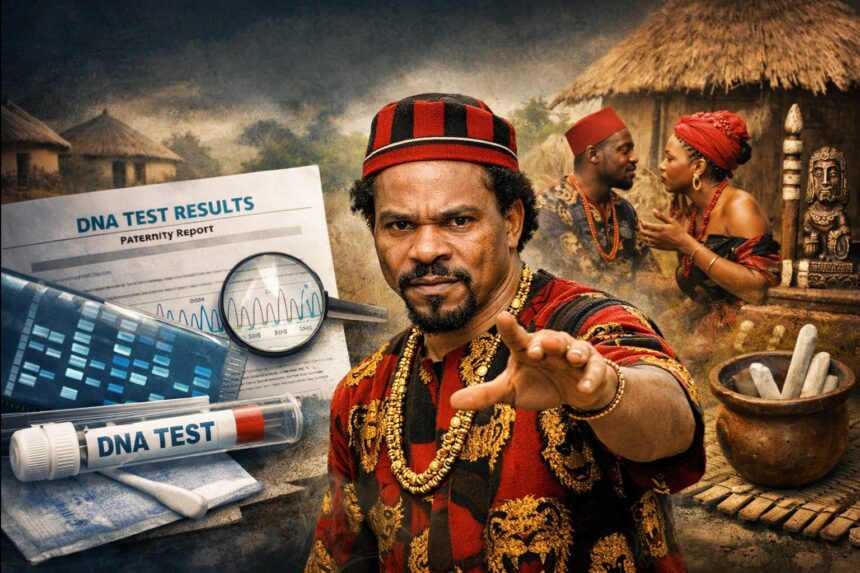
In March 2026, Nigerian cleric and popular pastor Odumeje made comments during a sermon that immediately sparked nationwide discussion, social media debates, and cultural reflection. His sermon centered on the issue of DNA paternity testing, particularly in the context of traditional Igbo society and family structures. Odumeje’s message suggested that seeking DNA tests to confirm a child’s paternity is contrary to Igbo cultural values, urging men to accept children born within their marriages without resorting to laboratory verification.
This sermon, which circulated widely online in video clips and news reports, highlighted tensions between cultural tradition, social expectations, and the modern availability of scientific tools like DNA testing. His remarks were not only interpreted as a moral and religious stance but also triggered debates about the relevance of traditional beliefs in contemporary Nigeria.
The controversy raised questions about how cultural practices intersect with legal and scientific innovations in family life and challenged audiences to think about trust, paternal rights, and societal evolution in a rapidly changing world.
What Odumeje Actually Said in March 2026
According to multiple credible Nigerian media outlets, Odumeje made several specific points during his sermon. First, he advised men against conducting DNA paternity tests, framing this advice as consistent with long-standing Igbo cultural beliefs regarding family, marriage, and fatherhood. He argued that the act of seeking scientific confirmation of a child’s paternity undermines the social trust and cohesion that have historically characterized Igbo families. His sermon emphasized that, traditionally, a child born to a wife is accepted as the husband’s unless there is a specific claim by another party disputing the relationship. This framing situates paternity as a social and communal recognition rather than a matter to be resolved through science. Additionally, Odumeje raised concerns about the reliability of DNA tests conducted in Nigeria, suggesting that local laboratory practices might not always provide trustworthy results.
He used this point to further discourage reliance on DNA testing, portraying the process as both culturally unnecessary and potentially fallible. These comments circulated widely, prompting lively online discussion, critique, and support, revealing the deep intersection of culture, religion, and science in contemporary Nigerian society.
Understanding “Against Igbo Culture”
When Odumeje said DNA testing is against Igbo culture, he referred to specific historical assumptions about family, lineage, and social recognition. In traditional Igbo society, children born within a marriage were almost universally accepted as belonging to the husband, regardless of biological verification. Community structures, elders, and family members collectively upheld these assumptions, ensuring that social cohesion was maintained and family integrity preserved. Pre-colonial Igbo systems relied heavily on community acknowledgment rather than scientific proof.
Blood testing and laboratory verification were non-existent, so social recognition and communal oversight constituted the primary means of establishing paternity. Odumeje’s statement reflects an interpretation of these norms, emphasizing social and familial bonds over scientific inquiry. While not codified as an unbreakable cultural law, the principle of social acknowledgment historically guided decisions regarding family, inheritance, and identity within Igbo communities. This perspective emphasizes trust, unity, and the symbolic authority of marriage in shaping family legitimacy.
Tradition versus Modern Science
The discussion around DNA testing is essentially a dialogue between historical tradition and contemporary scientific tools. Traditional Igbo practice operated on social assumptions: children born in a marriage were recognized by the husband as legitimate, and the community reinforced this bond. Elders, family heads, and local leaders acted as arbiters of paternity, emphasizing trust and communal cohesion. Biological verification was unnecessary and culturally irrelevant, as social recognition served both legal and moral purposes within the community. In contrast, modern DNA testing provides objective verification of biological relationships. Globally and within Nigeria, DNA tests are widely used to confirm paternity in legal disputes, inheritance claims, immigration cases, and personal decisions.
Scientific evidence demonstrates that unexpected results are not uncommon: research records indicate significant percentages of men who undergo paternity testing discover they are not the biological father. While traditional methods rely on trust and communal authority, modern science offers concrete confirmation, which can prevent disputes, protect rights, and guide personal decision-making. The tension between these approaches is at the heart of Odumeje’s controversial message, raising questions about when tradition should yield to scientific certainty and how cultural identity adapts in the modern world.
Why Odumeje’s Sermon Became Controversial
Odumeje’s sermon quickly ignited public debate. Supporters praised his defense of cultural values, arguing that constantly seeking DNA verification undermines trust in marriages and family cohesion. They suggested that overreliance on scientific tools could erode social bonds, weaken paternal responsibility, and diminish the symbolic authority of traditional marriage structures. These supporters emphasized the moral and relational dimensions of fatherhood, valuing commitment, care, and social recognition over empirical evidence.
Conversely, critics disagreed, asserting that DNA testing does not negate culture but safeguards individual rights, ensures legal clarity, and protects the welfare of children and fathers. They pointed out that no explicit Igbo cultural law prohibits scientific verification of paternity and argued that Odumeje’s claims reflected personal opinion more than codified cultural practice. The conversation quickly moved beyond religious contexts to legal, ethical, and sociological dimensions, highlighting tensions between evolving scientific norms and long-established cultural beliefs. Online discourse featured divergent perspectives, illustrating generational divides, urban versus rural viewpoints, and the broader debate about tradition versus modernization in Nigerian society.
Cultural Context and Family Recognition
Understanding the cultural context requires examining how Igbo society historically recognized family relationships. Children born to married women were socially assumed to be the husband’s offspring, ensuring familial stability and social cohesion. Inheritance, lineage, and community reputation were based on these assumptions rather than empirical verification. Social acknowledgment shaped family bonds, while communal enforcement of marriage norms protected the integrity of households. Odumeje’s advice reflects this principle, advocating for trust, acceptance, and social validation over reliance on laboratory confirmation.
This perspective underscores the symbolic and moral dimensions of fatherhood, prioritizing social responsibility, relational trust, and continuity of lineage through communal recognition. It highlights a worldview where family legitimacy is grounded in social structures, ethical obligations, and historical continuity rather than purely scientific methods.
Modern Practices and the Role of DNA Testing
Despite cultural assumptions, DNA testing has become a common practice globally and within Nigeria. It is applied in diverse contexts, including legal adjudication, child support disputes, inheritance claims, and personal decisions. Scientific verification provides objective evidence that can prevent misunderstandings, clarify rights, and ensure accurate records of biological relationships. While tradition assumes legitimacy through social recognition, modern DNA testing removes uncertainty and provides legal protection. The emergence of affordable and accessible DNA testing in Nigeria has intensified debates between tradition and science.
Families must now navigate the complex intersection of cultural values, social expectations, legal requirements, and scientific possibilities. This duality creates tension but also offers opportunities to harmonize ancestral wisdom with contemporary needs, ensuring that cultural heritage adapts responsibly to new realities.
Societal Implications of Odumeje’s Stance
Odumeje’s sermon has wider implications for Nigerian society. It calls attention to the role of cultural authority in shaping social norms, moral expectations, and family practices. By discouraging DNA testing, he emphasizes trust, social cohesion, and moral accountability within marriages. At the same time, it raises questions about the rights of individuals, particularly fathers, children, and potential heirs, to obtain empirical verification when necessary. The discourse also reveals generational and urban-rural differences in attitudes toward science, tradition, and family law. In urban centers, where legal disputes and scientific literacy are more prominent, DNA testing may be viewed as practical and protective.
In more traditional or rural communities, cultural norms emphasizing trust, communal validation, and historical practices retain stronger influence. The sermon illustrates the ongoing negotiation between enduring cultural values and modern societal practices, highlighting the fluidity of cultural adaptation in contemporary Nigeria.
Ethical and Legal Dimensions
Beyond cultural debate, DNA testing intersects with ethical and legal considerations. Scientifically verified paternity affects inheritance, child support, custody, and legal rights. Courts increasingly rely on DNA evidence to resolve disputes, ensuring clarity and protecting vulnerable parties. Ethical questions emerge when social assumptions clash with scientific proof: should a child be denied rights based on cultural belief if biological evidence differs? How does the law reconcile traditional recognition with empirical verification?
Odumeje’s sermon implicitly questions whether modern scientific tools should always take precedence over long-standing social norms. His perspective emphasizes relational trust and community-sanctioned legitimacy, while critics highlight individual rights, justice, and the protection of vulnerable parties. This interplay between ethics, law, and culture forms the core of ongoing national conversations sparked by his statements in March 2026.
Cultural Evolution and Adaptation
Igbo culture, like all living cultures, evolves over time. Practices that were practical centuries ago may be supplemented or reinterpreted in light of modern technology and legal frameworks. Odumeje’s sermon reflects one interpretation of tradition, but it also raises awareness that culture is not static. Communities must balance respect for ancestral practices with adaptation to contemporary realities, including scientific discovery.
While social recognition remains an important principle, objective verification tools like DNA testing are increasingly recognized as essential for safeguarding rights, resolving disputes, and ensuring fairness. The debate highlights the tension between cultural continuity and adaptation, demonstrating that Nigerian society continuously negotiates the boundaries between historical belief systems and modern innovations.
Tradition, Science, and Family in Contemporary Nigeria
Odumeje’s sermon in March 2026 brought the question of DNA paternity testing into the spotlight, generating widespread debate about culture, trust, science, and individual rights. His message emphasized the importance of social recognition, communal validation, and traditional values within Igbo society, framing fatherhood as a relational and socially sanctioned responsibility rather than a purely biological question.
Critics argued that modern science offers clarity, protection, and fairness that complements rather than undermines tradition. The controversy highlights the ongoing tension between historical practices and contemporary innovations in Nigerian family life, demonstrating that culture is both a guiding force and an adaptable system.
As society navigates this tension, the debate underscores the importance of informed decision-making, respect for cultural context, and acknowledgment of evolving scientific possibilities. Odumeje’s perspective invites reflection on how Nigeria can honor its cultural heritage while embracing tools that ensure justice, truth, and social cohesion for future generations. The conversation sparked in March 2026 will likely continue shaping discussions on family, culture, and science for years to come.