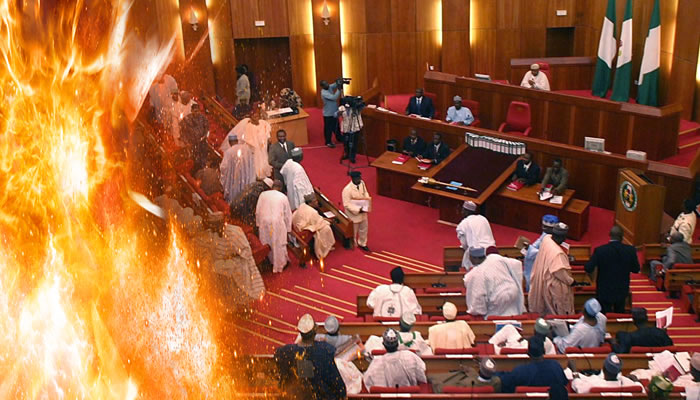
Growing incidents of political violence across Nigeria are drawing attention to potential risks as the country moves gradually towards the 2027 general elections.
Reports from different parts of the country indicate a pattern of clashes, attacks and intimidation linked to political activities and party processes.
These developments have emerged within both ruling and opposition political platforms, where internal disagreements and rivalry have intensified.
Observers note that party primaries, which often precede general elections, have historically been periods of heightened tension.
In recent months, such tensions have manifested in physical confrontations, destruction of property and disruption of political gatherings.
One of such incidents occurred in February when a political meeting in Benin, Edo State, was disrupted by suspected thugs.
The gathering, which involved leaders of the African Democratic Congress, ended abruptly after violence broke out.
Properties were reportedly damaged, while participants dispersed amid fears for their safety.
Some political figures present at the event were said to have sought refuge following the disturbance.
The incident has since generated discussions around political tolerance and security during party activities.
Earlier in February, violence was also reported during ward congresses of the All Progressives Congress in Ondo State.
Casualties were recorded, with some individuals sustaining injuries during the unrest.
The situation was attributed to internal disagreements among party members.
In Imo State, reports indicated that two political figures were killed in January under circumstances linked to political activity.
Similarly, in Cross River State, disruptions at a party secretariat led to the destruction of items and temporary displacement of members.
In Rivers State, an attack was reported on a political convoy travelling to a party secretariat for registration purposes.
These incidents reflect a broader pattern of insecurity surrounding political engagement in different regions.
The Nigerian Constitution guarantees freedom of movement and association for all citizens.
These provisions are considered essential for the functioning of a democratic system.
However, recent developments have raised questions about the extent to which these rights are being upheld in practice.
There have also been instances where political visits were met with resistance or warnings from state authorities.
Such actions have generated debate over constitutional rights and the responsibilities of public office holders.
Statements perceived as confrontational or restrictive have also contributed to heightened political tension.
Security concerns have further been amplified by threats circulating on social media platforms.
In one instance, an individual publicly claimed involvement in an attack and issued further warnings.
Authorities later confirmed the arrest of the suspect, with plans for prosecution underway.
The situation has drawn attention to the role of law enforcement agencies in addressing politically motivated threats.
Comparisons have been made with other jurisdictions where similar offences are handled with urgency.
Ensuring accountability for acts of violence is seen as critical in deterring future incidents.
The federal government, as the central authority, is expected to maintain law and order across the country.
This responsibility becomes more significant during election periods when political activities intensify.
The role of security agencies includes providing protection for citizens, political actors and electoral processes.
Observers have also pointed to the importance of neutrality and fairness in the enforcement of laws.
In addition to physical violence, inflammatory rhetoric has been identified as a contributing factor to tensions.
Public statements that appear to threaten or exclude certain political actors may influence behaviour at the grassroots level.
Recent comments by individuals regarding political campaigns in specific regions have raised concerns.
Such remarks have been interpreted as discouraging participation by certain groups.
The need for responsible communication among political actors has therefore been emphasised.
Historical events have also been referenced in discussions about political violence in Nigeria.
Past cases involving attacks on political figures remain unresolved, highlighting challenges in achieving justice.
These unresolved cases continue to shape public perception of accountability within the political system.
As preparations for the 2027 elections progress, stakeholders are paying closer attention to security developments.
Political parties, civil society organisations and citizens have all expressed interest in peaceful electoral processes.
Efforts to reduce violence are likely to involve collaboration between security agencies, political actors and regulatory bodies.
Maintaining stability during the pre-election period is considered essential for credible elections.
The ongoing incidents underline the importance of preventive measures and effective response mechanisms.
As the electoral cycle advances, the focus remains on ensuring that political participation can take place without fear or disruption.