Real Madrid’s Champions League story is confusing in the most honest way. You look at their squad some seasons and you wonder how they are supposed to compete with the depth and firepower other clubs have. You watch them in league matches and sometimes they do not even look like the most convincing team in Spain. Yet when the Champions League reaches its most uncomfortable stage, Real Madrid are usually still there.
- European History as Competitive Heritage
- Champions League Mentality
- Tactical Discipline and Mid-Block Organisation in European Nights
- Resilience Under Adversity
- Experience and Leadership
- Squad Balance — Depth in Roles Rather Than Star Power Alone
- Champions League Peaking — Timing Is Everything
- The Bernabéu Factor — Home Pressure Translates Into Results
- What Coaches and Leadership Teach Us About Madrid’s UCL Edge
- Why Being “Underdogs” Does Not Stop Madrid
- What Other Clubs Miss That Madrid Understand in the UCL Context
- Conclusion
They do not always control matches. They do not always look dominant. But they almost always look composed. Even when they are defending, even when they are chasing a goal, even when things are not going their way, they rarely look like a team that has lost its head. That calm shows up again and again in Europe.
Over time, it becomes clear that Real Madrid approach the Champions League differently from most clubs. They understand when to slow a game down. They understand when to suffer. They understand when to wait. And they understand that in this competition, one moment handled well can matter more than twenty minutes of good football.
This article looks at how Real Madrid keep winning the Champions League with squads that often do not look like favourites, and why this pattern keeps repeating itself in a competition that is supposed to reward only the strongest teams.
How Real Madrid Keep Winning the UCL
Real Madrid’s Champions League story has never been about having the most obvious superteam. In many seasons, other clubs arrive with louder hype, bigger spending, and deeper squads. Yet, when the tournament reaches its decisive stages, Madrid are usually still standing. That pattern is not accidental. It is built on habits, mindset, preparation, and a long understanding of how European football actually works.
Before breaking down the specific reasons behind this dominance, it is important to look closely at the foundations that keep Real Madrid competitive in the Champions League, even when they do not look like favourites on paper.
European History as Competitive Heritage
Real Madrid’s reputation in European football was established almost from the moment the competition began, long before the Champions League was even called the Champions League. When the European Cup was launched in the mid-1950s as a contest to determine the best club side on the continent, Madrid did not just participate, they dominated. The club won the first five consecutive editions of the tournament from 1956 to 1960 in a run that no other team has ever matched. That remarkable start did not simply give them medals and trophies, it embedded in the club’s DNA a belief that success in Europe was not rare or occasional, but something that was attainable and, ultimately, expected.
It is easy to forget how extraordinary that begins sounds to anyone who studies football history. In the opening years of what would become the Champions League, Madrid were competing against national champions from across the continent, the best teams from England, Italy, Germany, France and beyond, and still managed to win five titles in a row. This wasn’t a period of weak competition; it was competitive football in its purest form, and Real Madrid set a standard early in the European game that shaped the rest of the club’s continental journey.
Madrid’s European identity did not stop in the 1960s. Over the decades, the club has added to its continental trophy haul in different eras and under different managers, but always with a sense that winning in Europe is simply part of who they are. As of 2026, Real Madrid hold a record 15 European Cup and Champions League triumphs, more than any other club in history, and they have appeared in more finals and won more matches in the competition than anyone else. That sheer weight of success across generations creates a kind of quiet expectation inside the club, for players, for coaches, and for everyone connected to the organisation that they are capable of performing under European pressure.
Two of Madrid’s greatest continental achievements also highlight the club’s legacy of peaking at the right time. They are the only club to have defended the Champions League title in the modern era, meaning winning it in back-to-back campaigns and they are the only team to have won it three times in a row twice, first in the opening days of the competition, and again under manager Zinedine Zidane in 2016, 2017 and 2018. These records matter not just for the history books, but for the psychological imprint they leave on the club’s culture. When players walk into the dressing room, they inherit a sense of responsibility and belief that comes from knowing the jersey has been worn by generations who succeeded in Europe again and again.
This history also affects how rivals approach matches against Real Madrid. Clubs know they are facing a team with an unmatched list of European nights behind it, a team that has been in finals and produced winning performances under pressure more often than any other. That reputation alone can shape the psychology of competition, making opponents more cautious or less confident when the stakes are high. Seasons where Madrid do not look strongest on paper still see them treated as credible threats in European knockout ties, precisely because their past success has become part of their present identity.
So when modern conversations talk about Madrid winning the Champions League with squads that do not look like favourites, it is important to remember that they carry with them a heritage of winning in Europe that no other club can claim. This legacy is a form of confidence built over decades, one that shows up in tight matches, in big moments, and in players’ belief that success in Europe is not just a possibility, but an outcome their history suggests is very much on the table.
Champions League Mentality
Real Madrid’s Champions League mentality is not built on slogans or dressing-room speeches. It is built on memory. Collective memory. The kind that sits quietly in a club and reminds everyone wearing the shirt that difficult situations in Europe are not emergencies, they are familiar territory.
You can trace this mentality through very specific nights.
In 2014, Sergio Ramos rose in the 93rd minute of a final to force extra time against Atlético Madrid. That header did not just win a trophy, it reset how Madrid players viewed desperation moments. In 2017 and 2018, they managed knockout ties with the calm of a team that expected to survive them. In 2022, they eliminated Paris Saint-Germain after looking completely out of the tie, then produced the most famous late comeback in Champions League history against Manchester City, scoring twice in the final minutes before winning the tie in extra time. Those were not lucky goals. They were goals scored by players who never believed the tie was finished.
Even in more recent campaigns, the pattern has not changed. Madrid have continued to score late goals, win tense second legs, and handle penalty shootouts with a level of composure that separates them from teams who only look confident when they are already winning.
This is where their psychological edge lives. They do not treat setbacks as danger. They treat them as part of the story. When they concede first, they do not rush. When time runs out, they do not panic. When the stadium gets loud against them, they slow the game down instead of speeding it up. That behaviour does not come from tactics. It comes from belief formed by repetition.
What makes this mentality more powerful is that it is passed down. Players who arrive at Madrid do not need to be taught that comebacks are possible. They are shown videos. They hear stories. They walk past photographs. They play in stadiums where fans have seen it happen too many times to accept defeat early. Over time, belief stops feeling emotional and starts feeling practical.
That is why Madrid often look calmer in chaos than other teams look in comfort. And that is why, when a tie looks lost to everyone watching, Madrid players often look like a team that has simply reached the part of the match they understand best.
Tactical Discipline and Mid-Block Organisation in European Nights
One of the most misunderstood parts of Real Madrid’s Champions League success is how little they care about controlling games in the traditional sense. They do not chase possession for pride. They do not force high pressing when it does not suit the match. They organise first, then decide when to act.
In many Champions League knockout ties, Madrid set up in a structured mid-block. Not deep enough to invite endless pressure, not high enough to leave space behind. The midfield line stays compact. The defensive line stays disciplined. Passing lanes into central areas are closed before attackers can receive the ball comfortably.
This approach does two things. First, it frustrates teams that rely on rhythm. Possession-based sides struggle because Madrid do not allow clean combinations through the middle. Everything is pushed wide, slowed down, and forced into crossing or speculative passing.
Second, it protects Madrid from chaos. By staying compact, they reduce the number of high-quality chances they concede. Even when opponents dominate territory, Madrid often limit them to low-probability shots or crosses rather than clear central openings.
This was visible in multiple knockout ties across recent seasons. Against technically superior teams, Madrid were content to defend in shape, absorb pressure, and wait. Not passively. Intelligently. When they regain the ball, they do not rush into meaningless possession. They look for structure. A simple pass into midfield. A controlled progression. Then a quick vertical movement when space opens.
Their transitions are not reckless counters. They are planned movements into areas the opponent has already vacated. That is why Madrid often create their best chances from moments that look harmless seconds earlier.
Another important detail is their zonal discipline. Madrid defenders do not chase attackers everywhere. They hold zones. They pass runners on. They trust the system. This reduces individual mistakes and keeps the defensive shape intact even under sustained pressure. This style is not beautiful in highlight reels. It does not impress casual viewers. But in two-legged Champions League ties, it is brutally effective.
Because in Europe, one goal can flip an entire tie. Madrid understand this better than most clubs. They understand that conceding fewer quality chances matters more than creating many average ones. They understand that surviving difficult phases often matters more than dominating comfortable ones.
So when people say Madrid win the Champions League with squads that do not look like favourites, this is part of the explanation. They are not trying to look like favourites. They are trying to behave like a team that knows how knockout football actually works. They defend with patience. They attack with timing. And they trust that discipline, more than dominance, wins European ties.
Resilience Under Adversity
Real Madrid’s Champions League history reads like a catalogue of situations where logic said “this is over” and Madrid quietly replied “not yet.” This is not something that started in one generation. It is a habit that has followed the club across decades, managers, and different types of squads.
One of the clearest examples in modern times remains the 2022 run. Against Paris Saint-Germain, Madrid were dominated for long periods and were effectively one goal away from elimination. Then Karim Benzema scored, and suddenly the tie felt different. Against Chelsea, they conceded three goals at the Bernabéu and still found a late winner. Against Manchester City, they were seconds from elimination before Rodrygo scored twice in stoppage time. Those were not isolated miracles. They were part of a behavioural pattern.
Madrid have consistently overturned situations where other teams usually collapse. They have scored in moments when expected-goals models, possession charts, and shot counts suggested they should already be out. They have progressed in ties where their overall performance across two legs looked inferior, yet their performance in the decisive moments was superior.
What makes this important is not the goals themselves, but the timing. Madrid’s goals in Europe often arrive when pressure is highest, when the opponent is emotionally relaxed, or when the crowd has already started processing elimination. That timing is not accidental. It comes from players who remain mentally present when others switch off.
Even in recent seasons where Madrid entered knockout rounds with lower statistical rankings than rivals such as Manchester City, Bayern Munich, or Arsenal, they still progressed deeper because their performance level spiked exactly when the competition demanded it. They might look average in group stages, uneven in domestic matches, and tactically cautious across long stretches. But when elimination becomes real, their football sharpens.
This pattern creates a dangerous internal expectation. Inside the club, the belief is simple: if the match is still alive, the tie is still alive. That belief shapes behaviour. Players press a little harder. Midfielders protect the ball more carefully. Defenders stay focused for one more duel. Attackers keep making runs even when service looks unlikely.
Over time, that expectation becomes self-reinforcing. Because Madrid have come back so many times, players expect to come back again. And because they expect it, they act in ways that increase the chances of it happening. That is why Madrid’s Champions League comebacks do not feel emotional. They feel controlled. They are built on patience, clarity, and a refusal to mentally exit a match before the referee says it is finished.
Experience and Leadership
Champions League football does not reward excitement. It rewards awareness. And Real Madrid have understood this longer than most clubs.
In knockout football, experience matters in ways statistics cannot fully measure. It matters in knowing when to slow the game down. It matters in choosing when to commit to a tackle and when to delay. It matters in recognising when an opponent is nervous and when to increase pressure. And it matters in understanding that sometimes the smartest decision is to keep the ball for ten seconds longer instead of forcing a risky pass.
This is where Madrid’s veteran core has repeatedly made the difference. Players like Toni Kroos and Luka Modrić have played in enough Champions League knockout matches to recognise patterns before they fully develop. They sense when a game is becoming chaotic and pull it back into order. They sense when a team needs to breathe and when it needs to accelerate. They do not rely on physical dominance. They rely on judgment.
Even when their physical influence reduces with age, their situational influence grows. A simple pass in the right direction can change the rhythm of a match. A well-timed foul can break momentum. A calm touch under pressure can prevent panic from spreading through the team.
These veterans also influence younger players in ways that are subtle but powerful. When a young player sees a teammate remain composed while the stadium is loud and the clock is against them, that calm becomes contagious. Fear does not spread. Control does.
In recent Champions League campaigns, Madrid have often relied on this balance: youthful energy in attack combined with veteran intelligence in midfield and defence. The result is a team that rarely looks rushed, even when chasing a result.
Leadership here is not about shouting. It is about behaviour. It is about body language. It is about showing teammates that the match is still manageable. This is why Madrid can look less spectacular than other teams yet feel more stable. Their leaders understand that knockout football is not about dominating for ninety minutes. It is about surviving long enough to control the moments that decide everything.
That blend of experience and composure gives Madrid a situational advantage that cannot be captured by squad market values or pre-match predictions. It allows them to manage games instead of being controlled by them. And in a competition where one mistake can erase an entire season, that ability to manage moments is often the difference between exiting early and lifting the trophy.
Squad Balance — Depth in Roles Rather Than Star Power Alone
One of the biggest misunderstandings about Real Madrid’s Champions League success is the assumption that it is always built on the most expensive or glamorous squad in Europe. In reality, many of their winning squads have looked less impressive on paper than those of their rivals. What Madrid consistently get right is not star concentration, but role balance.
Madrid build squads where every player understands why he is there. Not everyone is expected to be a hero. Some players are there to stabilise. Some to stretch games. Some to protect leads. Some to arrive late into moments that decide matches. That clarity of role is what allows Madrid to function as a unit rather than as a collection of reputations.
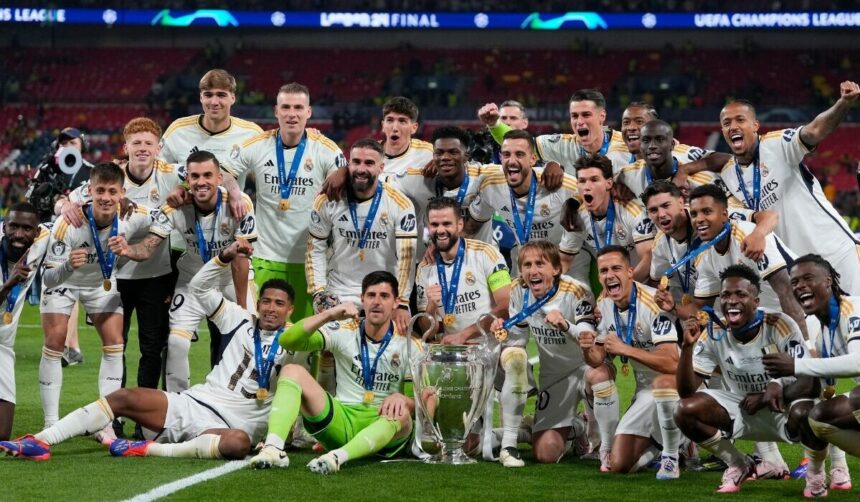
During the 2023–24 Champions League campaign, this balance was obvious. Madrid did not have the most dominant midfield on paper, nor the most feared attack in Europe. Yet players like Dani Carvajal, Nacho, Joselu, Camavinga, Valverde, and Rodrygo all delivered in different moments. None of them were carrying the team alone. Each of them carried responsibility when the situation demanded it.
Carvajal scored in a final. Joselu rescued a semi-final. Nacho organised defensive phases under pressure. Valverde covered spaces others could not. Camavinga shifted roles depending on the opponent. This is not star power. This is functional football intelligence.
Madrid’s coaches have always understood how to maximise this kind of squad. Instead of forcing players into fixed identities, they adjust responsibilities. A fullback can become a midfielder in one match. A winger can become a secondary striker in another. A midfielder can sit deeper when control is needed and push higher when momentum shifts.
This tactical adaptability allows Madrid to survive injuries, dips in form, and uneven performances. When one player struggles, the structure does not collapse. Someone else absorbs the responsibility. That is why Madrid can beat teams with higher market values, deeper benches, and more fashionable names. Those teams often depend on individuals. Madrid depend on structure.
Even when Madrid lack a clear standout performer in a match, they rarely lack usefulness. And in knockout football, usefulness matters more than reputation. This is the quiet advantage behind their Champions League success. They do not need eleven stars. They need eleven players who understand how to solve different types of problems. And that is exactly what their squad balance provides.
Champions League Peaking — Timing Is Everything
If you track Real Madrid across full seasons, one pattern keeps repeating. They do not always dominate LaLiga. They do not always look convincing in domestic matches. They drop points in games they should win. They sometimes look slow. Sometimes disconnected. Sometimes ordinary.
But when the Champions League knockout stages arrive, they look sharper. This is not coincidence. It is preparation.
Madrid understand that league titles are won through consistency, but Champions League titles are won through timing. You do not need to be perfect for eight months. You need to be ready for two. Their physical preparation, rotation, and tactical planning are built around this idea. They manage minutes. They accept certain domestic imperfections. They allow players to grow into form instead of forcing peaks too early.
By the time February, March, and April arrive, Madrid usually look like a different team. Their pressing becomes more selective. Their passing becomes calmer. Their defensive distances become tighter. Their transitions become more purposeful. Their decision-making improves.
This is why their European performances often look disconnected from their domestic form. A team that struggled against a mid-table Spanish side suddenly looks disciplined and ruthless against elite European opposition. And this is where other clubs often fail. Many teams exhaust themselves chasing league perfection. Madrid conserve themselves for continental survival.
Their players also mentally prepare differently. Champions League matches are treated as events, not just fixtures. The dressing room atmosphere changes. The concentration level rises. Mistakes that appear in league games disappear in Europe.
Over the last decade, no club has shown this pattern more consistently. Other teams peak early and fade. Madrid often build quietly and explode when elimination becomes real. That is why their Champions League runs often surprise people. They do not look dangerous in December. They look dangerous in April.
Timing, not dominance, is their advantage. And in a competition decided by moments, not averages, that timing has been worth more than any squad rating, possession statistic, or pre-tournament prediction.
The Bernabéu Factor — Home Pressure Translates Into Results
The Santiago Bernabéu does not intimidate teams because it is loud. Plenty of stadiums are loud. It intimidates teams because of what has happened there before. Every visiting player knows the history before stepping onto that pitch. They know how many teams have arrived confident and left confused. They know how many ties have turned inside that stadium when logic said they should not.
That awareness alone changes behaviour. You see it in how visiting teams start matches. Some play too cautiously. Some rush their decisions. Some defend deeper than usual. Some lose their normal rhythm. Even experienced players feel it, because they are not just playing against eleven men, they are playing against a story that refuses to stay quiet.
The Bernabéu crowd is not emotional noise. It is informed pressure. The fans react to moments, not just goals. A good tackle gets applause. A blocked shot lifts the volume. A misplaced opposition pass draws energy. The stadium communicates belief in real time, and Madrid players feed off it.
What makes this environment more powerful is expectation. Madrid fans do not hope for comebacks. They expect them. That expectation changes how players behave when the team is behind. Instead of seeing nervousness in the stands, players see patience. Instead of panic, they see belief. That belief gives players permission to stay calm.
Over the years, this has shaped countless Champions League nights. Teams that looked comfortable away from Madrid suddenly looked uncertain in Madrid. Teams that handled pressure in their own stadiums lost control of simple moments at the Bernabéu.
A misplaced clearance. A rushed pass. A defender stepping out at the wrong time. A goalkeeper hesitating. These are not tactical failures. They are psychological ones.
And Madrid know how to use that. They increase tempo when the crowd senses vulnerability. They slow the game when tension rises. They keep the ball longer in key moments. They force visiting teams to make decisions in front of forty thousand people who are already expecting mistakes.
That is why so many Madrid comebacks begin at home. Not because the stadium scores goals, but because it reshapes the emotional balance of the match. The Bernabéu does not win ties by itself. But it changes the conditions under which those ties are decided. And in Champions League football, conditions matter more than reputation.
What Coaches and Leadership Teach Us About Madrid’s UCL Edge
Real Madrid’s Champions League success has never belonged to one manager, one system, or one generation. What has remained constant is not a formation, but a principle: the competition demands adaptation, not ideology.
Zinedine Zidane understood this better than most. His Madrid side did not play the same way every week. Some matches required control. Some required patience. Some required directness. Some required survival. Zidane trusted his players to make decisions instead of forcing patterns onto them. He focused on managing moments rather than designing perfect sequences.
That is why his teams rarely looked spectacular across full matches but often looked unstoppable in decisive phases.
Carlo Ancelotti continued that tradition in a different way. He trusted experience. He trusted rhythm. He trusted that players who understood pressure would solve problems when tactics alone could not. His Madrid sides were rarely the most dominant in possession, but they were among the most efficient in key situations.
Then came Xabi Alonso’s influence, which added another layer. More tactical discipline. More structural clarity. More deliberate control of space. But the core principle remained the same: prepare the squad to win moments, not to impress charts.
Under Alonso, Madrid became even more comfortable shifting shapes during matches. A fullback could become a midfielder. A midfielder could drop into defence. A winger could become a second striker. These changes were not chaotic. They were rehearsed solutions to different match scenarios.
What connects all these coaches is not style, but understanding. They understood that the Champions League is not about being better for ninety minutes. It is about being better in five minutes that decide everything. They trusted players to read games. They trusted experience. They trusted emotional intelligence. They trusted decision-making more than diagrams. And that trust created players who were comfortable making choices under pressure.
Madrid coaches do not try to remove pressure from players. They teach players how to live inside it. That is the real coaching legacy at the club. Not trophies alone, but behaviour. Behaviour in moments when everything feels fragile. From Zidane’s calm authority to Alonso’s structured clarity, the message has remained consistent: you do not win the Champions League by dominating matches, you win it by managing moments. And Real Madrid, more than any other club, have turned that understanding into a tradition.
Why Being “Underdogs” Does Not Stop Madrid
Real Madrid have become very comfortable wearing the underdog label, mainly because they understand something many clubs still struggle with: being rated lower on paper does not decide Champions League ties. Knowing how to behave when the game becomes uncomfortable does.
Statistical models often underrate Madrid for simple reasons. Their domestic form is not always dominant. Their squads are not always the most expensive. Their possession numbers are not always overwhelming. Their pressing metrics are not always the highest. But the Champions League is not a league table. It is a sequence of moments that punish hesitation and reward clarity.
Madrid peak late because they are built to. They rotate early. They manage form. They accept inconsistency. They treat the season as a journey toward specific nights rather than as a constant performance exam. By the time knockout rounds arrive, they are not chasing rhythm, they are refining it.
They are also better at high-pressure situations because pressure does not surprise them. Many clubs only encounter true pressure in semi-finals or finals. Madrid encounter it every time they enter the competition. That repeated exposure changes how players respond emotionally. Instead of panic, there is familiarity. Instead of rush, there is calculation.
Psychological momentum also matters more than people admit. When Madrid progress from one difficult tie, they carry that confidence into the next. Not as arrogance, but as calm certainty. Players begin to trust that even imperfect performances can still produce results. That trust shapes decision-making.
Competitive intelligence is the real difference here. Madrid players know when to slow a game down after conceding. They know when to push for a goal and when to protect a narrow advantage. They know when to commit bodies forward and when to wait. These are not tactical instructions shouted from the bench. They are habits learned over seasons of European football.
That is why raw talent gaps often shrink when Madrid are involved. A faster winger matters less when space is closed correctly. A stronger striker matters less when service is delayed intelligently. A more creative midfielder matters less when passing lanes are blocked patiently.
In one-off or two-leg situations, Madrid’s understanding of game management regularly outweighs athletic superiority or technical depth.
So when Madrid are called underdogs, it does not weaken them. It often frees them. It allows them to play with patience instead of expectation. And in a competition built on thin margins, patience becomes power.
What Other Clubs Miss That Madrid Understand in the UCL Context
Many clubs approach the Champions League as an extension of their league identity. Madrid do not. They treat it as a separate discipline.
This is where the gap begins. Other teams focus heavily on possession dominance, pressing intensity, or attacking volume. Madrid focus on emotional control, spatial discipline, and moment management. They understand that a Champions League match can change in thirty seconds, and they prepare for those thirty seconds more than for the previous sixty minutes.
Psychological management is central to this. Madrid players are not taught to ignore pressure. They are taught how to exist inside it. They are taught that mistakes will happen and that the response matters more than the error. This prevents emotional collapse.
Tactical adaptability follows naturally. Madrid do not protect a system. They protect the match. If a shape is failing, they adjust it. If a player is struggling, they change responsibilities. If momentum shifts, they shift with it. The priority is never to look organised. It is to remain competitive.
Their preparation for knockout football is also different. They study opponents not only for weaknesses, but for emotional habits. Which teams panic when pressed. Which teams slow down after conceding. Which defenders hesitate in one-versus-one situations. Which midfielders avoid responsibility under pressure. These details matter more than formation diagrams.
And finally, Madrid understand that dominating possession does not equal dominating outcomes. They are comfortable winning with less of the ball. They are comfortable defending leads. They are comfortable waiting for mistakes instead of forcing brilliance.
Most clubs chase control. Madrid chase opportunity. This is why squads that do not look like favourites can still lift the trophy. Because the competition does not reward beauty, youth, depth, or budget. It rewards clarity in chaos.
Madrid do not try to remove chaos from Champions League football. They learn how to function inside it. That understanding, more than any transfer, more than any formation, more than any individual star, is why Real Madrid continue to win a competition that keeps defeating teams who look better prepared on paper.
Conclusion
Real Madrid do not keep winning the Champions League because they always have the best squad. Anyone who watches football properly knows that is not true. They keep winning because they understand the competition better than anyone else.
They understand that Europe is not about who plays better football for longer periods. It is about who stays mentally present when things stop making sense. It is about who can survive uncomfortable phases without losing control. It is about who knows when to wait, when to suffer, and when to strike.
Madrid arrive in most Champions League seasons with doubts around them. Sometimes about age. Sometimes about balance. Sometimes about depth. But they also arrive with something most teams do not have, a quiet confidence built from years of handling exactly these situations.
They do not rush matches. They do not chase perfection. They do not panic when plans fail. They accept that the Champions League will test them, and they prepare for that test instead of pretending it will not come. That is why their wins never feel random. They feel earned through patience, discipline, and understanding.
And maybe that is the simplest way to explain it. Real Madrid do not win the Champions League because they look like favourites. They win it because they behave like a team that knows what the Champions League actually demands. Everything else, the trophies, the comebacks, and the arguments, simply grows from that.