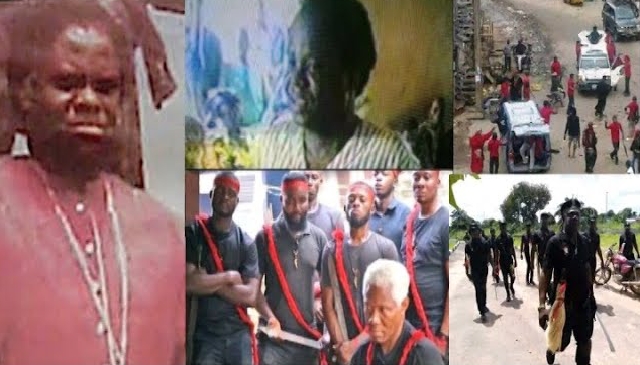
Nawgu town in Anambra State has always had stories, stories that move faster than cars on the expressway, stories that sit in the market, in compound walls, in the soft murmur of children chasing goats. And in the 1980s, one name started twisting through those stories, slipping into conversations that began with caution and ended in awe. Eddy Nawgu. Some called him a prophet, others whispered deity, some just shook their heads and crossed the street when he walked by.
He carried himself like he belonged everywhere, from church gatherings to village meetings, and yet people said he carried a darkness with him, a weight they could feel in the air when he passed. Some nights mothers whispered prayers when his shadow touched their thresholds. And by the late 1980s, Nawgu was no longer just a man, he was a symbol, a riddle, a warning and a marvel all at once.
The Prophet Who Walked Church Aisles
Eddy Nawgu did not fit neatly into one box. He called himself a prophet, he held church-like meetings, and sometimes he preached from pulpits that smelled of incense and polished wood. He spoke with conviction, quoting scripture, waving hands like he could lift the world from its troubles. People came, some believing, some curious, some wanting to see the man behind the whispers.
And yet, the other side of him, the side that made elders tighten their lips and shake heads, was cloaked in accusations. People said he practiced occult arts, that he could curse, bless, or see the invisible. Stories grew with each retelling, passing through compounds, spilling into markets, crossing the river and back, each version slightly darker, slightly more terrifying. By the 1990s, the legend of Eddy Nawgu was as alive as any living person in Nawgu, and fear and fascination walked hand in hand.
Community Tensions and Vigilante Eyes
By the late 1990s, Nawgu could no longer move without the weight of suspicion following him. People had begun to organize, not in newspapers or letters, but in the streets and alleys, deciding that if the law would not act, they would act. Enter the Bakassi Boys, a vigilante group that had risen across southeastern Nigeria, feared and respected for their swift justice and brutal methods.
They were known for targeting kidnappers, thieves, and anyone suspected of wielding occult influence against the community. Eddy Nawgu fell under their gaze, a man both revered and feared, and the tension that had long simmered finally boiled. Some say the villagers brought complaints, others say the Bakassi Boys acted on their own, following the instincts and unspoken rules of a society that feared unseen powers more than the state.
And so the stage was set, the whispers became plans, and what followed would etch Nawgu into memory for generations.
The Capture and Vigilante End That Shook the Town
By the late 1990s, tensions around Eddy Nawgu had reached a breaking point. People in Nawgu whispered constantly about his alleged powers, some fearing him, some believing he was a prophet, and some quietly praying they would never cross him. The Bakassi Boys, a vigilante group that had risen across southeastern Nigeria, came into the picture. They were known for targeting kidnappers, thieves, and suspected occultists, operating outside formal law enforcement, carrying out swift and often violent community justice.
In 1999, Eddy Nawgu was captured by the Bakassi Boys. Reports say he was publicly executed, accused of occultism, sorcery, and endangering the community through his alleged mystical practices. Some witnesses recall that he was paraded before a crowd, questioned about his actions, and then killed in front of the public, a method meant to serve as both punishment and a warning to others. The death was violent, brutal, and immediate, reflecting the fear and anger that had built up over years.
His death became emblematic of vigilante justice in southeastern Nigeria, showing the extremes a community could take when they believed formal law had failed. It was both a spectacle and a cautionary tale, a violent resolution to a conflict that had grown out of fear, faith, and human unpredictability.
Why the Story Still Echoes
The story of Eddy Nawgu echoes because it lives in the cracks between myth and memory. People still speak of him as if he exists in the spaces between the visible and invisible, the sacred and the feared. Stories of his supernatural abilities float in the air, some believed, some exaggerated, some whispered in warning.
It also echoes because the Bakassi Boys, for better or worse, symbolized the power of community enforcement in the absence of strong policing. Vigilante justice became both a tool and a question, a mirror of society’s fear, frustration, and need for control.
Finally, the story resonates because it is about contradictions. A man who walked into churches, preached to crowds, and yet was accused of dark arts. A community that loved, feared, and punished him in equal measure. The narrative challenges people to think about faith, power, morality, and what it means to wield influence, whether spiritual, social, or legal.
Human Lessons Behind the Legend
Eddy Nawgu’s story is a warning, a lesson, and a reflection. It teaches that power, when unchecked, can create both reverence and fear. That communities will act when they feel law and order fail them. That human beings, driven by memory, belief, and emotion, create legends that last longer than any life.
For the Bakassi Boys, it was a demonstration of control, of their interpretation of justice. For the people of Nawgu, it was the end of fear, or perhaps the transfer of fear to a memory. For Nigeria, it is a case study of belief, power, law, and vigilante action colliding in ways that leave echoes decades later.
The human cost is in the fear, in the whispers, in the silence that follows a violent act. And yet, it is also in the stories that survive, in the cautionary tales parents tell children, in the debates in streets, offices, and living rooms across the southeast.
Closing Thoughts
Eddy Nawgu was more than a man, he was a symbol, a paradox, a reflection of human fear and faith. Calling him a deity captures the aura he held in the minds of those around him, and saying he went to church shows the contradictions that made him unforgettable.
His vigilante end reminds us that law, culture, and belief do not always align, and that communities will act in the spaces where formal structures fail. The story is violent, unsettling, but it is instructive. It teaches about faith, morality, the limits of power, and the unpredictable ways human societies enforce justice.
Even decades later, the memory lingers. The streets whisper, elders tell the story, and the lesson remains: influence carries responsibility, fear carries power, and legends, whether real or imagined, shape communities long after the person is gone.
Eddy Nawgu is dead, but the echoes remain, and they will continue to teach, warn, and fascinate as long as the story is told.