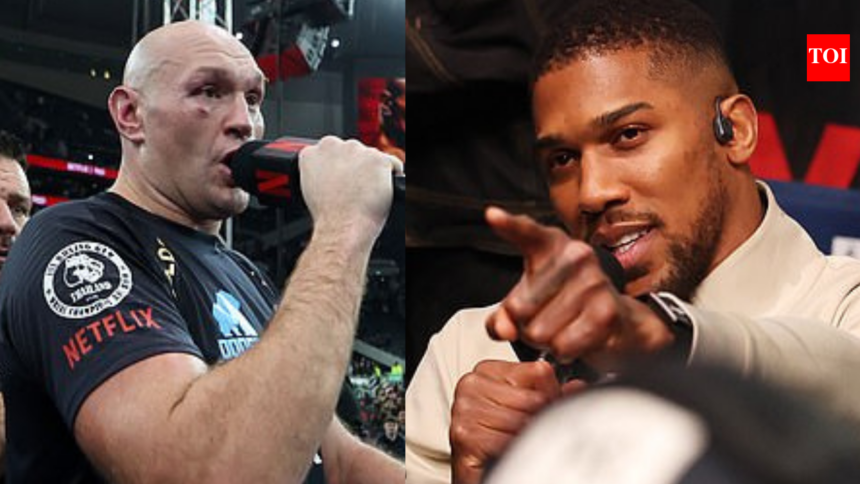
The heavyweight boxing world was pulled back into global attention following a highly publicized post fight moment involving Tyson Fury and Anthony Joshua after Fury’s recent ring appearance on April 11 2026 in London. What unfolded was not another fight inside the ropes but a charged ringside confrontation that reignited one of boxing’s most anticipated rivalries. The moment, broadcast during a major Netflix televised boxing event at Tottenham Hotspur Stadium, immediately shifted attention away from the fight result itself and toward a verbal exchange that carried the weight of years of unfinished business between both fighters.
While Fury had just secured a unanimous decision victory over Arslanbek Makhmudov, the spotlight quickly moved toward Joshua sitting ringside, setting the stage for a public callout that would dominate sports conversation across multiple platforms.
This article breaks down the sequence of events, the reactions, the underlying negotiations, and what this moment realistically means for the future of heavyweight boxing.
Event Setting: April 11 2026 Fight Night
The boxing event held on April 11 2026 at Tottenham Hotspur Stadium in London was structured as a high profile heavyweight showcase designed for global streaming audiences, with Netflix carrying broadcast rights. Tyson Fury entered the ring in a fight against Arslanbek Makhmudov, a bout that had been promoted as a test of dominance and ring control rather than a title fight. From the opening rounds, Fury maintained composure, using reach control, defensive movement, and measured combinations to establish dominance across the scorecards. By the final bell, the judges returned a unanimous decision in favor of Fury, confirming a clear win without controversy or disputed scoring.
The atmosphere inside the stadium shifted immediately after the result was announced. While traditional post fight celebrations were expected, attention quickly transitioned toward the ringside area where Anthony Joshua was seated among high profile guests. The presence of both fighters in the same venue created a natural narrative tension, as media coverage had long speculated about whether a public interaction might occur. This anticipation set the foundation for what would become one of the most talked about boxing moments of the year.
Ringside Callout From Tyson Fury
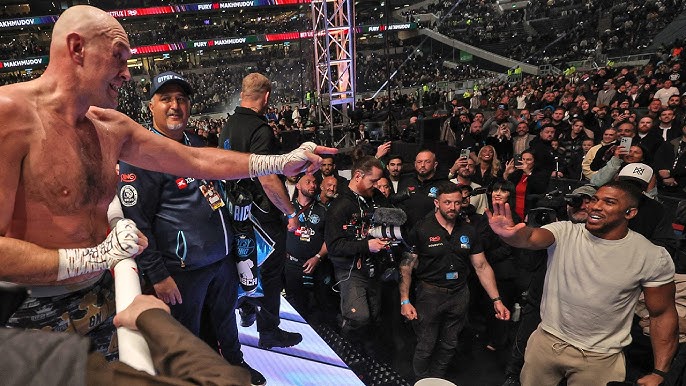
Immediately after his victory was confirmed, Tyson Fury moved toward the ringside area and requested a microphone from event officials. What followed was an unscripted verbal challenge directed at Anthony Joshua, delivered in front of a live audience and millions of global viewers. Fury’s message focused on demanding a long awaited heavyweight clash often referred to in boxing circles as a Battle of Britain. He emphasized readiness, claimed willingness to proceed without delay, and urged Joshua to publicly accept the challenge rather than remain on the sidelines.
The tone of Fury’s callout carried emotional intensity combined with competitive assertion, reflecting years of rivalry built through interviews, negotiations, and stalled fight talks. His positioning suggested urgency, as though the opportunity for the fight had reached a decisive moment. The crowd reaction amplified the moment, turning what could have been a routine post fight segment into a headline defining confrontation. This escalation transformed the event from a single fight night into a broader narrative about unfinished business in heavyweight boxing.

Anthony Joshua’s Ringside Response
Anthony Joshua, seated ringside during Fury’s callout, remained composed and did not enter the ring or engage in immediate verbal confrontation. His physical restraint became one of the defining elements of the moment, as cameras focused heavily on his reactions while Fury addressed the crowd. Rather than responding impulsively, Joshua maintained a controlled posture, signaling that he was not willing to convert the moment into a spontaneous public agreement.
Reports from ringside commentary indicated that Joshua’s stance emphasized the importance of formal negotiation processes rather than public pressure situations. His position suggested that major boxing decisions require structured agreements involving promoters, timing, and contractual clarity. While he did not reject the fight opportunity, he also did not accept Fury’s challenge in that immediate setting. This measured response added complexity to the narrative, as it contrasted sharply with Fury’s direct and emotional callout style.
The contrast between both fighters created a visual and psychological tension that quickly spread across digital platforms. Observers interpreted Joshua’s restraint in multiple ways, with some viewing it as strategic discipline and others interpreting it as reluctance to engage under public pressure. This divergence of interpretation contributed significantly to the viral nature of the exchange.
Negotiation Landscape After Viral Moment
Following the April 11 2026 event, attention shifted toward the business and promotional side of boxing, where discussions surrounding a potential Fury versus Joshua fight began to intensify. Industry reports and insider commentary suggested that preliminary negotiations had already been circulating before the fight night, but the viral ringside confrontation added new urgency to those discussions. Promoters reportedly began exploring logistical frameworks for a possible matchup targeting late 2026 or early 2027.
The negotiation process involves multiple layers including purse distribution, venue selection, broadcasting rights, and training timelines. Both fighters represent major commercial value in global boxing, meaning any agreement requires alignment between several promotional entities. While some reports indicated that terms might already be partially agreed in principle, no official signed contract had been publicly confirmed as of April 2026.
The post fight momentum, however, significantly increased pressure on stakeholders to finalize discussions. Public demand for the fight surged immediately after the event, reflecting long standing anticipation that has followed both fighters for more than a decade.
Historical Rivalry Development Between Both Fighters
The rivalry between Tyson Fury and Anthony Joshua has evolved over years of parallel career progression within the heavyweight division. Both fighters rose to prominence during the same era, each capturing world titles and dominating different phases of heavyweight boxing. Their careers have often been compared, with discussions frequently centered around the question of superiority within British boxing history.
Multiple attempts to organize a fight between them have previously been discussed in public media, although many negotiations reportedly collapsed due to timing conflicts, contractual disagreements, and shifting championship priorities. This history has contributed to the perception that the matchup represents unfinished business rather than a newly created rivalry. The continued inability to finalize the fight over the years has only intensified public interest each time new developments emerge.
The April 11, 2026 ringside confrontation therefore carried emotional weight beyond a simple callout. It symbolized years of speculation, negotiations, and near agreements that never reached execution. This context is essential to understanding why the moment escalated so quickly in global sports discourse.
Media Amplification Across Platforms
Following the event, social media platforms and sports media outlets rapidly circulated clips of the ringside exchange. The combination of Fury’s verbal challenge and Joshua’s silent composure created a visually compelling contrast that drove engagement across digital audiences. Short form video clips, commentary threads, and analytical breakdowns contributed to sustained visibility of the moment over several days.
Media interpretation varied widely depending on perspective. Some analysts emphasized Fury’s aggressive attempt to force a public agreement, while others focused on Joshua’s refusal to be drawn into immediate negotiation theatrics. This dual interpretation reinforced the narrative complexity of the moment, allowing both fighters to maintain strong public positioning without immediate resolution.
The involvement of Netflix as the broadcast platform also expanded global reach, ensuring that the moment was not limited to traditional boxing audiences but extended to mainstream entertainment viewers. This contributed to the viral scale of the confrontation and elevated its significance beyond sport alone.
Strategic Implications for Both Fighters
From a strategic standpoint, the exchange created advantages and challenges for both athletes. Tyson Fury positioned himself as the fighter actively seeking the biggest available challenge, reinforcing his public image as a competitor willing to engage without delay. This positioning strengthens his marketability and reinforces demand for his next major fight.
Anthony Joshua, meanwhile, maintained a controlled approach that preserved negotiation leverage. By avoiding immediate public commitment, he retained flexibility in contractual discussions and prevented potential pressure based decision making. This approach aligns with modern boxing management strategies where long term career planning often outweighs immediate public expectations.
Both positions reflect different philosophies within professional boxing promotion, one driven by public confrontation and the other by structured negotiation control.
Public Expectation Landscape Moving Forward
Public anticipation for a Fury versus Joshua fight continues to grow following the April 11 2026 moment. Fans, analysts, and promoters recognize the commercial and sporting magnitude of such a matchup, which is widely regarded as one of the biggest possible events in heavyweight boxing. Estimates of global revenue potential place the fight among the most lucrative in boxing history.
Despite this demand, the finalization of the bout depends on alignment between multiple parties, meaning public excitement does not automatically translate into immediate agreement. The balance between expectation and negotiation reality remains central to understanding why the fight has not yet been officially confirmed.
Final Takeaway
The ringside exchange following Tyson Fury’s victory over Arslanbek Makhmudov on April 11 2026 represents a pivotal moment in modern heavyweight boxing narrative rather than a finalized sporting agreement. Fury’s direct callout of Anthony Joshua created global attention, while Joshua’s composed response maintained procedural distance from public negotiation pressure. The moment intensified ongoing discussions about a potential megafight, pushing it closer to realization while still leaving key contractual and promotional details unresolved.
As of April 2026, the heavyweight division stands at a critical intersection where public demand, promotional negotiation, and fighter strategy continue to shape what may become one of the defining boxing events of the decade.