In a football economy shaped by transfer windows, short contracts, and constant squad turnover, long-term loyalty has become the exception rather than the rule. Players move earlier, clubs rebuild more frequently, and careers are increasingly guided by market opportunity as much as sporting fit. Against that backdrop, those who spend most or all of their careers at one club stand out not simply for longevity, but for what their decisions reveal about development pathways, competitive stability, and how modern teams are constructed.
- What Loyalty Means in Modern Football
- Paolo Maldini at AC Milan (1984 to 2009)
- 1. Ryan Giggs at Manchester United (1990 to 2014)
- 2. Francesco Totti at AS Roma (1993 to 2017)
- 3. Carles Puyol at Barcelona (1999 to 2014)
- 4. Igor Akinfeev at CSKA Moscow (2003 to present)
- 5. Jamie Vardy at Leicester City (2012 to 2025)
- 6. Mark Noble at West Ham United (2004 to 2022)
- 7. Thomas Müller at Bayern Munich (2008 to 2025)
- 8. Rogério Ceni at São Paulo (1990 to 2015)
- 9. Gary Neville at Manchester United (1992 to 2011)
- 10. Patterns Across the Most Loyal Footballers
- Conclusion
Loyalty in football is rarely accidental. It tends to emerge where youth systems are strong, where players are given clear roles over time, and where clubs create environments that reward continuity as much as short-term success. In some cases, it is shaped by local identity and academy progression. In others, it comes from repeated choices to stay put during peak years, when transfers to bigger leagues or wealthier teams were realistic options. These decisions carry real consequences. They influence dressing room leadership, tactical consistency, fan connection, and even recruitment strategy, especially when a club builds around players who become long-term reference points.
Looking closely at the most loyal footballers offers insight into how sustained commitment affects careers and club trajectories. It highlights the conditions that allow players to grow within one system, adapt across different managers and tactical eras, and remain relevant as squads evolve around them. It also shows how rare this model has become, and why certain figures are remembered not only for trophies or appearances, but for representing continuity in a sport increasingly defined by movement.
What Loyalty Means in Modern Football
Loyalty in the context of modern football is a concept that extends far beyond simply spending a long time at one club. It encompasses emotional attachment, repeated choices to resist major transfer opportunities, and a sustained identification with club identity and culture. In an era driven by high transfer fees, agent influence, and globalization, players who remain with one team through different phases of their careers stand out precisely because such commitment has become rarer.
One common thread among the players discussed is their development within the same club system. Many were products of their clubs’ youth academies, which fostered not just technical skills but a sense of belonging and loyalty that persisted once they reached the first team. This pathway reinforces the connection between player and club, motivating continued service even when external opportunities arise. The cases of Paolo Maldini, Ryan Giggs and other academy graduates illustrate how long term identification with a club’s culture can shape career decisions.
Another important dimension of modern loyalty is resisting big money moves at peak moments. Players such as Jamie Vardy or Mark Noble made choices to stay even when offers from bigger clubs might have increased their profile or financial reward. These decisions resonate with fans because they represent a form of loyalty not tied solely to history or upbringing but to personal principle and belief in the club’s trajectory and values.
The shift in football economics over the past few decades has made loyalty rarer, but not absent. Clubs increasingly rely on recruitment strategies that value immediate impact and marketability, often at the expense of continuity. Against this backdrop, the players illustrated here are instructive because they demonstrate that loyalty can still occur even when the broader environment pushes toward mobility.
Understanding what loyalty means in this context helps explain why supporters celebrate one-club men not just for longevity, but for what it says about identity, connection and mutual commitment between a player and a community.
10 Most Loyal Footballers Ever
In modern football, loyalty has become a complicated idea. The game is now driven by short contracts, aggressive agent negotiations, and transfer windows that treat players as movable assets rather than long term pillars. Clubs rebuild more frequently, managers change systems every few seasons, and careers are increasingly shaped by opportunity rather than attachment. Against that background, players who stay put for a decade or more stand out sharply.
But loyalty in football is not only about spending an entire career at one club. It also shows up in repeated decisions to remain when bigger contracts or higher profile moves were available, in choosing continuity over novelty, and in building identity around a single badge rather than chasing success elsewhere. Some players became symbols of their clubs. Others turned down moves at their peak. A few did both.
What makes these cases particularly striking is that most of these players stayed during periods of transition as well as success. They lived through managerial changes, tactical overhauls, and generational squad shifts, yet remained central figures. Their loyalty was not passive. It involved adapting to new roles, accepting competition from younger teammates, and carrying responsibility across different eras.
The following profiles focus on players whose careers were defined by this kind of commitment. Not simply long service, but sustained identification with one club even when circumstances made leaving an obvious option.
-
Paolo Maldini at AC Milan (1984 to 2009)

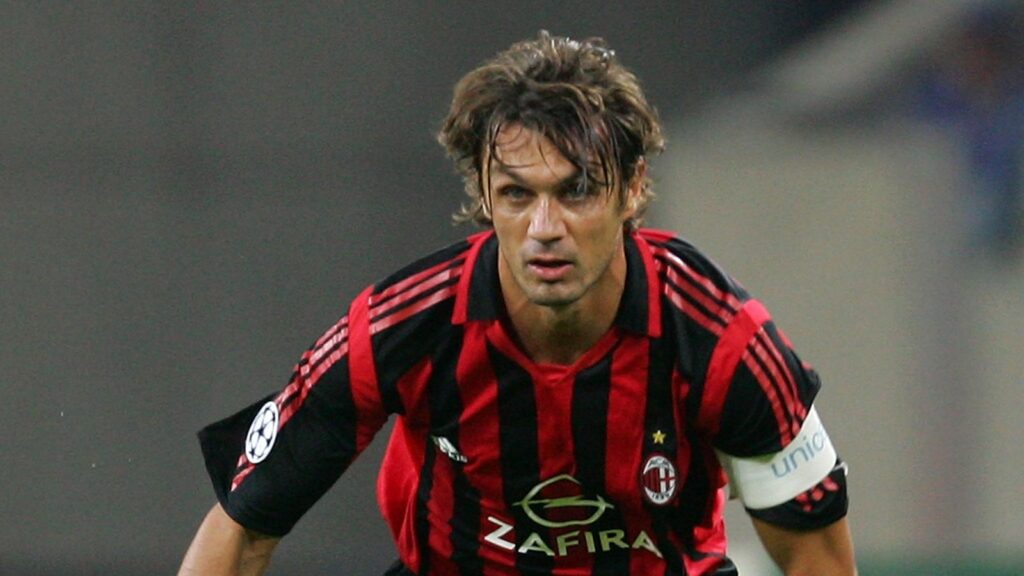
Paolo Maldini represents one of the clearest examples of lifelong loyalty in elite football. He joined AC Milan as a youth player and went on to spend twenty five seasons with the club, making more than nine hundred appearances across all competitions. His career covered multiple tactical eras, from the defensive discipline of Arrigo Sacchi’s Milan to the more fluid systems that followed under Fabio Capello and later managers.
Maldini made his senior debut at just sixteen, but it was the longevity of his excellence that defined him. Over two decades, he remained a constant presence in one of Europe’s most competitive environments. Milan went through cycles of dominance and rebuilding, yet Maldini continued to adapt. He began his career as a left back known for athleticism and recovery speed, then gradually transitioned into a central defensive role as experience and positional understanding became his primary strengths.
His honours reflect both individual consistency and collective success. Maldini won seven Serie A titles and five European Cups, achievements that span almost his entire playing life. What makes this remarkable is not only the volume of trophies, but the fact that they were earned across different generations of teammates. From Franco Baresi to Alessandro Nesta, from Marco van Basten to Andriy Shevchenko, Maldini bridged eras without losing relevance.
There were opportunities to leave. Maldini was admired across Europe, particularly during Milan’s dominant years in the late 1980s and early 1990s. Yet he chose to remain in Italy, tied not only to the club but also to family history. His father Cesare Maldini had also played for Milan, reinforcing a sense of continuity that went beyond professional ambition.
Loyalty for Maldini was expressed through leadership as much as longevity. He captained Milan during some of their most successful periods and later through rebuilding phases when trophies were less frequent. Even as his physical pace declined, he remained tactically indispensable, relying on anticipation and positioning rather than athletic recovery.
By the time he retired in 2009, Maldini had become inseparable from Milan’s identity. His career illustrates how loyalty can be sustained at the very highest level, not by resisting change, but by evolving within it. Few players have managed to remain elite for so long at a single club while carrying both historical weight and modern responsibility.
1. Ryan Giggs at Manchester United (1990 to 2014)

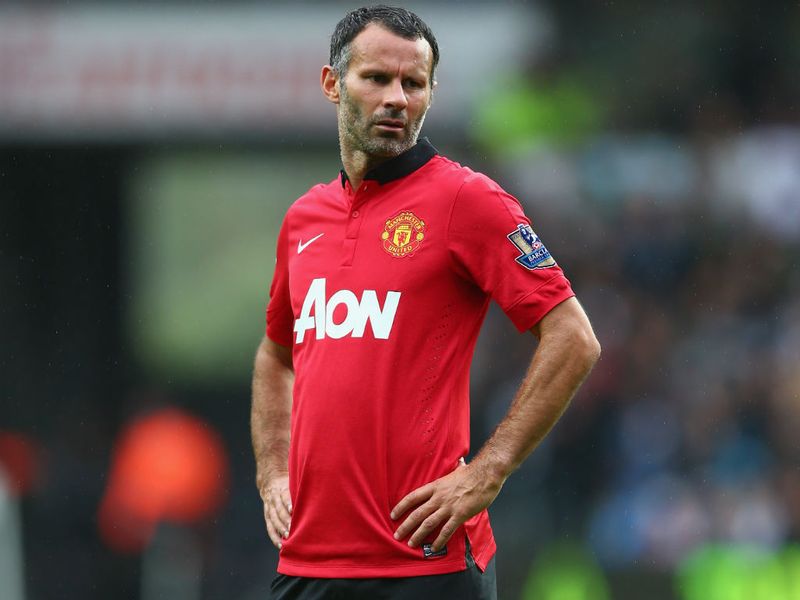
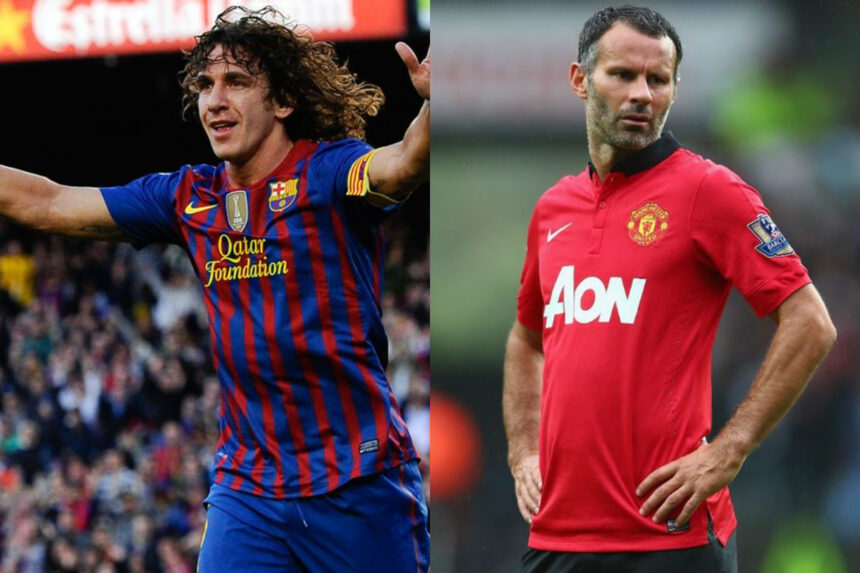
Ryan Giggs spent his entire professional playing career at Manchester United, a period that lasted twenty four years and produced one of the most decorated individual records in English football. He made 963 appearances for the club, a figure that reflects not only longevity but constant selection across multiple generations of teams.
Giggs emerged from United’s youth system at the start of the Premier League era and quickly established himself as a dynamic left winger. In his early years, his game was built on acceleration, direct running, and the ability to destabilise defences from wide areas. As he moved into his thirties, that role evolved. He became a central midfielder, contributing through passing, spatial awareness, and tempo control rather than pace.
What makes Giggs’ loyalty notable is the sheer scale of change he lived through. He played under Sir Alex Ferguson for his entire career, but the squads around him were repeatedly rebuilt. From the Class of 92 to later generations featuring Cristiano Ronaldo, Wayne Rooney, and Robin van Persie, Giggs adapted to shifting tactical demands while remaining relevant.
During this period, Manchester United won thirteen Premier League titles, two Champions Leagues, and numerous domestic cups. Giggs was present for nearly all of it. Yet there were moments when he could have left. In his prime, several European clubs expressed interest, particularly during the mid to late 1990s when he was regarded as one of the best wide players in the world. He chose instead to remain at Old Trafford, committing to a club that offered stability and long term vision.
His loyalty was reinforced by versatility and professionalism. Rather than insisting on a fixed role, Giggs reshaped his game as his physical attributes changed. This allowed him to extend his career deep into his forties and remain a functional part of the squad rather than a ceremonial presence.
Giggs also embodied continuity within the dressing room. Younger players often referenced his standards in training and preparation, and managers relied on him as a bridge between generations. His later transition into coaching and interim management further cemented his identity as a United figure rather than simply a former player.
Giggs’ career demonstrates that loyalty does not require stagnation. It can involve constant reinvention within a familiar environment. By staying at Manchester United through both dominant periods and transitional phases, he became part of the club’s institutional memory, helping preserve its culture while adapting to modern demands.
2. Francesco Totti at AS Roma (1993 to 2017)
Francesco Totti’s career offers one of the most striking examples of loyalty and longevity in modern football. Born and raised in Rome, Totti joined AS Roma’s youth setup before signing his first professional contract with the club in 1993. From that moment, he remained exclusively with Roma for 25 seasons, refusing moves abroad even when some of Europe’s elite clubs reportedly expressed interest in his services.
Over the course of his career, Totti became a fixture in Roma’s attack, operating as a creative midfielder, second striker, and outright forward as tactics evolved. He amassed 786 senior appearances for the club, scoring 307 goals, making him one of the most prolific attackers in Serie A history. His contributions were not only in statistics but also in how he embodied the club’s identity for generations of fans.
Totti’s loyalty was shaped by his deep connection to the city of Rome and its supporters. Unlike players who may use a hometown club as a stepping stone, he remained committed even at peak moments when a move could have brought greater financial reward or more trophies. His only major league title came in the 2000–01 Serie A season, a triumph that cemented his status as a symbol of Roma’s best achievements in the modern era.
Injuries and the natural progression of age meant that Totti’s role in the final years of his career changed, yet he stayed with Roma longer than many professionals manage at any club. His retirement in 2017 marked the end of a rare career defined by continuous service to the same team, and his later brief role as a club director further underscored his lifelong association with Roma.
3. Carles Puyol at Barcelona (1999 to 2014)

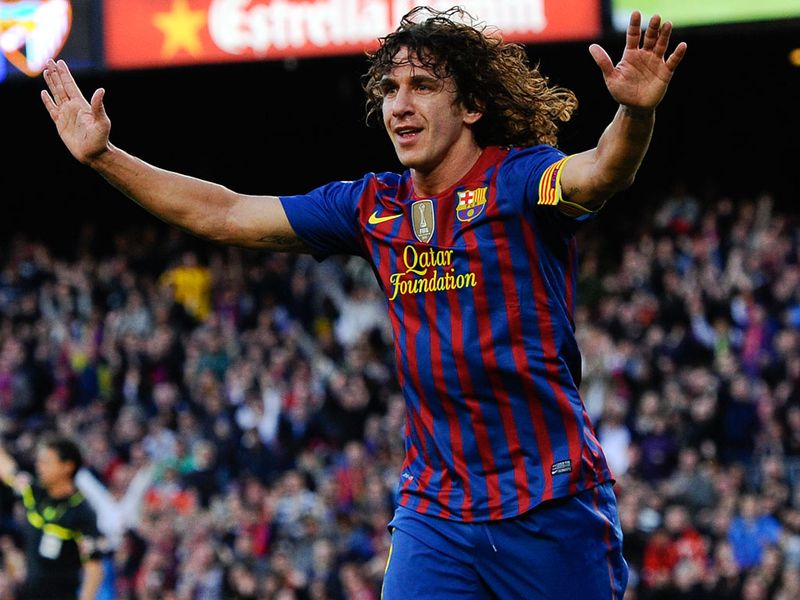
Carles Puyol is another example of exceptional loyalty in an era when top defenders are often subject to transfer speculation and big money moves. Puyol rose through Barcelona’s famous La Masia academy and went on to spend his entire professional career at Barcelona, making 392 league appearances from 1999 to 2014 and totaling close to 600 senior matches.
Puyol’s loyalty was most visible in his consistent presence at the heart of Barcelona’s defence during one of the club’s most successful periods. Under managers such as Frank Rijkaard and Pep Guardiola, Barcelona developed a style of play that relied on possession, intelligence, and leadership from the back. As captain, Puyol embodied those values, providing stability during multiple tactical changes and leading the team to numerous La Liga titles and three Champions League trophies throughout his career.
His decision to stay at Barcelona was not simply a matter of a long contract. Puyol was reportedly nearly sold early in his career, but he refused the move, choosing instead to stay and fight for his place as part of the club’s long-term project. This kind of commitment from a central defender at one of the world’s wealthiest clubs highlighted loyalty in both competitive and cultural terms, and his career remains a reference point for defenders who value continuity over frequent moves.
Puyol retired in 2014, his career ended by injuries that limited his ability to continue at the top level. Rather than seeking moves elsewhere, he transitioned directly into roles that kept him connected with the sport and with Barcelona’s identity, further reinforcing how his loyalty extended beyond mere playing years.
4. Igor Akinfeev at CSKA Moscow (2003 to present)
In a game increasingly dominated by high-profile transfers, Igor Akinfeev stands out for his steadfast commitment to CSKA Moscow. Akinfeev joined CSKA Moscow’s youth system in the early 1990s and made his senior debut in 2003 at just 17 years old. Since then, he has remained with the club, spending his entire professional career in Moscow and becoming a fixture in Russian football.
Akinfeev’s career longevity is rare not only because of the duration but also because of his sustained role as a first team regular. By late 2025, he had made more than 610 top-flight appearances for CSKA Moscow, a record for the club, and had been involved in over 800 official matches across competitions.
His honours with CSKA include multiple Russian Premier League titles, Russian Cup victories, and a UEFA Cup in 2005, the latter remaining one of CSKA’s most significant achievements on the European stage. These trophies were won with Akinfeev as an integral member of the team, and he has served as captain, further emphasising his leadership role at the club.
Throughout his career, Akinfeev has resisted moves abroad despite interest and maintained his place as the long-term anchor of CSKA’s defence. His loyalty is notable not just in the numbers, but in how he has helped sustain competitive continuity over two decades, providing stability through managerial changes and squad evolution.
5. Jamie Vardy at Leicester City (2012 to 2025)
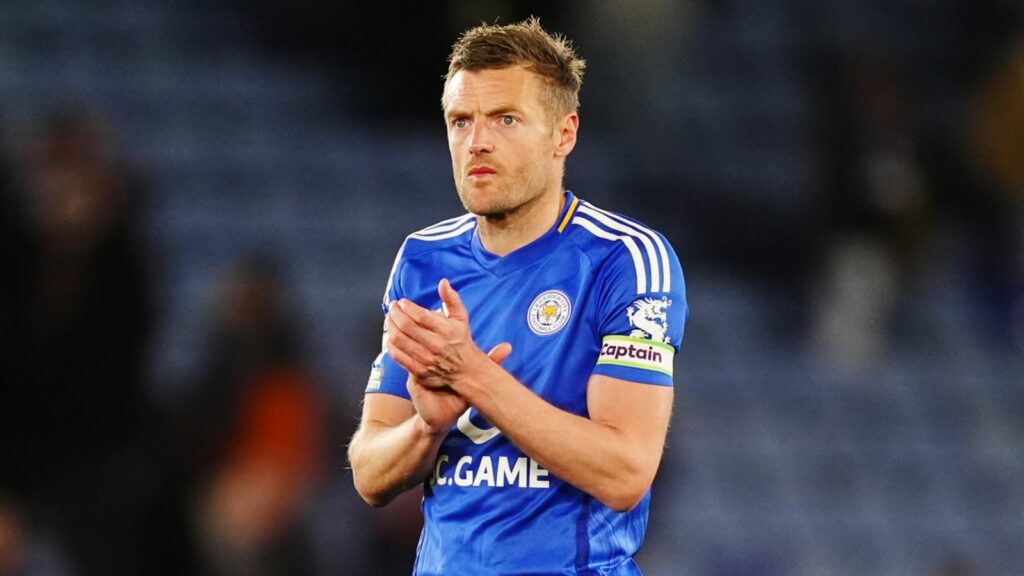
Jamie Vardy’s career at Leicester City stands out as a rare example in the modern game of loyalty through choice rather than circumstance. Vardy’s rise to prominence was already unconventional. He played non-league football well into his twenties, featuring for clubs like Stocksbridge Park Steels and Halifax Town before Leicester City signed him in May, 2012. Over the next decade plus, he helped transform the club’s fortunes, playing a central role in one of the most remarkable title wins in Premier League history.
After Leicester completed their unlikely 2015-16 Premier League triumph, Vardy’s value in the transfer market skyrocketed. Arsenal, then one of the established “big six” clubs in England, triggered his release clause in the summer of 2016. The Gunners had just finished second in the Premier League and hoped Vardy would bolster their attack, but he chose not to take the move. Vardy later explained that the decision to stay was straightforward for him, citing the collective spirit at Leicester and his own belief that the club was moving in the right direction. He said that committing his long-term future to Leicester was an “easy decision,” reflecting not just personal comfort but a conviction that the club’s progress was still unfolding.
Rather than simply signing a new contract for monetary reasons, Vardy’s choice was rooted in identity and unfinished ambition. He had been a late bloomer whose career trajectory had already defied the conventional academy route. Staying at Leicester gave him the platform to play regular first-team football and to shape the club’s narrative rather than entering a crowded attacking lineup elsewhere. This decision also carried a message to teammates and supporters about continuity after the high of winning the league, and it temporarily helped convince others that Leicester could maintain stability in the post-title period.
Vardy’s loyalty was reflected in his longevity. Over thirteen seasons, he scored nearly 200 goals for Leicester and became an iconic figure in the club’s history, known for his goalscoring exploits as well as his role in Leicester’s FA Cup win and multiple promotions. His refusal to depart at a time when bigger clubs were knocking at his door encapsulated a form of loyalty that does not simply mean staying for convenience, but choosing continuity even in the face of lucrative and high-profile opportunities.
6. Mark Noble at West Ham United (2004 to 2022)
Mark Noble’s career at West Ham United represents a more traditional form of loyalty, defined by near-continuous service and deep personal connection to the club. Noble joined West Ham’s youth ranks and progressed into the first team, where he played for nearly two decades, amassing over 470 league appearances and more than 550 in all competitions before retiring in 2022.
Nicknamed “Mr West Ham” by fans and commentators alike, Noble became synonymous with the club’s identity. As a central midfielder and captain for many years, he was valued not just for his technical contributions but for his leadership, consistency, and embodiment of the club’s ethos. Throughout his career he remained committed even as West Ham endured promotions, relegations, and managerial changes, choosing continuity over uncertainty.
Despite interest in his services from other clubs at various points in his career, Noble remained at West Ham, preferring to contribute where he had deep roots rather than seek new challenges elsewhere. His relationship with supporters extended beyond the pitch; he was often seen as a representative of the club’s heritage and its connection with the local community.
Even after retiring from playing, Noble’s loyalty to West Ham continued. He returned to the club in a sporting director role in 2023, further tying his professional identity to his boyhood team. His career is a reminder that loyalty encompasses not just long service on the field, but a sustained association that bridges playing days and post-playing roles within a single club.
7. Thomas Müller at Bayern Munich (2008 to 2025)


Thomas Müller is a rare example in modern football: a player who stayed with one top club for almost his entire career in an era when stars move constantly. He joined Bayern Munich’s youth academy at just ten years old and broke into the first team in the 2009–10 season. From there, he became a fixture in one of the most successful periods in the club’s history.
What makes Müller’s story stand out isn’t just Bayern’s ability to keep their best players, it’s that he chose to stay, even when moves to other leagues or clubs could have raised his personal profile. Over the years, he helped Bayern win thirteen Bundesliga titles, multiple domestic cups, and Champions League trophies. His ability to adapt, whether as a forward, playmaker, or tactical utility player, kept him important under different coaches and systems.
Across nearly two decades at senior level, Müller grew into Bayern’s all-time appearance leader and made major contributions in both goals and assists. His loyalty was less about nostalgia and more about fit: he remained where he could compete for trophies every season and feel fully at home.
That remarkable chapter ended in August 2025, when Müller joined Whitecaps FC, closing a 25-year journey with Bayern Munich. His career shows that commitment and success don’t have to be opposites, sometimes, staying put can be the key to lasting impact.
8. Rogério Ceni at São Paulo (1990 to 2015)
Rogério Ceni’s career at São Paulo stands as one of the most remarkable records of loyalty in world football, not only for its duration but also for the unique role he played and the impact he had on his club’s identity. Ceni joined São Paulo’s youth setup as a teenager and remained with the senior team from 1990 until his retirement in 2015, a continuous span of 25 years in the same first team, an extraordinary commitment in an era where even long-serving players often move between clubs at least once.
His loyalty is made even more striking by the context of his position and performance. Ceni was a goalkeeper, and his case highlights that loyalty is not confined to outfield players, but can involve figures whose contributions go beyond conventional expectations for their role. Across more than 1,200 appearances for São Paulo, Ceni became the club’s all-time leader not only in matches played but also in goals scored, a rare feat for a keeper. Unlike typical goalkeepers, Ceni was a regular set piece taker, scoring from free kicks and penalties with remarkable precision. Over his career he scored over 130 goals, the vast majority of which came from dead ball situations, making him the highest scoring professional goalkeeper in football history.
Ceni’s influence extended far beyond his unusual scoring record. He was a steadying presence in goal through multiple tactical eras at São Paulo, featuring prominently in the team’s domestic and continental success during the 1990s and 2000s. He helped São Paulo win numerous Campeonato Brasileiro titles and Copa Libertadores trophies, anchoring defenses that often included future national team players, and serving as a leader in the dressing room. His confidence with the ball at his feet also allowed São Paulo to build play from the back at times when such skills were less common among goalkeepers, prefiguring more modern expectations for the position.
Repeated transfer speculation throughout his career underscored the rarity of his long stay. Clubs in Europe and elsewhere reportedly showed interest in acquiring him, particularly during peak moments of São Paulo’s success, yet Ceni stayed. His commitment was shaped by a deep connection with the club’s history, culture, and supporters, marked by a sense that São Paulo was not only his professional home but also his footballing family. This sense of belonging was reinforced by his role as captain for many years, a position that further tied his personal legacy to the club’s fortunes.
In a football landscape dominated by frequent transfers and lucrative contracts abroad, Ceni’s choice to remain at São Paulo throughout his entire senior career reflects an exceptional form of loyalty. It was not merely an absence of movement. It was an ongoing, actively chosen commitment to sustained performance for one club, across changing managers, tactical shifts, squad turnover, and the shifting demands of domestic and continental competition.
By the time he retired in December, 2015, Ceni had become almost inseparable from São Paulo’s modern identity, not just as a goalkeeper who stayed, but as a generational figure whose career arc mirrored the club’s own path through eras of dominance, transition, and renewal. His story is not only one of loyalty but also of adaptation, leadership, and a rare integration of individual skill into a team’s long run of collective achievement.
9. Gary Neville at Manchester United (1992 to 2011)

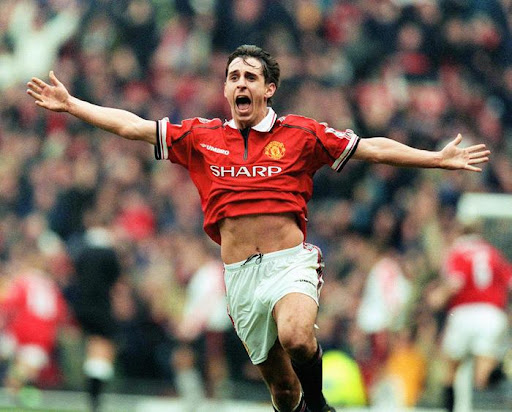
Gary Neville’s career at Manchester United is a textbook example of loyalty built through academy development, institutional stability, and long-term integration into a single footballing culture. He joined United’s youth system in the late 1980s and made his senior debut in 1992, going on to spend his entire professional playing career at Old Trafford before retiring in 2011. Over that period, he made more than 600 appearances for the club across all competitions, the vast majority as first choice right back during United’s most successful modern era.
Neville emerged as part of the famous Class of 92, alongside players like Ryan Giggs, Paul Scholes, David Beckham, Nicky Butt, and his brother Phil. Unlike some of his teammates who attracted global attention for attacking flair, Neville built his career on positional discipline, tactical intelligence, and consistency. He was not a fullback known for explosive pace or creative output, but for reliability in defensive situations, intelligent movement in support of wingers, and an exceptional understanding of team structure.
His peak years coincided with Manchester United’s dominance under Sir Alex Ferguson. Neville was a regular starter in sides that won eight Premier League titles, two Champions League trophies in 1999 and 2008, three FA Cups, and multiple League Cups and Community Shields. He featured prominently during the treble-winning season in 1998 to 99, playing in both legs of the Champions League semi final and starting the final in Barcelona. Across more than a decade, he was trusted in the biggest domestic and European matches, reflecting Ferguson’s reliance on players who could execute tactical instructions with minimal risk.
What makes Neville’s loyalty notable is not simply that he stayed, but that he remained relevant through continuous squad renewal. Manchester United repeatedly refreshed their attacking units, midfield combinations, and defensive partnerships, yet Neville retained his place through competition from new signings and younger players. His understanding of Ferguson’s positional demands, particularly in how United balanced wide attacks with defensive cover, made him tactically indispensable even when his athletic attributes were no longer at their peak.
While Neville was never the subject of the same high-profile transfer speculation as United’s attacking stars, opportunities to leave did exist during his prime years in the late 1990s and early 2000s, when English fullbacks were increasingly valued across Europe. He chose to remain at United, committing to a club environment that offered continuity, clear sporting direction, and long-term trust. His loyalty was reinforced by the culture of the club, where academy graduates were encouraged to see themselves as custodians of identity rather than short-term contributors.
In his later seasons, injuries significantly limited Neville’s availability, particularly after 2007. Rather than seeking moves elsewhere to extend his playing time, he accepted a reduced role within the squad and eventually retired in 2011. That decision reflected the same attachment that had defined his career. He did not attempt to prolong his playing days through transfers to smaller clubs. Instead, he closed his career where it began.
After retirement, Neville remained closely associated with Manchester United through media work and later brief involvement in coaching and management elsewhere, but his professional identity has always been tied to his years at Old Trafford. His career represents a quieter form of loyalty than that of players like Maldini or Totti, built less on symbolic hero status and more on sustained contribution within a highly structured collective system.
Neville’s story shows how loyalty can emerge from stability and shared values as much as emotional attachment. He stayed because Manchester United provided a clear pathway from youth football to elite competition, rewarded consistency, and allowed him to grow inside a system that valued discipline and tactical understanding. In an era increasingly defined by mobility, his career stands as an example of how long-term commitment can still coexist with sustained success at the highest level.
10. Patterns Across the Most Loyal Footballers
Across the range of players discussed so far it is possible to identify several common themes that help explain how and why these footballers remained at one club or chose not to leave even when opportunities arose elsewhere. These themes are not universal, nor do they apply in the same way to every player, but they illustrate consistent patterns of behaviour, identity and decision making that distinguish loyal careers from the more transient norm of modern football.
One clear pattern is early integration into the club environment and a strong academy connection. Players who join a club at a young age, especially through youth systems, frequently develop deeper ties than those who arrive later in their careers. Paolo Maldini, Ryan Giggs, Francesco Totti and Carles Puyol all came through the youth ranks of the clubs they served, giving them formative experiences that tied their personal development directly to the club’s culture and values from a young age. In these cases, loyalty is not just an adult decision but a continuation of long term association.
Another pattern is adaptability and evolution within the team’s tactical framework. Loyal players rarely stagnate. Over long careers they often shift roles as demands change. Ryan Giggs, for example, began as a quick, direct winger but later found success in deeper midfield positions as his pace declined, ensuring he remained relevant and useful to successive managers. Likewise, Paolo Maldini transitioned from a more wide defensive role into central defence as his anticipation and reading of the game became even more central to his effectiveness. This capacity to evolve with the team helps sustain long tenures because it reduces the friction that often leads clubs and players to part ways.
Leadership and symbolic significance within the club is another consistent feature. Many of the most loyal players became figures around which club identity coalesced. Francesco Totti was widely regarded not just as a key performer for Roma but as a symbol of the city itself, a figure fans identified with through peaks and valleys of the club’s fortunes. Such symbolic ties make loyalty a matter of legacy as well as performance, reinforcing a player’s value in ways that transcends pure on-field output.
A further commonality is situational choice in the face of external opportunity. Jamie Vardy’s refusal to join Arsenal after Leicester City won the Premier League is one of the clearest contemporary examples. Vardy could have moved to a club with broader financial and competitive resources, yet chose continuity and role visibility at Leicester. Similarly, several players on one-club lists were reported to have resisted interest from larger clubs in their primes, choosing to remain where they had built identity and influence rather than chase trophies or higher profiles elsewhere.
Loyalty also manifests in long term leadership roles within the squad. Mark Noble’s tenure at West Ham United was defined not only by length but by leadership, routinely captaining his side through relegations, promotions and managerial changes. These players often become the connective tissue in dressing rooms, embodying standards and expectations that help stabilise teams during periods of transition.
Taken together these patterns explain why loyalty in football cannot be reduced simply to the number of years served or the number of appearances made. It also involves adaptability, identity, choice and leadership in the face of changing competitive and economic environments.
Conclusion
Loyalty in football is increasingly rare, not just because player movement is more common, but because the incentives around transfers, contracts and club priorities have changed dramatically over recent decades. Players once spent the bulk of their careers in one place, sometimes by choice and sometimes simply as the norm. In the modern game, there are more opportunities to move and more reasons to do so, whether financial, competitive or personal.
The careers examined here show that true loyalty is not simply about longevity at one club. It is about repeated decisions to embrace continuity when alternatives exist. Players such as Paolo Maldini, Ryan Giggs and Francesco Totti did not stay because they could not move. They stayed because the club remained central to their identity and because they found ways to contribute meaningfully across tactical shifts and managerial changes. Others, such as Jamie Vardy, show that loyalty is still possible even outside the classic model of one-club careers, when a player chooses consistency over bigger stage opportunities.
Across different leagues and eras there are still figures willing to build a narrative around a single badge. Their careers are not only long but deeply intertwined with the history of their clubs, shaping not just results on the pitch but fan memory and cultural identity off it. As football continues to evolve, the examples of these loyal professionals remind us that commitment can still shape careers in meaningful ways, even in a sport increasingly defined by movement and change.