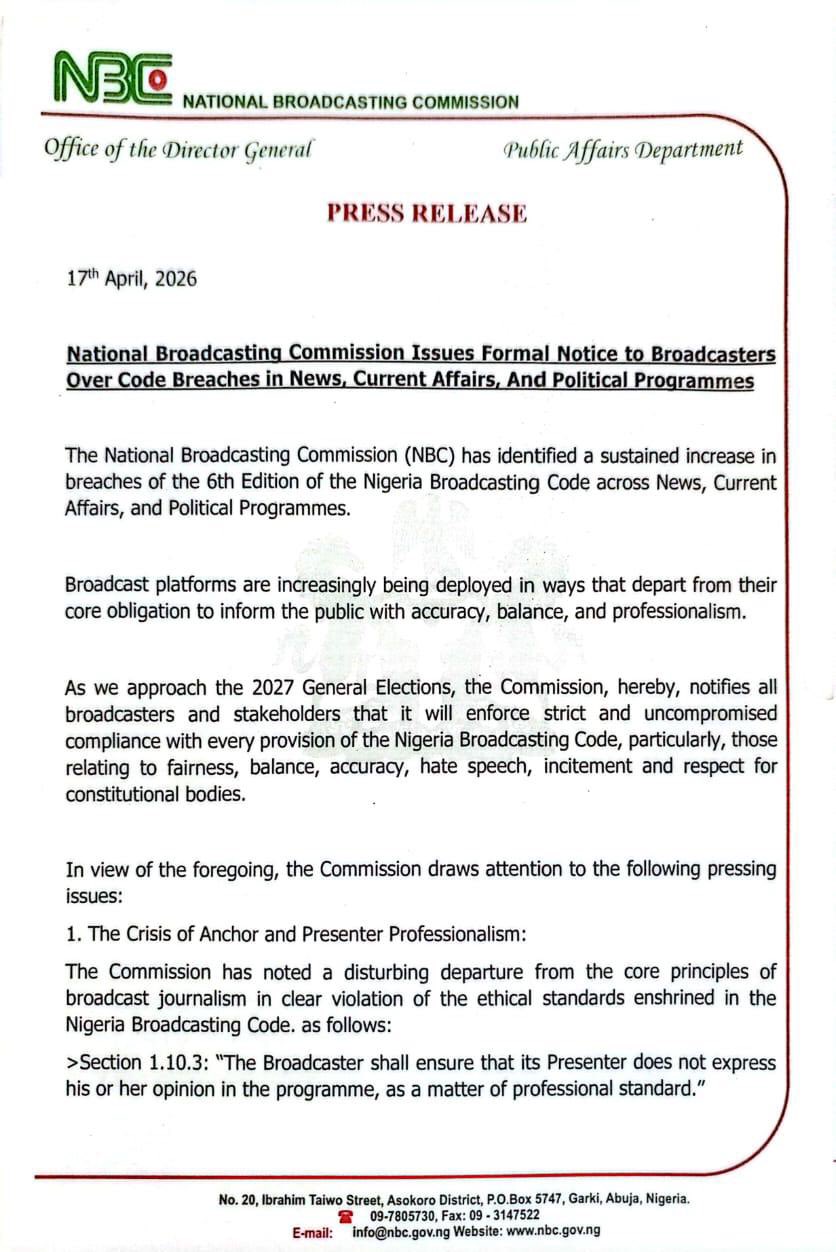
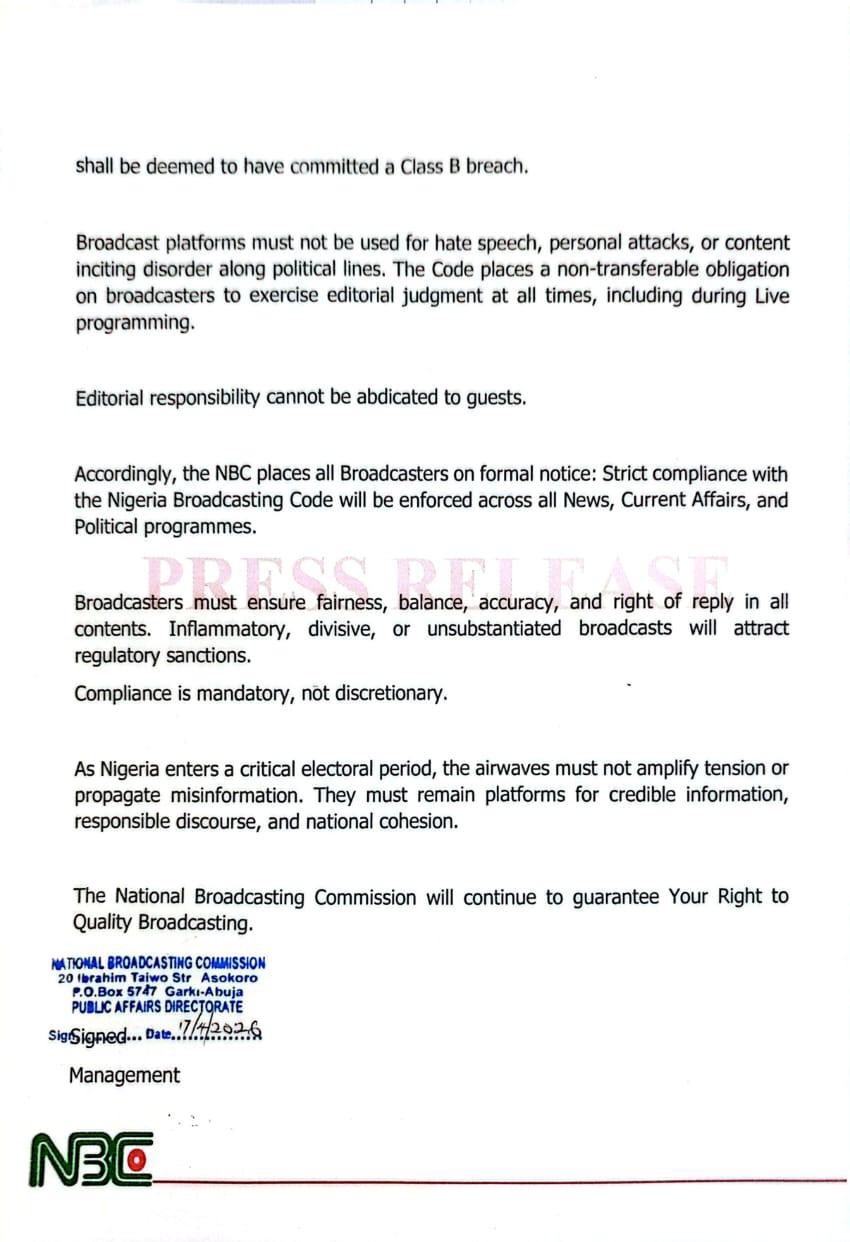
On Saturday, the National Broadcasting Commission (NBC) expressed concerns over broadcasters’ persistent violation of its codes and regulations in news, current affairs, and political programmes. The commission’s concerns were contained in a formal notice sent to television and radio station operators in the country.
According to the commission, the notice is not unrelated to the sharp deviation of broadcast platforms from their primary obligation to inform the public with accuracy, balance, and professionalism.
It added that, ahead of the 2027 elections, it is imperative to notify broadcasters and relevant stakeholders that the commission will not tolerate continued violations of its code and will comprehensively enforce adherence to all broadcasting regulations.
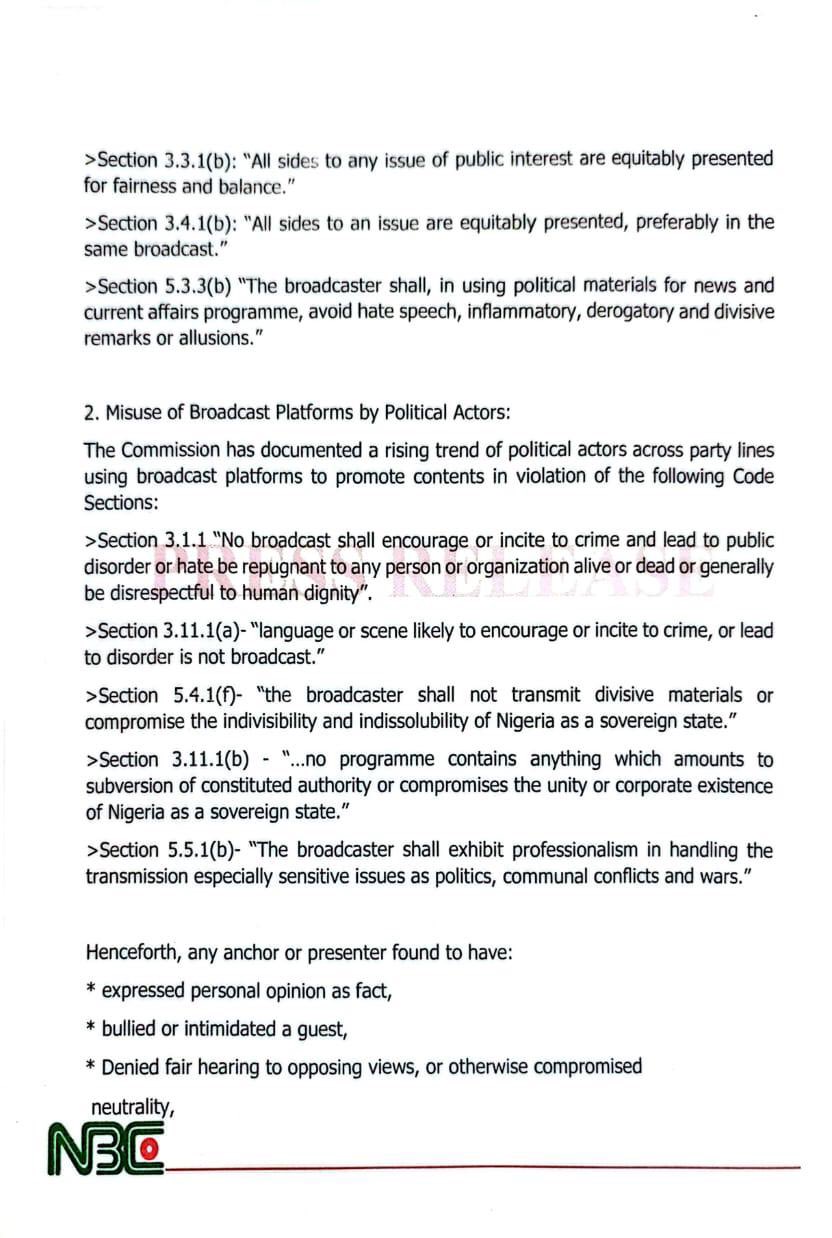
The commission warned that following the issuance of the code of conduct advisory, any anchor or presenter found to have expressed personal opinion as fact, bullied or intimidated a guest, denied fair hearing to opposing views, or otherwise compromised “shall be deemed to have “committed a class B breach”
The notice read in part: “As we approach the 2027 General Elections, the Commission, hereby, notifies all broadcasters and stakeholders that it will enforce strict and uncompromised compliance with every provision of the Nigeria Broadcasting Code, particularly, those relating to fairness, balance, accuracy, hate speech, incitement and respect for constitutional bodies.”


Legal gray areas
The formal notice and the issues raised therein by the commission have again brought to the fore the constitutionality and legality of how NBC performs its duties as a regulator of the media space. The question of whether the commission has the power to unilaterally impose fines and sanctions on broadcasters and whether the body can act independently of the constitution has once again become a topical subject.
Section 1.10.3 of the Nigeria Broadcasting Code, which prohibits presenters from expressing personal opinions and other codes that reference provisions on balance, hate speech, incitement, and divisive content that run afoul of constitutional provisions and established judicial precedent.
This restriction directly clashes with Section 39(1) of the 1999 Constitution, which guarantees the right to freedom of expression, including the right to hold and impart opinions. Section 39(2) further protects the right to operate media for disseminating ideas and information. A regulatory code cannot override these rights.
Section 36 of the Constitution is also engaged. Courts have repeatedly ruled that the NBC, as an administrative body, is now legally empowered to impose sanctions without due process.
In Media Rights Agenda v. National Broadcasting Commission (Federal High Court, Abuja, 2023), the court ruled that NBC’s fines on broadcasters were unlawful and restrained the commission from imposing such penalties. That ruling was affirmed by the Court of Appeal in April 2026, which dismissed NBC’s appeal, annulled prior sanctions, and averred that the commission cannot act as accuser, prosecutor, and judge.
Past judicial verdicts established the supremacy of the Constitution on the matter. In Arthur Nwankwo v. The State (1985), the Court of Appeal held that criticism of public officials is protected expression. In Director of SSS v. Olisa Agbakoba (1999), the Supreme Court held that restrictions on fundamental rights must be strictly justified.
The directive’s deployment of ambiguous and broad terms such as “divisive,” “inflammatory,” and “compromising neutrality” raises further compliance concerns within constitutional limits. Taken together, the directive stands in clear tension with constitutional guarantees and binding court decisions.
The notice has sparked outrage among Nigerians with many seeing it as a plot to gag the media and shrink the civic space. Influential Nigerians and politicians, like former president, Atiku Abubakar, have expressed concerns over the notice.
The directive sparked public outrage
Reacting to the NBC’s code of conduct notice, Atiku, a chieftain of the African Democratic Congress, ADC, described it as an attempt to muzzle the media and limit free expression in Nigeria.
In a statement on Saturday, Atiku, who expressed solidarity with the Nigerian broadcast industry, noted it has been a habit for NBC to issue restrictive and heavy-handed directives aimed at stopping critics of the government from speaking freely.
He further opined that timing and tone of the directive had a political undertone and carried a troubling agenda, stressing that it is an indication of a government “more interested in controlling narratives than permitting a free, fair, and transparent electoral process.”
The statement read: “The Code of Conduct advisory issued by the National Broadcasting Commission is yet another troubling attempt to muzzle the media and shrink the space for free expression in Nigeria.
“Our media industry has grown into a formidable institution, respected globally for its resilience and professionalism. It is therefore alarming that, each time elections approach, the NBC resorts to heavy-handed directives that do more to silence dissent than to uphold ethical journalism.
“I stand firmly with Nigeria’s broadcast industry and all media platforms resisting this creeping censorship. Let it be clear: ethical standards are not seasonal tools to be weaponised during campaigns, they are constant obligations.”
Human rights organisation, Amnesty International and the Socio-Economic Rights and Accountability Project have also decried the directive by the National Broadcasting Commission, describing it as an attempt to suppress press freedom and impose unlawful restrictions on journalists
Amnesty International’s Executive Director, Isa Sanusi, said the notice would erode the independence of the media and violate international human rights standards. The human rights watchdog described the NBC’s directive as authoritarian and unconstitutional, insisting that the commission lacked the power to dictate how journalists carry out their duties.
He implored the Nigerian authorities to refrain from what he described as an “unrelenting quest to silence journalists,” stressing that independent and diverse media were essential to protecting the public’s right to information.
On its part, SERAP labels the directive unlawful and a threat to press freedom and demands its immediate withdrawal.
The organisation’s displeasure and strong opposition to the directive are made known in a letter dated April 18, 2026, and signed by its Deputy Director, Kolawole Olúwa Dare.
The organisation urged President Bola Tinubu to instruct the Minister of Information, Mohammed Idris, and the NBC to reverse the notice.
SERAP said, “The NBC’s notice represents a dangerous attempt to impose prior censorship on the media and suppress legitimate journalistic expression.”
The group also enjoined the government to “abstain from imposing prior censorship on broadcast stations and Nigerian journalists, including presenters and to allow them to freely carry out their constitutional responsibilities.”
It described such provisions as vague and unconstitutional, stressing that, “The Nigerian Constitution and international human rights law protect both the absolute right to hold opinions and the qualified right to express ideas of all kinds.”
It warned that it would institute a legal action against the government stating, “if the recommended measures are not taken within 48 hours.
“If we have not heard from your government and the NBC by then, SERAP shall take all appropriate legal actions to compel compliance.”
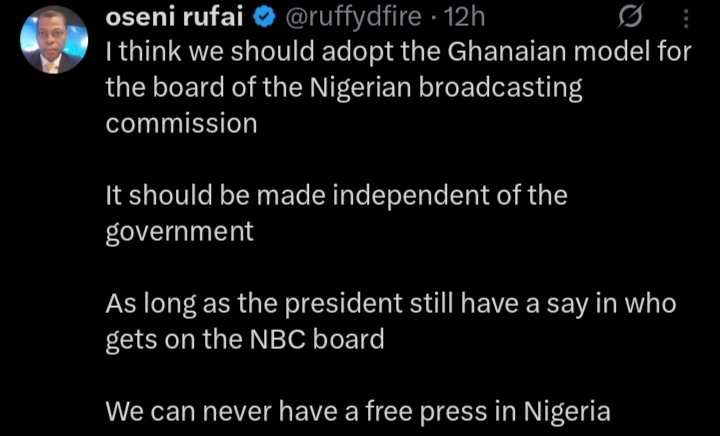
Popular journalist and Arise News TV host, Rufai Oseni, did not hold back in his castigation of the NBC over the directive. He noted that the directive is part of the government’s effort to evade criticism and go after dissents.
He explained that on many occasions the NBC has conveniently looked away when state-owned media outlets and government officials breached its codes and violated journalism ethics.
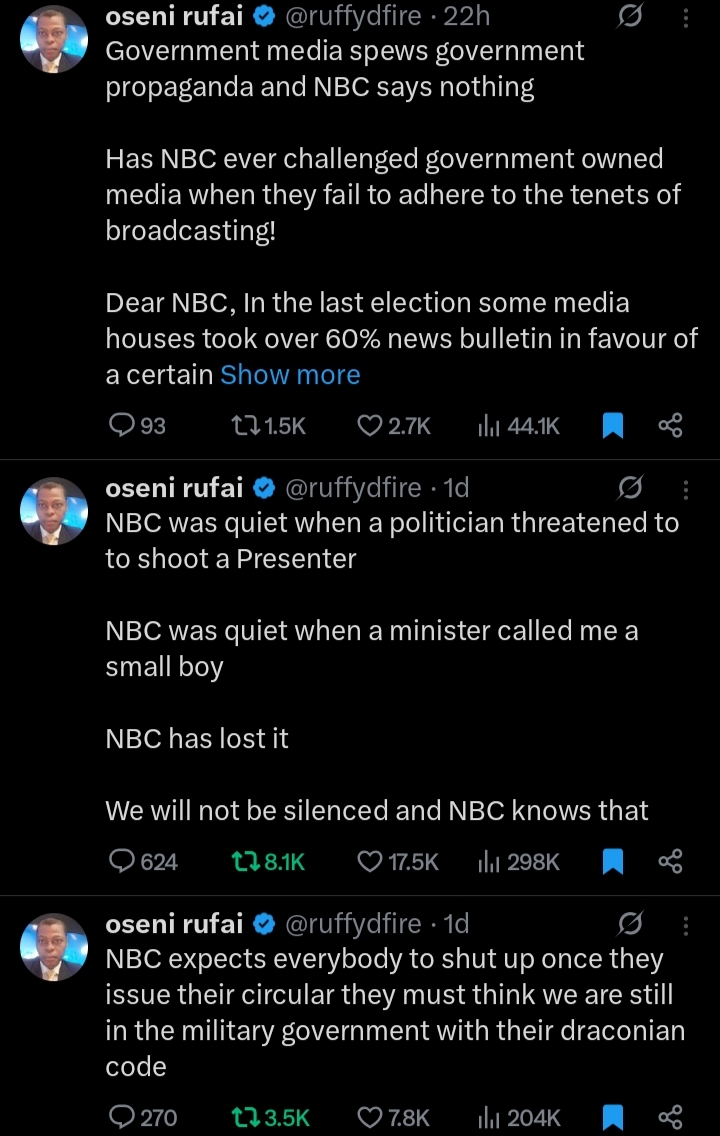
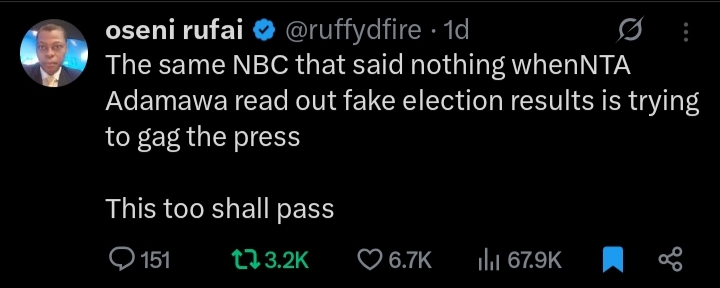


He also suggested that Nigeria should adopt the Ghanaian model in forming the board of NBC so as to reduce or totally remove the influence of government on the commission.

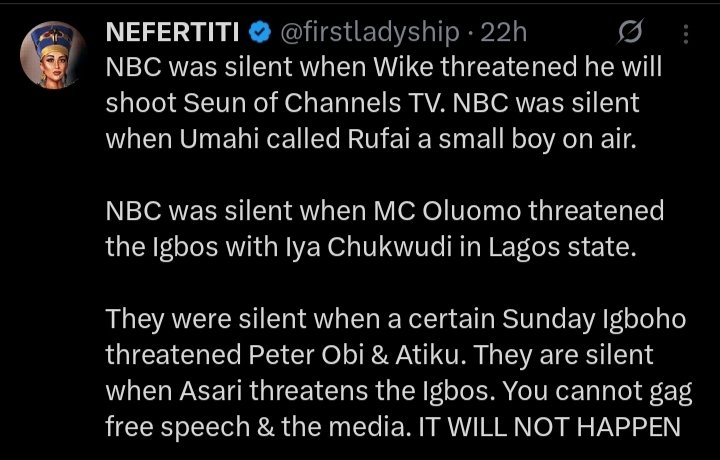
An influencer on X known as Nefertiti expresses concern over NBC’s selective enforcement of the commission’s code. She pointed out that supporters and high-ranking officials of the current government have made vile, divisive, damaging and harmful comments and the commission did not move against them.

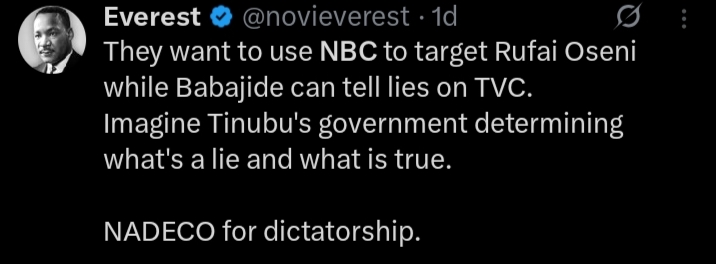
Another X user with the moniker Everest claimed the notice was targeted at Rufai Oseni, noting that it is not up to the government to determine what is true or false.