If you have a Nigerian bank account, you need to read this 2026 BVN update before May 1, 2026.
The Central Bank of Nigeria has overhauled how the Bank Verification Number system operates, and the changes go far beyond the fragments circulating on social media. Most posts have fixated on the phone number restriction. That is real, but it is one piece of a broader set of changes that will affect how you log into mobile banking, how quickly you can transfer money on a new device, and whether your account gets flagged mid-transaction.
Here is a proper breakdown of everything that is changing and what you actually need to do about it.
What Is the BVN and Why Is the CBN Tightening It?
The Bank Verification Number was introduced in 2014 to link every bank customer’s biometric identity, fingerprints and photographs to their accounts across all Nigerian financial institutions. It was designed to reduce fraud and ghost accounts. For a long time, it worked reasonably well.
But the banking landscape has shifted. Nigeria now has over 67.8 million BVN registrations as of December 2025, up from 51.9 million in 2021. Mobile banking is mainstream. Digital transfers happen in seconds. And fraud has followed the money.
SIM-swap fraud, in which criminals convince a telecom provider to transfer your phone number to a SIM they control, has become one of the most damaging threats to Nigerian bank customers. By controlling your phone number, a fraudster can intercept OTP codes, reset passwords, and drain accounts before the victim realises anything is wrong.
The CBN’s response is this new framework: tighter controls on identity, stricter device management, real-time watchlisting, and a hard limit on phone number changes. The measures take effect May 1, 2026.
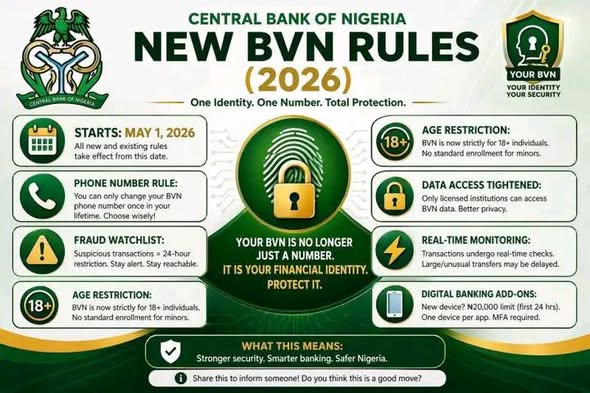
The 8 Key Changes, Explained
1. Your Phone Number Can Only Be Changed Once — Ever
This is the most consequential change for most people. Under the new rules, you can update the phone number linked to your BVN exactly one time for life. After that, the number is locked.
The policy directly targets SIM-swap fraud. Fraudsters have historically exploited the ease with which BVN-linked phone numbers could be changed multiple times. Remove that flexibility, and a major attack vector closes.
The practical implication is stark. If you currently have an old number tied to your BVN, one you rarely use, borrowed from a family member, or registered through an agent, you need to fix it before May 1. That one permitted change becomes your safety net. Use it deliberately.
Losing access to your registered number after that single change could mean serious difficulty accessing banking services, and the resolution process will be far more formal than walking into a branch and requesting a quick fix.
2. Banking Apps Are Restricted to One Device at a Time
Your mobile banking app will now work on a single device. Log in on a new phone, and your old device is automatically signed out. No simultaneous access across multiple phones.
This is not entirely new thinking, some digital banks, like OPay, have already implemented it. But applying it universally across all CBN-licensed institutions is on a different scale.
For most people who use one phone, this changes nothing day to day. For anyone who regularly switches between devices or has set up banking access on a family member’s phone, there are adjustments to make.
3. Switching Devices Requires Extra Verification
Moving to a new device is not just a matter of logging in anymore. Customers will need to go through additional identity verification before the new device is activated for banking use.
This matters if your phone gets stolen, breaks down, or you upgrade. Plan for this process to take time. Attempting it during an urgent financial situation, needing to pay rent, and handle an emergency transfer, will be stressful if you have not prepared.
4. Transaction Cap of ₦20,000 for the First 24 Hours on a New Device
Even after you complete verification on a new device, transfers are capped at ₦20,000 for the first 24 hours. The thinking is reasonable: a fraudster who somehow manages to activate your banking app on a new device cannot immediately run off with large sums.
But for a legitimate customer who just switched phones and needs to move money urgently, this cap will be a real inconvenience. Worth knowing in advance rather than finding out mid-transfer.
5. A 24-Hour Fraud Watchlist for Suspicious Activity
Banks now have the authority to place a BVN on a temporary watchlist for up to 24 hours if a transaction triggers a fraud flag. During that window, the account can be partially frozen or restricted while the bank tries to contact the account holder for verification.
This is modelled on anti-money laundering systems used in international banking. The goal is to catch suspicious activity in real time rather than chasing the money after it has already moved.
The downside? Legitimate transactions can get caught up in this. High-value transfers, unusual spending patterns, or even logging in from a new location could trigger a flag. If your bank cannot reach you on your registered number during that 24-hour window, the process gets complicated. Which brings us back to point one: make sure your registered phone number is active and yours.
6. BVN Database Access Locked Down to Licensed Institutions Only
Access to the BVN database is now restricted exclusively to CBN-licensed financial institutions. Third parties, including fintechs, data aggregators, and informal verification services, are cut off unless expressly approved by the CBN.
This plugs a significant data leak. BVN data has historically been accessible through channels that were not fully regulated, creating exposure to identity theft and unauthorised profiling. Under the new rules, if you have a BVN issue, you resolve it through your licensed bank. No shortcuts.
7. Stricter KYC Across All Banks
The updated framework puts more pressure on Know Your Customer compliance. Banks are required to keep customer data accurate and consistent. Discrepancies in your records, a different name spelling across institutions, outdated address information, and mismatched dates of birth could trigger restrictions.
Now is a good time to check that your BVN details match what is on your national ID, voter card, or international passport. Inconsistencies that seemed harmless before may become friction points under the new regime.
8. BVN Registration Age Limit Set at 18
Only individuals aged 18 and above can now register for a BVN. Minors must operate bank accounts under the supervision of a guardian. This brings Nigeria in line with international standards, where independent financial identity is tied to adulthood.
For parents who opened accounts in their children’s names with independent BVN registrations, there may be administrative steps required to move those accounts into a guardian-supervised structure.
What the Numbers Say About Why This Matters
Digital payment fraud losses in Nigeria dropped sharply, from ₦52.26 billion in 2024 to ₦25.85 billion in 2025, a reduction of around 51 percent. Reported fraud cases also fell from over 123,000 in 2021 to roughly 67,515 in 2025.
Those numbers suggest the BVN system has already been working. But the CBN is clearly not satisfied that the current safeguards are sufficient for a financial system processing millions of digital transactions daily. The May 1 changes are an attempt to close the remaining gaps before they widen.

What You Need to Do Before May 1
There isn’t much time. Here is what actually matters:
Check your registered phone number today: Log in to your banking app or visit your bank and confirm what number is linked to your BVN. If it is an old number, a borrowed SIM, or one you cannot reliably access, use your one permitted change now. Do not wait until after May 1.
Make sure your BVN details are consistent: Your name, date of birth, and other details should match across your BVN record and your primary ID documents. Visit your bank if there are discrepancies.
Update your KYC records if they are outdated: Many banks have been prompting customers to do this for months. If you have been ignoring those notifications, now is the time.
Be reachable on your registered number: The fraud watchlist works by contacting you when a transaction is flagged. If your registered number is inactive or goes unanswered, a 24-hour restriction becomes harder to lift.
If you have children with independent BVN registrations, speak to your bank about the steps required under the new age requirements.
Wrap Up
These changes are uncomfortable in some ways. Less flexibility. More friction. A system that, going forward, will require customers to take their own identity management seriously rather than treating it as something banks will quietly handle.
But the fraud figures show why this is happening. The CBN is essentially saying: the casual approach to BVN management served its purpose when the system was young. Nigeria’s digital banking infrastructure has grown too large and too fast for that to continue.
Your BVN-linked phone number is now, for all practical purposes, the key to your financial identity. Treat it accordingly.
The May 1 deadline is approaching. Whatever adjustments you need to make, make them now.