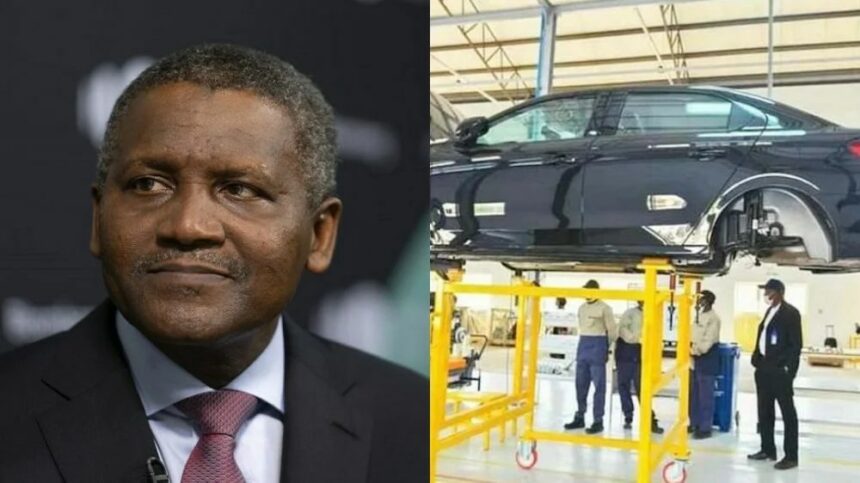
Inside Kaduna, a familiar name is beginning to reappear in a very different form, as assembly work on the Peugeot 3008 and 5008 SUVs is now underway under Dangote Peugeot Automobiles Nigeria, with early production activity already in motion and market entry still projected around April 2026 as the rollout phase slowly builds. What is being projected in headlines as a full move into vehicle manufacturing sits on a more structured and less dramatic foundation once the details are examined closely.
The operation is rooted in a joint arrangement between Dangote Industries and Stellantis, the global parent company of Peugeot, built around local assembly rather than complete vehicle manufacturing from raw production stages. That distinction matters, but it does not fully explain why this development is drawing attention, because the real story is not just about what is being assembled in Kaduna, but what the gradual activation of this line could eventually lead to once production stabilises and expands beyond its current phase..
Nigeria Automotive Landscape Before The Current Phase
Nigeria’s relationship with automobile production has always moved in cycles of ambition and setback. Earlier decades saw attempts to build local capacity through partnerships that never fully matured into stable manufacturing ecosystems. By the early 2000s, the country had become heavily dependent on imported vehicles, with limited assembly operations struggling to maintain consistency. This created a gap between industrial aspiration and market reality, where demand kept growing but local production capacity remained shallow.
By 2020 and into 2022, renewed interest in automotive assembly began to emerge again as policy direction leaned toward industrial diversification. Government conversations around reducing import dependency and strengthening local production capacity became more prominent. Within this environment, partnerships involving established global automotive brands and Nigerian industrial groups began to take shape again, with Peugeot becoming one of the central names returning to the conversation.
DPAN Structure And Foundational Purpose
The entity at the center of this development is Dangote Peugeot Automobiles Nigeria, commonly referred to as DPAN. It operates as a joint industrial venture rather than a standalone Dangote controlled automotive brand. The structure includes Dangote Industries alongside Stellantis, the global automotive group that owns Peugeot, and in earlier frameworks, elements of government aligned industrial participation were also involved during its formation stages.
DPAN’s operational goal is focused on vehicle assembly rather than full vehicle manufacturing from raw engineering design to finished product development. This distinction is essential because it defines both the capability and the limitation of the operation. The Kaduna facility serves as the physical base where imported vehicle kits are assembled into finished units, inspected, completed, and distributed into the Nigerian market.
The intention behind DPAN is not to reinvent Peugeot as a brand but to re establish local assembly presence that can support job creation, technical training, and reduced dependency on fully imported vehicles. It is a revival strategy built on existing automotive architecture rather than a completely new industrial invention.
Kaduna Assembly Plant Activation Sequence
The Kaduna plant represents the operational core of this entire process. Reports confirm that assembly activity for Peugeot SUVs has begun within the facility, marking a continuation of Nigeria’s long standing but inconsistent automotive assembly history. The plant is structured to handle semi knocked down and completely knocked down kits that arrive from Stellantis supply chains, which are then assembled locally into finished vehicles.
By late 2025, internal production readiness phases were already underway according to industry reports, with equipment calibration, workforce training, and assembly line testing forming part of the preparatory process. By early 2026, production of the Peugeot 3008 and 5008 models had moved into active assembly stages, with expectations that initial units would reach the Nigerian market around April 2026.
This timeline reflects a phased industrial rollout rather than a sudden manufacturing launch. It also highlights the cautious approach often required in automotive assembly environments where quality control, supply chain coordination, and regulatory compliance must align before mass distribution begins.
Peugeot 3008 And 5008 Assembly Focus
The two SUV models at the center of this development, the Peugeot 3008 and Peugeot 5008, represent modern mid range and family oriented vehicles within the Peugeot lineup. The 3008 is positioned as a compact SUV with a strong urban and lifestyle appeal, while the 5008 extends into a larger seven seat configuration designed for broader passenger capacity and long distance utility.
Both models assembled in Kaduna are reported to use a 1.6 liter turbo petrol engine configuration, delivering approximately 163 horsepower, paired with a six speed automatic transmission system known within Peugeot engineering frameworks as EAT6. The trims being assembled include Allure and GT versions, which typically represent mid to higher specification offerings within the Peugeot range.


These specifications matter because they show that the Nigerian assembly operation is not limited to stripped down versions of vehicles. Instead, it reflects a structured attempt to introduce globally competitive SUV models into the local market with consistent technical standards maintained through imported component systems.
Assembly Process Versus Full Manufacturing Reality
A major point of confusion in public discussions is the difference between vehicle assembly and full scale manufacturing. The Kaduna operation is firmly positioned within assembly, not complete manufacturing from scratch. Vehicle components arrive in partially or fully disassembled form from Peugeot global supply networks, after which they are assembled, calibrated, and completed locally.
This process involves body assembly, interior fitting, mechanical integration, electrical system installation, and final quality inspection. What it does not involve is full engine production, transmission engineering, or platform design development within Nigeria. Those core engineering functions remain within Stellantis global manufacturing ecosystems.
Understanding this distinction is essential because it clarifies that the industrial achievement lies in localization of assembly operations rather than full technological independence in automobile production. It is still a meaningful step for industrial development, but it does not represent a fully self designed Nigerian vehicle brand.
Market Entry Timeline April 2026 Projection
Industry reports indicate that the first locally assembled units of the Peugeot 3008 and 5008 are expected to enter the Nigerian market around April 2026. This timeline reflects the completion of initial assembly runs, quality assurance validation, and distribution preparation across dealership networks.
The phased rollout approach ensures that early production batches can be tested for reliability and compliance before full commercial scaling begins. It also allows market reception to be monitored in real time, which can influence future production adjustments or model expansion decisions within the DPAN framework.
April 2026 therefore represents not just a sales milestone, but a validation point for the entire assembly operation, marking the transition from production initiation to commercial availability.
Economic Implications For Local Market Structure
The introduction of locally assembled Peugeot SUVs carries economic implications that extend beyond vehicle availability. One of the most direct impacts is employment generation within the Kaduna plant itself, where assembly line workers, engineers, logistics personnel, and administrative staff are required to maintain operations.
Beyond direct employment, there is also the potential for indirect economic activity through supplier networks, maintenance services, transport logistics, and dealership expansion. Even though core components are still imported, the final assembly process creates a localized industrial layer that can stimulate related service sectors.
There is also the question of vehicle pricing dynamics. Local assembly can potentially reduce certain import related costs, although final pricing is still influenced by currency fluctuations, taxation structures, and logistics expenses associated with imported parts.
AfCFTA Industrial Positioning Context
The broader continental trade framework known as the African Continental Free Trade Area provides an additional layer of relevance to this development. Nigeria’s participation in AfCFTA creates long term expectations around industrial capacity building and regional manufacturing competitiveness.
DPAN’s assembly operations can be viewed within this strategic context as a step toward positioning Nigeria as a regional hub for vehicle assembly rather than a purely import dependent market. While the current operation remains assembly based, it lays groundwork for potential export oriented activity in the future if scale and policy alignment improve.
This positioning is less about immediate transformation and more about gradual integration into continental industrial supply chains.
Peugeot Historical Presence In Nigeria
Peugeot is not a new name in Nigeria’s automotive memory. The brand had strong visibility in the country from the mid twentieth century through the late 1980s, when locally assembled Peugeot models were widely recognized on Nigerian roads. At that time, Peugeot assembly operations in Nigeria represented one of the more structured automotive efforts in the region.
However, over time, challenges related to import dependency, policy instability, and changing market competition contributed to the decline of that early manufacturing presence. Japanese and other Asian automotive brands gradually filled the market space, leaving Peugeot with reduced local assembly visibility for several years.
The current DPAN operation can therefore be seen as a revival attempt, not of a new idea, but of an interrupted industrial history.
Dangote Industrial Expansion Direction
Dangote Industries has historically been associated with cement production, sugar refining, and energy sector investments, but its participation in DPAN signals a broader industrial diversification strategy. Rather than entering vehicle design or automotive engineering from scratch, the group is positioning itself within existing manufacturing frameworks where global technical partners already provide foundational systems.
This approach reflects a pattern of industrial participation that prioritizes infrastructure, logistics, and operational capacity rather than core technological invention. Within DPAN, Dangote’s role is therefore more aligned with industrial scaling and operational support rather than automotive engineering leadership.
Long Term Outlook For DPAN Operation
The future trajectory of DPAN will likely depend on several interlinked factors including market acceptance of locally assembled Peugeot SUVs, stability of import supply chains, policy consistency around automotive assembly incentives, and overall economic conditions affecting consumer purchasing power.
If these elements align positively, there is potential for expanded model lines, increased local content integration, and possibly deeper technical training programs within Nigeria’s automotive workforce. However, full transition into independent vehicle manufacturing would require far more extensive industrial investment, technological transfer, and long term engineering development.
What is currently visible is not the final stage of transformation, but an early phase of structured industrial rebuilding that could either expand or remain stable depending on execution and economic conditions.
Closing Perspective On The Kaduna Assembly Move
The start of Peugeot 3008 and 5008 assembly in Nigeria through DPAN represents a carefully structured industrial step rather than a dramatic reinvention of the automotive sector. It reflects collaboration between local industrial capacity and global automotive engineering systems, positioned within a broader national ambition to strengthen manufacturing presence.
The significance lies not in exaggerated claims of full vehicle manufacturing independence, but in the gradual return of structured automotive assembly activity within Nigeria. Kaduna has become the focal point of this effort, and April 2026 marks the moment when this development will move from production phase into public market visibility.
What unfolds next will determine whether this remains a symbolic industrial milestone or grows into a sustained automotive assembly ecosystem capable of shaping Nigeria’s position within the regional vehicle market.