The situation between Seun Kuti and VeryDarkMan did not arrive as a loud explosion at first glance, it built slowly through overlapping conversations, public positions, silent disagreements, then sudden visibility that caught a large online audience off guard as April 2026 discussions intensified across social platforms. What looked like ordinary commentary between public figures gradually turned into a layered disagreement shaped by ideology, influence, loyalty, and interpretation, creating a tension that many observers only fully noticed when reactions had already spread widely across timelines.
The most striking part of the entire development is not just that two outspoken voices found themselves on different sides, but how quickly supporters turned small signals into a full narrative that neither side openly planned to escalate. As events unfolded across early 2026, especially around March 2026 into April 2026, the digital space became a mirror reflecting deeper disagreements about activism style, influence power, and public accountability culture, all of which shaped how the fallout eventually became a trending conversation rather than a private misunderstanding.
Early Alignment Pressure Point
Before any visible tension appeared, both Seun Kuti and VeryDarkMan were already operating in spaces where public commentary on governance, accountability, and social issues often overlap, which naturally placed them in proximity within online civic discussions during late 2025 into early 2026. Seun Kuti, known for his structured political commentary rooted in long standing activist tradition, often engages conversations through systemic critique, while VeryDarkMan operates through immediate digital exposure methods that rely heavily on viral response culture and direct confrontation style commentary.
The difference between both approaches was not originally a conflict point, but it created subtle divergence in how audiences interpreted their involvement in overlapping topics. By February 2026, observers began noting that their audience spaces occasionally intersected but rarely aligned fully in tone or interpretation, setting the stage for future misunderstanding without either figure directly acknowledging friction at that time.
Sowore’s Influence Layer
The role of Omoyele Sowore became a defining factor in how the situation evolved, particularly as public discussions around activism accountability intensified in early 2026, especially within Nigerian online civic spaces. Seun Kuti has historically aligned with Sowore on issues related to institutional criticism, governance accountability, and state power scrutiny, which meant his public positioning often reflected similar ideological framing during discussions that involved state agencies or civic activism disputes. VeryDarkMan on the other hand found himself associated with separate conversations that included business related controversies and online accountability claims, including discourse connected to the situation involving Blord that gained attention in early 2026.
When Sowore publicly maintained critical positioning on certain aspects of these discussions, interpretations within online communities began to separate into two visible camps, not necessarily defined by direct opposition between individuals, but by perceived alignment with broader activist direction. This ideological layering became the quiet foundation upon which later tensions grew, even before any direct statements were exchanged between Seun Kuti and VeryDarkMan.
Blord Related Controversy Context
The legal and public discussion surrounding businessman Blord added another dimension to the evolving online climate during March 2026, as conversations around accountability, digital influence, and business transparency became widely debated. VeryDarkMan was frequently referenced within these discussions due to his involvement in commentary that highlighted concerns and public scrutiny around certain allegations and responses connected to the case. While Seun Kuti was not directly involved in the Blord situation, his alignment with broader activist perspectives that prioritized systemic critique placed him in a position where audiences often interpreted his commentary style as indirectly supportive of accountability frameworks associated with Sowore aligned activism spaces.
This created an indirect association loop where separate discussions began merging in public interpretation, even though the individuals involved were not formally connected in any structured collaboration or confrontation at that stage.
Instagram Visibility Shift
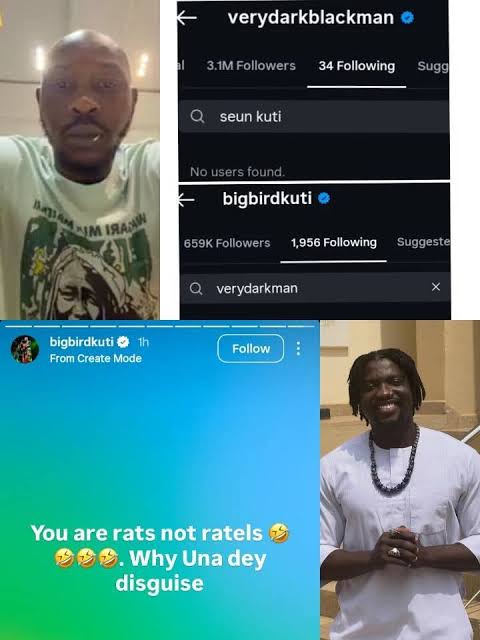
The most visible turning point occurred when social media behavior changed noticeably between both figures, particularly through Instagram interactions that became widely discussed around mid March 2026. Observers noted that both Seun Kuti and VeryDarkMan were no longer engaging each other online in the way previously assumed neutral public figures might, and this absence of interaction quickly became interpreted as symbolic distance. The situation escalated further when Seun Kuti posted a strongly worded message that referenced supporters in a dismissive tone, describing them as rats not ratels while questioning perceived identity representation in the online space.
This statement circulated rapidly across platforms, not because it introduced new conflict material, but because it confirmed to many users that tension had moved beyond ideological difference into personal expression. The post became a reference point for debate, reaction, and counter commentary, effectively marking the first moment where the situation was no longer interpreted as background disagreement but as visible public fallout.
Fan Response Expansion Cycle
Once the Instagram post gained traction, the situation shifted from individual positioning into a wider audience driven reaction cycle that expanded the visibility of the disagreement far beyond the original participants. Supporters of VeryDarkMan, often referred to within online spaces as Ratels, responded strongly to the perceived disrespect embedded in the wording of the post, while supporters of Seun Kuti defended the message as a response to sustained misinterpretation and online pressure.
This phase of the situation became less about the original ideological discussion and more about identity alignment within digital communities, where each side reinforced its interpretation through repeated commentary, reposting, and reaction content. By late March 2026, the discourse had evolved into a multi layered online exchange where the original context of activism, accountability, and ideological difference was gradually overshadowed by audience driven narrative building, creating a cycle where engagement itself became the fuel for continued visibility.

Earlier Support Irony Layer
One of the most frequently discussed elements of the situation is the earlier period where VeryDarkMan had publicly expressed support for Seun Kuti during his separate public disagreement with Wizkid over discussions related to Fela legacy interpretation. That earlier moment, which occurred before the 2026 escalation, is often referenced as evidence that the relationship between both figures was not originally hostile or competitive.
Instead, it was shaped by situational alignment at different points in time, where public commentary intersected in ways that appeared supportive rather than conflicting. This earlier support created a layer of irony in the later fallout, as audiences began revisiting previous interactions and comparing them to the current tension, highlighting how quickly public alignment can shift when broader ideological and audience interpretation structures change over time.
Ideological Separation Development
As the situation developed further into April 2026, the underlying ideological differences became more visible in how both figures were discussed across online spaces. Seun Kuti was increasingly framed within structured activist discourse that emphasizes systemic critique, historical continuity, and institutional accountability, while VeryDarkMan was framed within fast response digital activism culture that prioritizes direct exposure, immediate reaction, and viral accountability narratives.
These distinctions were not necessarily new, but they became more pronounced as supporters attempted to define what each figure represented in relation to ongoing social debates. The result was not a formal split declared by either party, but a gradual separation in public interpretation that made coexistence in shared discourse space more complicated. This ideological distinction became one of the central reasons why the situation continued to attract attention even without direct confrontation between the individuals involved.
Current Status Assessment April 2026
As of April 2026, the situation remains without legal action, physical confrontation, or structured public debate between Seun Kuti and VeryDarkMan, yet the digital tension continues to exist through indirect commentary, audience interpretation, and periodic reference by supporters on both sides. The relationship is widely understood within online communities as strained, not because of a single defining incident, but due to accumulated interpretation differences, ideological positioning, and audience amplification of selective moments.
What makes the current status particularly notable is that both individuals continue their separate public engagement paths without direct interaction, yet their names remain linked within ongoing discussions that revisit earlier moments of alignment, disagreement, and commentary. The situation now exists more as a reference point within online civic discourse rather than an active confrontation, reflecting how digital spaces can preserve tension narratives even after direct interaction has ceased.
Final Reflection Frame
The Seun Kuti and VeryDarkMan fallout ultimately reflects a broader pattern within modern online activism culture where ideological overlap, audience interpretation, and visibility cycles can transform subtle divergence into widely discussed public tension without requiring sustained personal conflict between the individuals involved. What began as intersecting commentary spaces gradually evolved into separate identity narratives shaped heavily by supporter communities, algorithmic amplification, and selective framing of public statements.
As April 2026 discussions continue to circulate, the situation stands as an example of how quickly alignment can be reinterpreted when public figures operate within highly responsive digital ecosystems where meaning is often constructed by audience reaction as much as by original intent.