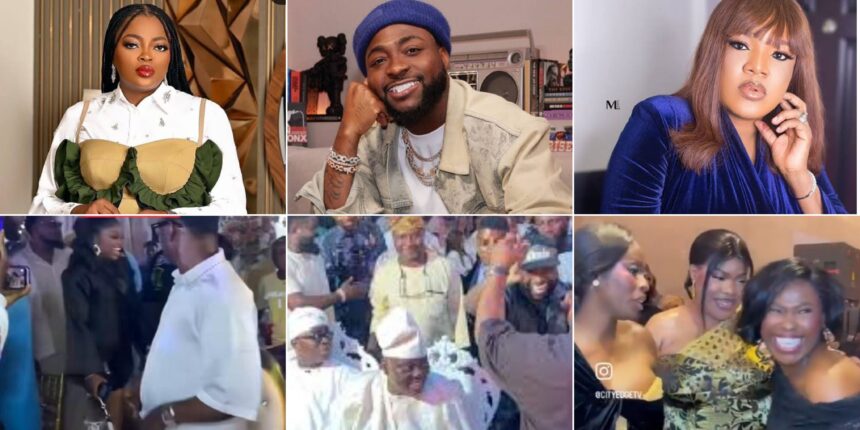
Public celebrity moments often look ordinary until a short clip turns them into something bigger online. That pattern repeated recently with Davido, Funke Akindele, and Toyin Abraham, where brief encounters at social events were lifted out of their full settings and reshaped by public interpretation. None of the moments began as controversy, yet each one ended up trending for the same reason, a few seconds of interaction without full context.
What made these cases spread quickly was not what actually happened, but what was missing from what people saw. A greeting here, a pause there, or a facial expression captured mid moment became enough for social media to build entire narratives. The speed of circulation left little room for the original environment to be understood properly.
DAVIDO AND RAZAQ OKOYA MOMENT
The Davido and Razaq Okoya encounter happened at a high profile private social event in Lagos in 2026 attended by influential figures across business and entertainment. The atmosphere was informal, with guests moving between conversations rather than standing in fixed introductions.
Davido approached Okoya respectfully and exchanged greetings. Shortly after, Okoya appeared to turn and ask a question about who he was speaking with, a moment that was quickly clipped and shared widely online. The interpretation that followed suggested unfamiliarity, even though the setting was crowded and fast paced.
A key detail often overlooked is that the clip resurfaced later and was not originally framed as a formal introduction moment. It was part of a longer, busy interaction sequence where recognition could easily be delayed without any deeper meaning.
A commonly circulated explanation within discussions summarized the moment simply as
“it was just a brief exchange in a crowded setting where recognition was not immediate”
That framing aligns with how elite gatherings often function, where multiple greetings happen at the same time and attention shifts quickly from one person to another.
Age difference and environment density played a role in how the moment was perceived. Okoya, born in 1940, was in a setting where many younger public figures were present, and conversations were happening simultaneously around him. Davido’s global fame also raised audience expectations, which influenced how the clip was interpreted online.
SEE VIDEO OF DAVIDO AND OKOYA BELOW

FUNKE AKINDELE AND PASUMA MOMENT
The interaction involving Funke Akindele and Pasuma took place during a birthday celebration hosted by Fathia Balogun in 2026. The event brought together several entertainers in a lively environment where guests constantly moved between greetings, photos, and conversations.
A brief clip captured Pasuma rising to welcome Funke Akindele, who seemed to miss him as she greeted others nearby. The Fuji star then sat back down, his expression hinting at disappointment. That short moment sparked speculation about a cold or incomplete greeting, even though the full interaction wasn’t shown.
SEE VIDEO BELOW

In reality, such events often involve multiple encounters between the same individuals. One greeting may occur early, another later, and not all of them are recorded or shared. The single circulating clip therefore represented only one moment within a wider interaction.
Funke Akindele also addressed the situation directly, dismissing the viral interpretation and explaining that the clip did not reflect the full context of what happened. She emphasized that social media often removes key parts of interactions and builds narratives that were never present in real time, reteirated her deep respect for Pasuma.
SEE SCREENSHOT BELOW
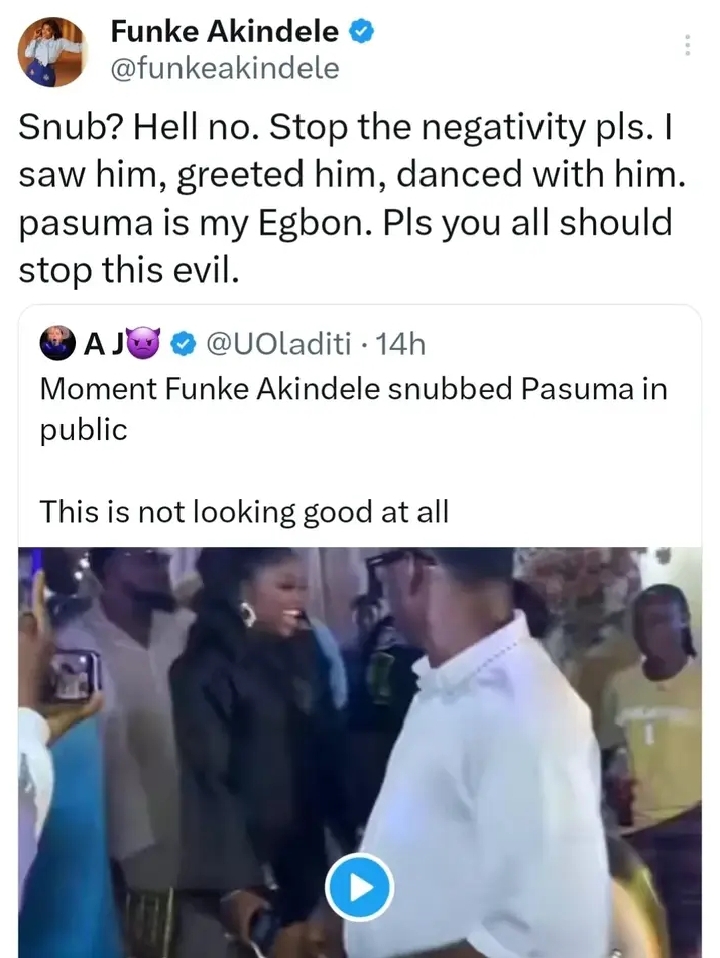

Both Funke Akindele and Pasuma have long standing familiarity within the entertainment industry, making the idea of intentional disregard less consistent with their professional history. The more realistic explanation lies in timing, camera angle, and incomplete recording rather than any underlying tension.
TOYIN ABRAHAM AND UCHE JOMBO MOMENT
The Toyin Abraham and Uche Jombo interaction took place at the Fair and White 30th anniversary celebration in Lagos in 2026, a corporate entertainment event attended by notable figures from film and beauty industries.
A video showed Toyin Abraham respectfully bending to greet Uche Jombo. The attention online shifted quickly to Uche Jombo’s facial expression during the moment, which viewers interpreted in different ways depending on perspective.
SEE VIDEO BELOW

However, the interaction itself was brief and part of a larger flow of greetings happening at the event. Such settings often involve changing expressions depending on timing, ongoing conversations, or camera positioning.
Toyin Abraham later responded to the attention the clip received, addressing how a simple greeting became over interpreted.
SEE SCREENSHOT BELOW
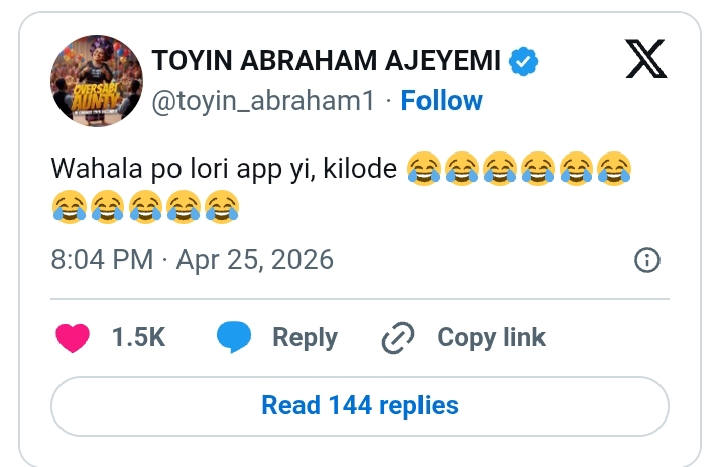

Uche Jombo and Toyin Abraham also share professional familiarity within Nollywood, which further supports the interpretation that the interaction was out of respect rather than unusual.
HOW VIRAL MOMENTS FORM FROM FRAGMENTS
Across all three cases, the same pattern appears. A short clip is recorded, then shared without full context, followed by interpretation that fills missing details. Once that interpretation spreads, it becomes the dominant version of the event.
The speed of social media makes this cycle even stronger. Within minutes, a moment can move from private interaction to public debate. Once that happens, the original setting is often forgotten while the interpretation continues to circulate.
These events all took place in busy environments where multiple conversations were happening at once. That makes it difficult for any single clip to represent the full experience accurately. What people saw was only a fraction of what actually happened.
A key reality across all three situations is that none of them contained confirmed conflict. The reactions were driven by perception, not verified disagreement. The difference between what was recorded and what was assumed became the source of attention.
REALITY BEHIND PUBLIC INTERACTIONS
Celebrity interactions often carry expectations that do not match real life settings. Recognition is assumed to be instant, greetings are expected to follow predictable patterns, and facial expressions are often read as fixed meanings.
However, real environments are more fluid. People move, talk, pause, and react differently depending on timing and surrounding activity. When only a short clip is taken from that flow, it can easily create a distorted impression.
In the cases involving Davido, Funke Akindele, and Toyin Abraham, the actual interactions were simple and brief. The complexity came afterward, created by how the clips were viewed and shared rather than by what happened in the moments themselves.
A grounded reading of all three situations points to the same conclusion. They were normal social exchanges inside busy events, later reshaped by selective viewing and online interpretation.
FINAL OUTLOOK
These encounters show how quickly ordinary celebrity interactions can become trending discussions without any real conflict behind them. Davido’s greeting at a Lagos gathering, Funke Akindele’s exchange at a birthday event, and Toyin Abraham’s moment at an anniversary celebration all followed the same path from normality to viral attention.
The common thread is not controversy but fragmentation. A few seconds of footage removed from its full environment created space for assumptions to grow. Once shared widely, those assumptions became the dominant narrative.
At their core, all three moments remain simple social interactions. The reactions they generated say more about how information spreads today than about the people involved or the events themselves.