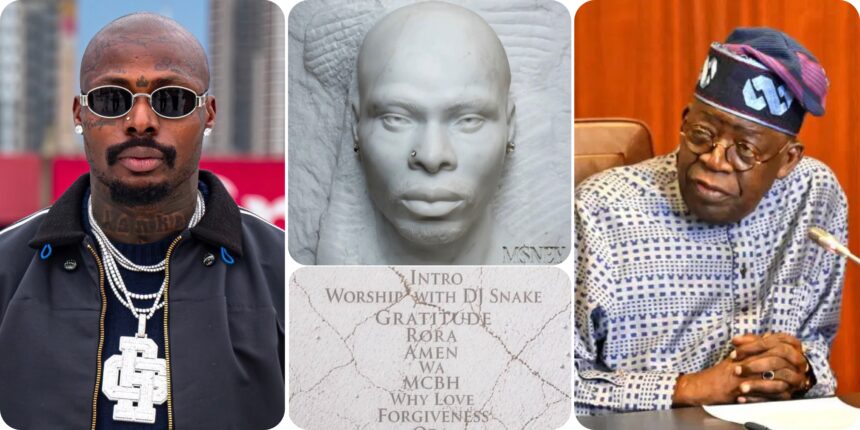
Days after the release of M$NEY, Asake has got people talking, especially about one track. “Amen,” a calm, prayer-like song, has quickly become a fan favourite, but not without debate. While some hear a message of faith and gratitude, others believe there may be something deeper in the lyrics, sparking conversations that go beyond the music. Before getting into the album and its lyrics, it’s worth asking, who is Asake?
Who Is Asake?


Asake (born Ahmed Ololade on January 13, 1995) is one of the defining voices of modern Afrobeats, known for blending Fuji-inspired melodies with high-energy street pop. Born and raised in Isale Eko, Lagos, he studied Theatre and Performing Arts at Obafemi Awolowo University before pivoting fully into music after early stints as a dancer and a road manager for comedian Broda Shaggi.
His stage name, “Asake,” is drawn from his mother’s name, popularised during his university days as “Omo Asake.” That identity which is rooted in family, culture, and the street, would later shape his sound and persona.
Since then, he has maintained a relentless rise. He has delivered back-to-back successful albums, selling out major international venues like London’s O2 Arena, and expanding his global footprint. In 2025, he launched his own imprint, Giran Republic, marking a shift toward greater creative and business control while retaining international distribution.
Across projects that range from “Work of Art” to “Lungu Boy” and now “M$NEY”, Asake’s music has remained consistent in tone: a fusion of spirituality, hustle, and street consciousness, delivered through chant-like hooks, layered vocals, and Yoruba-led lyricism.
Album Context


Released on May 1, 2026, M$NEY shows a clear change in Asake’s sound and direction. It’s his fourth album, and it focuses on themes he has always used which are faith, hustle, and success but this time from a bigger, global point of view.
The rollout hinted at that shift. One teaser showed Iraqi-Dutch sculptor Arthar Jabar hand-carving a marble bust statue of Asake, symbolising growth, pressure, and how he is shaping his legacy.
The “Mr Money” image is still there, but it feels deeper now. It’s not just about money, it’s also about gratitude, faith, and the weight that comes with success. He introduced the album with a private listening party in Lagos, adding to that high-status, aspirational feel.
The album has 13 tracks and shows more range in sound. His usual Fuji and Amapiano style is still present, but the production is richer, with orchestral and choral elements. Much of it was handled by his longtime collaborator Magicsticks.
There are also international features, including DJ Snake, Kabza De Small, and Tiakola, which helps push the album beyond Nigeria.
Songs like “Amen,” alongside “Gratitude” and “Forgiveness,” show a more reflective side of the project. Together, they highlight the album’s main ideas of growth, self-reflection, and the real cost of becoming “Mr Money.”
Lyric Analysis: “Amen”


Now to “Amen”, one of the most talked about track off the M$ONEY album. At its core, it seems like a prayer layered with affirmation, ambition, and quiet assertion of power. The structure is quite simple, but the messaging is not.
For context, the song opens with a declaration of intent and identity:
“Making money is my job / Networking and building, I dey focused
No be bad thing if I make billions… Generational wealth, that is the goal”
From the outset, Asake frames wealth not as excess, but as purpose. The language is deliberate with the use of “job,” “goal,” “focused”, positioning success as something earned, not accidental. This aligns with his long-running “Mr Money” persona, but here it feels more structured, almost philosophical.
The chorus then shifts the tone entirely:
“Amin… Help me align with my thoughts / Grant me wisdom
Trust in You, Ya Allah… Prosperity and happiness”
This is where the record finds its emotional centre. The repeated use of “Amin/Amen,” alongside “Ya Allah,” blends Islamic and general spiritual references, reinforcing a universal, faith-driven outlook. It’s less about religion as identity and more about divine alignment of success guided by something higher.
In the verse, the messaging becomes more layered and more open to interpretation:
“Speaking through the living God, divine communication…
Presido sọ pé, ‘Èmi ló kàn’, ó dẹ̀ win election
Power in the tongue… wish for all that I want”
Here, Asake leans into the idea of manifestation and words as instruments of reality. The phrase “power in the tongue” echoes a familiar spiritual principle that declaration and affirmations can shape outcome. But the reference to “Èmi ló kàn”, and a “Presido” who “wins election” introduces a shift. It’s that particular line that caught the attention of listeners, shifting the song from purely personal reflection into something that brushes against power and leadership, even if briefly.
He returns quickly to grounding themes: “Gratitude… meaningful joy… empowerment”. These closing ideas reinforce the song’s central loop of aspiration balanced by awareness. It’s like saying success is not just material; it’s emotional, spiritual, and communal.
Taken together, “Amen” operates on three levels at once: a gratitude record, a manifesto for wealth and growth, and a subtle meditation on influence. It’s that final layer where he sang briefly about authority and power that has fuelled wider interpretation beyond the music itself.
The Controversy: Pro-Tinubu Undertones?
As conversation around “Amen” grew, some listeners began to read more into certain lines, especially where the song touches on power, speech, and leadership. The moment that stands out is:
“Presido sọ pé, ‘Èmi ló kàn’, ó dẹ̀ win election”
For some fans, that line feels deeper than it looks, especially as talk around general elections begins to build again. Some believe Asake could be subtly endorsing or praising the administration of Bola Ahmed Tinubu, despite the current economic strain and public frustration. They point to the phrase “Èmi ló kàn,” which closely echoes Tinubu’s well-known “Emi Lokan” slogan that became central to his 2023 election victory.
Others, however, don’t see it that way. They argue that Asake is simply staying true to what he has always done, by making music rooted in faith, hustle, and self-belief. To them, lines about “power in the tongue” and “divine communication” are spiritual, not political, and the “Presido” mention is just a general reference to leadership and winning, not any specific person.
While Asake does not mention Bola Ahmed Tinubu directly in “Amen,” and has not said anything beyond that line, fans have continued to read different meanings into the song.
Conclusion
At a time when many Nigerians are dealing with rising costs and uncertainty, it’s not surprising that songs like “Amen” are being read through a different lens. With elections on the horizon, people are more alert, more critical, and quicker to question what their favourite artists might be saying or not saying.
For Asake, the song may simply be about faith, growth, and success. But for listeners navigating the realities of the moment, those same words can carry heavier meaning. In the end, “Amen” lands differently depending on who is listening and what they are living through.