Across global travel circles a quiet shift has been unfolding inside Europe’s border system, one that has slowly moved from policy papers into real airport experiences that travelers cannot ignore, especially those flying in from Africa and other non European regions. What began as a technical upgrade in immigration processing has now become a subject of concern, curiosity, and tension among frequent flyers who are beginning to feel the impact at arrival halls and departure gates. For many Nigerian travelers preparing for trips to Europe during busy seasons, the changes have not felt abstract at all, they have felt immediate, disruptive, and at times confusing enough to reshape entire travel plans before departure even begins.
The conversation gained more intensity after April 10 2026, when Europe fully activated a new border control framework that replaces traditional passport stamping with a biometric driven digital tracking system. As reports of congestion, long queues, and missed connections began to circulate across social media and travel communities, the system stopped being just another policy update and became a lived experience shaping how people think about Schengen travel. The shift has raised questions about timing, airport readiness, and how prepared travelers truly are for a system that records every entry and exit in real time without the familiar ink stamp on a passport page.
A New Border Reality Takes Shape Across Europe
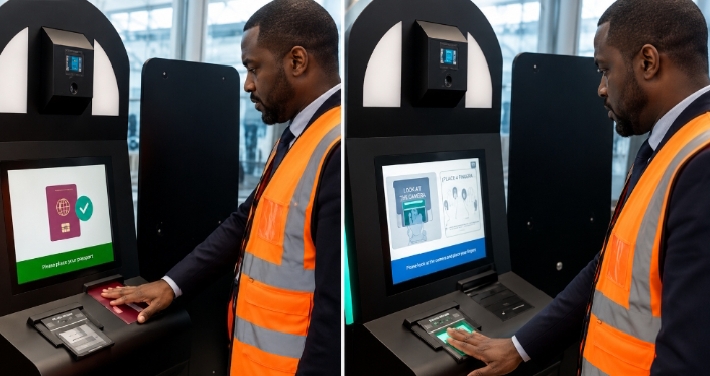
The Entry Exit System represents a major redesign of how external travelers move through European borders, officially rolled out on April 10, 2026 across participating countries within the Schengen framework. Instead of manual passport stamps, travelers are now processed through digital kiosks and immigration points that capture fingerprints, facial images, and travel details in a centralized database. Each movement into or out of the region is logged automatically, creating a record that updates instantly across border control systems.
For border authorities the system is presented as a modernization step that replaces outdated manual procedures with faster verification tools. For travelers however the experience has been mixed, especially during the initial rollout period when airports were still adjusting to new equipment, updated staffing demands, and unfamiliar passenger flows. What should have felt seamless in theory has in some locations resulted in slower processing times, particularly during peak arrival hours when multiple flights land within short intervals.
The Schengen Area which includes countries such as France, Germany, Spain, Italy, Portugal, Greece, Belgium, Netherlands, Switzerland, Norway, and several others became the central stage for this transition. Each country implemented the system within its own airport infrastructure, leading to variations in how smoothly the rollout unfolded depending on readiness levels and passenger volume.
How The Entry Exit System Changes Travel Processing
The Entry Exit System removes the familiar passport stamping process that many travelers have known for years and replaces it with biometric registration that links identity data directly to travel history. Upon first entry travelers are required to submit fingerprints and facial scans which are then stored for future verification. On subsequent visits the system retrieves stored data to confirm identity, reducing the need for repeated biometric capture.
Every entry and exit is digitally recorded, including travel dates, border location, and duration of stay. The system automatically calculates overstays by comparing recorded entry dates with exit data, removing reliance on manual checks. Authorities state that this reduces human error and improves detection of irregular travel patterns.
For first time travelers the process can take longer because biometric data must be collected and verified before clearance is granted. Once registration is completed future entries are expected to be faster, although early reports suggest that system delays are still common during peak traffic periods when multiple passengers are processed simultaneously at kiosks.
Countries Operating Under The New System
The rollout covers a wide range of European destinations frequently visited by Nigerian travelers and other international tourists. Countries fully operating under the system include France, Spain, Germany, Italy, Portugal, Greece, Belgium, Netherlands, Switzerland, Norway, Poland, and most Schengen member states.
Each of these countries applies the same digital framework but airport execution varies depending on infrastructure readiness and staffing levels. Larger hubs such as Paris, Frankfurt, Amsterdam, and Madrid have experienced heavier pressure due to high passenger volumes, while smaller airports have reported fewer but still noticeable delays during peak travel windows.
For many travelers this uneven experience has become part of the wider conversation, as expectations of uniform efficiency across Europe have been challenged by real time differences observed at different entry points.
Why Nigerian Travelers Reacted Strongly
The reaction among Nigerian travelers has been shaped by a combination of existing travel challenges and new uncertainty introduced by the system rollout. Schengen visa applications are already known for strict requirements, detailed documentation, and long waiting periods for embassy appointments. Against this backdrop any additional layer of border processing tends to attract attention quickly.
For many Nigerians the concern was not only about the system itself but about how it would interact with existing travel experiences that already include long immigration checks, secondary questioning at airports, and occasional delays during peak travel seasons. The introduction of biometric verification raised immediate questions about processing speed, fairness, and whether certain passports might experience longer scrutiny times.
Social media discussions intensified as travelers shared early reports of extended queues and missed connections. These stories spread quickly across travel communities, especially among students preparing for academic travel, tourists planning summer holidays, and professionals attending conferences in Europe. The timing was critical as April through July typically represents one of the busiest international travel periods for Nigerian outbound passengers.
Early Airport Reports Signal Operational Strain
As the system became fully active in April 2026 early reports from several European airports indicated that processing times were longer than expected during initial weeks. Passengers arriving from non European countries often faced queues lasting between two hours and four hours depending on arrival time and terminal congestion levels.
Some biometric kiosks experienced technical interruptions which slowed down passenger flow. In certain cases travelers were required to repeat scans when facial or fingerprint recognition systems failed to capture clear readings. Airport staff also reported adjustment challenges as they adapted to new procedures while managing high passenger volumes.
The situation became more visible in airports with heavy international traffic where multiple long haul flights arrived within short time windows. In such environments even small delays at biometric checkpoints quickly accumulated into longer waiting periods that affected onward travel connections.
Milan Incident Sparks Wider Attention Across Travel Communities
One of the most widely discussed incidents occurred in Milan during the early rollout period when more than 100 passengers reportedly missed a connecting easyJet flight after being held in extended border queues linked to the new biometric system. Travelers described crowded holding areas, repeated verification attempts, and confusion about processing lanes.
Although airport authorities worked to manage the situation, the incident became symbolic of early rollout challenges. It highlighted how quickly congestion can escalate when new systems are introduced without full stabilization across all operational points. The Milan case circulated widely across travel platforms and became a reference point in discussions about system readiness across Europe.
Reports from similar airports described similar patterns including long waiting times, overwhelmed staff, and passengers struggling to meet tight connection windows. While not all airports experienced disruptions at the same level, the overall perception during this early phase leaned toward caution among frequent travelers.
Government Response Across European Borders
European aviation and border agencies acknowledged early challenges and emphasized that the system was still stabilizing during initial weeks after full activation. Airports Council International Europe noted that congestion risks could increase during peak travel periods if passenger volumes continued to rise without corresponding staffing adjustments.
Some countries implemented temporary adjustments to ease pressure. Portugal reportedly suspended biometric registration at select airports during periods of extreme congestion to prevent terminal overcrowding. Greece introduced relaxed processing measures for certain categories of travelers to maintain tourism flow during high season arrivals.
Authorities maintained that these measures were temporary and intended to balance security requirements with operational efficiency while systems were fine tuned across different airports.
Data Storage Concerns Among International Travelers
One of the most discussed aspects of the Entry Exit System is data retention and digital tracking of travel history. The system stores biometric data including fingerprints and facial images alongside passport details and travel records.
For compliant travelers data may be retained for up to three years, while records linked to overstays or irregular travel patterns may be stored for up to five years according to official guidelines shared by EU authorities. This level of retention has sparked discussions among international travelers who are now more aware that border movement is permanently logged in digital systems rather than recorded manually.
Concerns have also emerged around how overstays are detected. Since the system automatically calculates duration of stay based on entry and exit records, travelers who exceed permitted time limits can be flagged immediately within immigration databases. This has increased awareness among frequent travelers about the importance of strict adherence to visa conditions.
Behavioral Shifts Among Nigerian Travelers
As awareness of the system spread, many Nigerian travelers began adjusting their travel behavior to reduce risk of disruption. One of the most common changes has been earlier airport arrival times, with travelers choosing to arrive several hours ahead of scheduled departures to allow extra time for biometric processing.
Another adjustment involves avoiding tight layovers in European hubs where immigration clearance must be completed before connecting flights. Travelers with previous experience of short layovers are now reconsidering itineraries to include longer transit windows.
First time travelers under the system are expected to experience the longest processing times due to initial biometric registration requirements. Experienced travelers who already have data stored in the system are likely to pass through faster during subsequent trips, although airport congestion can still influence timing.
ETIAS Confusion Adds To Public Uncertainty
Alongside discussions about the Entry Exit System another layer of confusion emerged around ETIAS, a separate European travel authorization system expected to come into effect later in 2026. Many travelers initially assumed both systems were active simultaneously, leading to misinformation across social platforms.
However ETIAS is not yet operational and is distinct from the Entry Exit System. Nigerian passport holders traveling to Schengen countries will continue to require traditional visas, and ETIAS primarily targets visa exempt travelers rather than visa holders.
This distinction has become important in clarifying misunderstandings that circulated during early rollout discussions, especially among travelers preparing documentation for summer travel seasons.
What Travelers Should Expect Going Forward
As the system continues to stabilize across European airports, travel experts expect gradual improvements in processing speed as staff become more familiar with procedures and biometric systems are optimized. However during peak travel periods delays may still occur, particularly at major international hubs with high passenger turnover.
Travelers are being advised to plan for additional processing time, particularly during first entry under the system. Flexibility in travel schedules has become increasingly important, especially for those connecting through multiple airports or traveling for time sensitive events.
The long term expectation is that once biometric data is fully integrated and airport systems are stabilized, processing will become significantly faster than traditional manual stamping. Until then however early disruptions remain part of the transition phase.
A New Chapter In Global Travel Experience
The Entry Exit System represents more than a technical upgrade, it marks a shift in how international mobility is recorded, monitored, and managed across borders. For Nigerian travelers the system arrives at a time when global travel already feels increasingly complex, shaped by visa requirements, economic pressures, and heightened immigration scrutiny.
What makes the current moment significant is not only the introduction of new technology but the adjustment period that follows it. Airports are adapting, travelers are recalibrating expectations, and governments are fine tuning systems that must balance security with efficiency.
For many passengers the real test will not be the technology itself but how smoothly it integrates into real travel experiences during busy seasons when every minute at immigration control can determine whether a journey continues seamlessly or takes an unexpected turn.