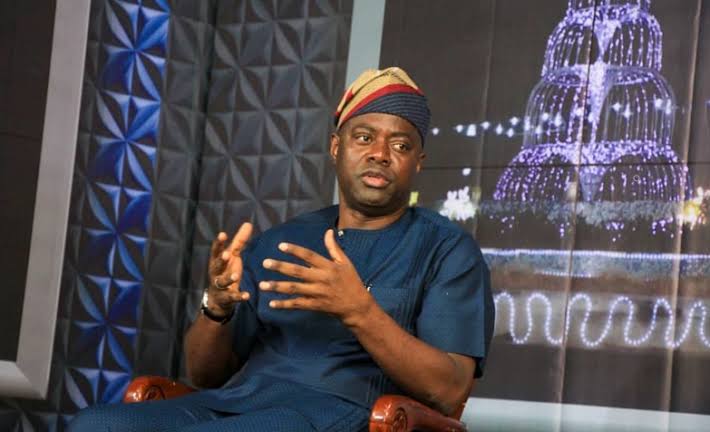
The emergence of Governor Seyi Makinde of Oyo State as a presidential contender ahead of the 2027 elections is beginning to challenge long-standing assumptions about the political direction of the South-West.
For decades, the region was regarded as one of Nigeria’s most ideologically aligned political blocs, shaped by the legacy of the late Chief Obafemi Awolowo and sustained through successive progressive political movements.
From the Action Group era in the First Republic to the dominance of the All Progressives Congress in recent years, the South-West largely maintained a reputation for coordinated voting patterns driven by shared political identity and regional solidarity.
Recent developments, however, suggest that the region may be gradually moving towards a more diverse and competitive political culture.
Governor Makinde’s increasing influence beyond Oyo State has drawn attention within opposition circles and among political observers who believe his political style represents a departure from traditional South-West partisan alignment.
His growing relevance across party divides, coupled with his independent posture within opposition politics, has positioned him as one of the most prominent political figures currently emerging from the region.
Political analysts argue that changing voter priorities, including governance performance, personality appeal and strategic coalition-building, may be weakening the dominance of inherited party loyalties in the South-West.
The implications of such a shift could prove significant for both the ruling and opposition parties as preparations for the 2027 elections gradually intensify.
Makinde formally declared his presidential ambition on the platform of the Allied Peoples Movement during a political gathering held at Mapo Hall in Ibadan, the Oyo State capital.
The event, attended by supporters of both the Peoples Democratic Party and the APM, also featured the unveiling of the “Reset Nigeria Movement,” which organisers described as a broader coalition initiative ahead of the next general election.
Addressing supporters and political stakeholders, Governor Makinde said, “We have found ourselves at a point in our political history as a nation where the very foundation of democracy is being shaken.”
He alleged that opposition parties in the country had come under increasing pressure aimed at weakening alternative political voices.
“We have witnessed the continuous meddling in the affairs of opposition parties in our dear country, with the aim of taking Nigeria to a one-party system. Without a multi-party system, there is no democracy,” he said.
Makinde described the coalition arrangement between opposition groups as a political necessity in the face of current national realities.
“They calculated and said opposition cannot unite. But I am here today to say that it is a miscalculation,” he stated.
“The opposition in Nigeria is not just political parties; the opposition is the everyday Nigerian for whom the country does not work,” he added.
Commenting on the country’s economic and security challenges, the governor said, “The economic and security situations have continued to deteriorate, putting the majority of Nigerians on survival mode on a daily basis.”
Makinde subsequently announced his presidential bid, declaring, “Today, history is being made. I pronounce today the birth of Reset Nigeria Movement.”
“Therefore today, I, Oluseyi Abiodun Makinde, announce my candidacy for the position of the President of the Federal Republic of Nigeria,” he added.
Within opposition ranks, Makinde is increasingly viewed as one of the few governors with an established political structure, sustained grassroots support and regional influence extending beyond his state.
Supporters of the governor argue that his political stability in Oyo State despite internal PDP disputes has strengthened perceptions of his national viability.
A member of the PDP Board of Trustees, Eddy Olafeso, commended Makinde’s “strategic capacity and management of resources” while also praising him for “bringing new energy and unity among political leaders.”
The participation of the APM in the coalition arrangement added another dimension to the unfolding opposition realignment ahead of 2027.
Though not traditionally regarded as a dominant national platform, the party is increasingly being considered by some political actors as a possible alternative structure for opposition mobilisation.
The national chairman of the APM, Yusuf Dantalle, described the coalition as part of efforts to strengthen democratic values in the country.
“We are determined to restore the pride of Nigerians and deepen democracy in this country,” Dantalle said.
Similarly, the national secretary of the APM, Oyadeyi Ayodele, said the alliance was designed to ensure Nigeria “reclaims its pride of place as one of the best countries in Africa.”
Before the rally at Mapo Hall, coalition leaders also signed a Memorandum of Understanding at the PDP South-West Secretariat in Ibadan.
Several speakers at the gathering criticised the ruling APC over governance and economic conditions in the country.
Former Governor Olagunsoye Oyinlola of Osun State said, “The failure of the ruling party to meet the expectations of Nigerians is responsible for this alliance. Nigerians deserve better leadership.”
Also speaking, Ali Odefa said Nigeria “cannot afford to operate a one-party system,” while urging opposition groups to unite ahead of future elections.
Despite the optimism surrounding the coalition, political observers note that alliances in Nigeria have historically faced challenges linked to personal ambition, zoning disagreements and internal power struggles.
Questions also remain over whether the “Reset Nigeria Movement” can evolve into a stable national political structure or become another temporary alliance driven by immediate electoral interests.
Nevertheless, the Ibadan declaration has already intensified political conversations around 2027 and signalled the beginning of fresh calculations within Nigeria’s opposition landscape.