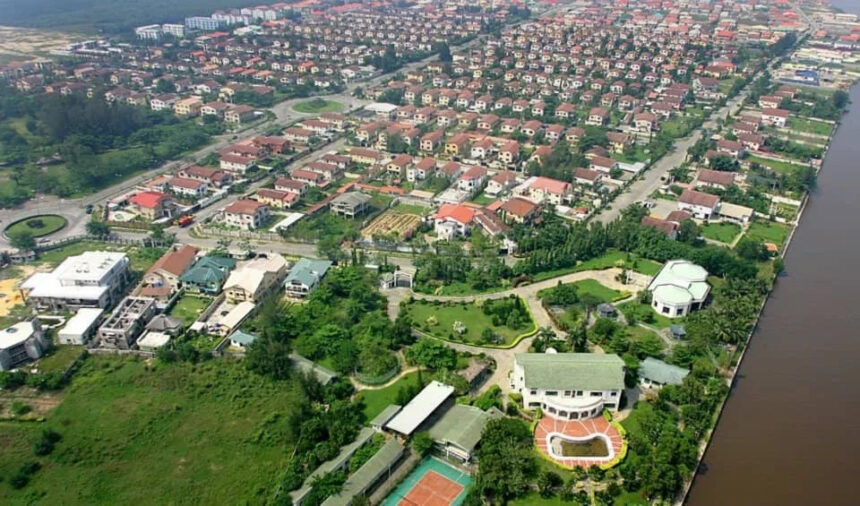
Lagos real estate has never moved in slow motion. Prices shift, new corridors open, and the investor who waited six months is always paying more than the one who moved early. But for buyers working with under N10 million, the city still has pockets worth serious attention, particularly in areas where infrastructure announcements are translating into actual construction activity.
The N10 million budget is not a limitation. It is a positioning tool. In the right Lagos location, that figure secures land that will look completely different in value terms within three to five years. The key is knowing which areas are backed by verifiable development drivers, not just developer hype.
Why Land Remains the Preferred Investment Asset in Lagos


Lagos is home to an estimated 18 to 21 million people, making it one of the most densely populated cities in Africa. Population pressure on a finite landmass continues to drive property prices upward year on year. According to data published by Nigeria Housing Market in January 2026, Lagos remains Nigeria’s most active and expensive residential property market, with price levels reflecting a sustained combination of population pressure, limited formal housing supply, and rising construction costs.
Land, specifically, outperforms other Lagos investment categories for several reasons. It requires no construction or maintenance budget after purchase. It sits in a class of assets that cannot be duplicated, only subdivided. And in an inflationary economy, it preserves naira-denominated value in ways that savings accounts or local equities cannot reliably replicate.
Nigeria Housing Market data from early 2026 shows that land prices in Lagos are currently categorised into prime, developing, and emerging zones. The emerging zone is where the sub-N10 million investor operates, and it is precisely this tier that has delivered the sharpest appreciation in recent cycles.
The Lagos-Calabar Coastal Highway, the Fourth Mainland Bridge, the Lekki Deep Sea Port, and the Lekki International Airport represent the infrastructure scaffold upon which the next decade of Lagos land prices will be built. All four are at varying stages of active development. Investors who position in corridors touched by these projects early stand to benefit the most.
Understanding the Current Price Environment
Before evaluating specific areas, it helps to understand where N10 million sits in the Lagos land market hierarchy. Nigeria Housing Market’s 2026 land price data breaks the market into three broad tiers:
Prime zones such as Banana Island, Old Ikoyi, and Lekki Phase 1 trade at between N1 million and N3.2 million per square metre. A standard 600-square-metre plot in those areas costs hundreds of millions of naira, well outside any under-N10-million conversation.
Developing zones such as Ajah and Sangotedo currently trade at between N250,000 and N500,000 per square metre, which places a standard plot between N15 million and N30 million. Entry plots in Ajah can still be found in the N8 million to N15 million range depending on the sub-location, though prices in the most accessible parts of Ajah are moving toward the upper end of that band.
Emerging zones, which include Ikorodu, Epe, the outer Ibeju-Lekki corridor, and Badagry, trade at roughly N50,000 to N300,000 per square metre. This is where N10 million buys a full standard plot in most sub-locations, and in some areas, it secures multiple plots or larger acreage.
Nigeria Housing Market pegs the general cheapest land bracket in Lagos (covering Epe, Ikorodu, and Badagry) at between N1.5 million and N15 million per full plot of approximately 500 to 600 square metres. Within that range, location, title quality, and distance from key infrastructure determine where individual parcels sit.
Best Areas to Buy Land in Lagos for Investment Under N10 Million
Finding the best areas to buy land in Lagos for investment under N10 million requires cutting through the noise of oversold estates and understanding where population growth, infrastructure spend, and genuine land scarcity are converging. Several areas meet that standard right now, and the price windows in most of them will not stay open for long.
Epe: The Investment Case Built on Proximity
Epe is the area most consistently mentioned by Lagos real estate analysts when discussing affordable land with genuine appreciation drivers. Its investment case rests primarily on proximity to three major projects: the Lekki International Airport, the Dangote Refinery, and the expanding Lekki-Epe Expressway corridor.
The Lekki International Airport, when operational, will need residential and commercial infrastructure around it. Epe sits in the natural catchment zone for that demand. The Dangote Refinery, located in nearby Ibeju-Lekki, has already begun reshaping the corridor’s economic identity, drawing workers, service businesses, and investor attention that radiates outward.
Current land prices in Epe vary considerably depending on exact location and title. Nigeria Property Centre listings active in early 2026 show estate plots ranging from approximately N3 million for basic registered-survey plots in outer Epe communities to N18 million for 500-square-metre plots in better-positioned estates with government-allocated titles. Under-N10-million options exist primarily in outer Epe communities, particularly in areas such as Iloti town and surrounding settlements, where plots of 300 to 500 square metres with registered survey documentation are available in the N3 million to N7 million range.
The risk to manage in Epe, as in most of the outer Lagos corridor, is title quality. The cheapest listings often come with only family receipt documentation, which carries legal vulnerability. Prioritising plots with at least registered survey status, or government allocation documentation working toward a Certificate of Occupancy, significantly reduces the exposure that comes with very low entry prices.
Epe is best suited to investors with a five to ten year horizon who are comfortable with illiquid land that generates no income until sold or developed. Appreciation potential is real but tied to infrastructure completion timelines, which in Lagos have historically taken longer than initially projected.
Ibeju-Lekki: The Outer Corridor That Has Already Moved
Ibeju-Lekki is no longer the undiscovered market it was five years ago. Properties in Ibeju-Lekki that sold for N15 million per plot in 2024 were commanding N25 million to N35 million by early 2026, according to transaction data published by ATLS Realtors, a Lagos property firm that tracked over 30 verified transactions in the corridor. The central and mid-corridor areas of Ibeju-Lekki are largely beyond the under-N10-million window.
However, the outer edges of Ibeju-Lekki, particularly in communities such as Eleranigbe, Akodo Ise, and some parts of the Ibeju axis beyond Eleko, still offer entry prices below N10 million. Nigeria Property Centre listings active in April 2026 show 400-square-metre plots in the Aboreji and outer Ibeju areas starting from approximately N6 million, with titles described as government allocation or registered survey.
The investment thesis for outer Ibeju-Lekki remains the Lagos-Calabar Coastal Highway, which secured a $1.26 billion financing deal in December 2025 for Phase 1, Section 2, covering the Eleko to Ode-Omi stretch. Nigeria Housing Market noted that properties within 5 kilometres of the coastal road corridor were seeing 25 to 40 percent appreciation premiums as accessibility to the Lekki Free Trade Zone and Dangote Refinery improved.
The practical caution for buyers in outer Ibeju-Lekki is that many plots in the sub-N10-million range sit in areas with no paved road access, limited drainage infrastructure, and no timeline for utility connections. This is not a reason to avoid the area, but it is a reason to inspect physically before purchasing, not just rely on estate brochures. Dry land status, in particular, must be verified because flood-prone plots in this corridor are sometimes marketed without adequate disclosure.
Ikorodu: Mainland Value With Infrastructure Momentum
Ikorodu occupies the northeastern edge of Lagos State, sitting at the intersection of the Lagos Lagoon, the Lagos-Ibadan Expressway, and the proposed Fourth Mainland Bridge corridor. For buyers seeking land under N10 million on the Lagos mainland, it currently offers one of the strongest combinations of affordability and genuine development momentum.
According to research published by Rightive Homes in late 2025, plots in various Ikorodu sub-communities were available in the N500,000 to N1.5 million range, though those represent the very lowest end of the market with minimal infrastructure. More functional estate plots in areas such as Ijede, Igbogbo, and Agbowa, with registered survey or excision documentation, were trading in the N1.5 million to N5 million range. Nigeria Property Centre listings from May 2026 show promo-priced plots in some Ikorodu estates as low as N1.5 million per 500-square-metre plot, with actual market prices in developed areas of the zone sitting closer to N5 million to N12 million for properly documented land.
The Fourth Mainland Bridge is the dominant infrastructure story for Ikorodu. The 38-kilometre bridge project moved from planning phase to active construction in 2025, with lagoon section pilework visible by January 2026. Nigeria Housing Market identified areas such as Baiyeku and Langbasa as potential beneficiaries of a significant price jump once the lagoon section completes, noting these as the ‘dark horse’ investments for 2026. These areas remain accessible under N10 million at current pricing.
Ikorodu also benefits from the Imota Rice Mill, described as the largest rice mill in Africa, which has driven logistics and residential development pressure in the Imota area. The practical living infrastructure in Ikorodu is also more developed than in Epe or outer Ibeju-Lekki, making it a more viable option for buyers who want the land to eventually support a building, not just land bank for an indefinite period.
Badagry: The Western Corridor and Long-Horizon Bet
Badagry is Lagos State’s western expansion zone, situated along the Lagos-Seme Expressway toward the Republic of Benin border. It occupies a different investment logic from the Lekki-Epe corridor areas: rather than industrial spillover, Badagry’s development thesis is centred on tourism, border-adjacent commerce, and long-term state government expansion of Lagos westward.
Land in Badagry remains among the most affordable in Lagos State. Nigeria Property Centre listings from early 2026 show standard plots in Badagry communities available from approximately N2.5 million to N6 million, with government-approved excision titles. A listing on the platform from early 2026 showed a full plot of dry land with government-approved excision at a promo price of N3 million, with an actual listed price of N6 million, plus ancillary charges including survey and deed fees.
The practical risks in Badagry are more significant than in the other areas on this list. The area is less connected to Lagos’s employment centres. Infrastructure remains limited across most of Badagry, and the timeline for development activity catching up to investor expectations is the longest of all areas discussed here. Badagry is best positioned as a very long-term land bank play, ten years or beyond, for buyers who understand they are buying into potential rather than current trajectory.
The upside argument for Badagry is that it may be the last place in Lagos State where full standard plots remain available under N5 million for some time. As the Lekki and Ikorodu corridors continue moving up in price, some capital will inevitably shift westward. But investors should enter Badagry with clear-eyed expectations about timeline.
Sangotedo and Outer Ajah: The Affordable Fringe of an Established Market
Ajah itself has moved significantly beyond the under-N10-million land market in most sub-locations. Nigeria Housing Market data shows that vacant land in Ajah now sells for N15 million to N50 million per plot, appreciating at approximately 18 to 30 percent annually in the growth zones. However, the outskirts feeding into the Ajah market, particularly areas such as Sangotedo, Awoyaya, and sections of Oribanwa, still offer entry points in the N8 million to N15 million range.
Nigeria Property Centre listings active in early 2026 show 600-square-metre residential plots in Sangotedo, off Monastery Road, with C of O titles available in the higher end of this range. A buyer working with N8 million to N10 million in this corridor will be buying a smaller plot or negotiating on a plot where documentation is working toward a full C of O rather than already holding one.
The advantage of Sangotedo and outer Ajah over the further-reaching emerging zones is proximity to established amenity infrastructure. Shops, hospitals, schools, and road connectivity are already in place. The area also benefits from Fourth Mainland Bridge appreciation momentum, which according to ATLS Realtors has already driven 15 to 25 percent year-on-year growth in the Ajah corridor. That trajectory makes even the outskirts of Ajah a competitive mid-term investment relative to areas where appreciation is more speculative.
Title Documents: What Actually Protects Your Investment
Across every area discussed in this article, title quality is the single variable most likely to determine whether a land investment succeeds or becomes a legal dispute. The Lagos real estate market has historically produced land fraud at sufficient scale that several documented cases involve buyers losing tens of millions of naira on forged or conflicted documentation. Atlas Realtors published a case study in March 2026 describing a client who nearly paid N45 million for land with a professionally fabricated Certificate of Occupancy, a fraud only caught through a Lagos Land Registry search.
The hierarchy of land titles in Lagos runs as follows. A Certificate of Occupancy, issued by the Lagos State Government, represents the strongest form of title. It confirms a 99-year right of occupancy, is bankable, and can be verified directly at the Lagos State Land Registry. When a property with a C of O is sold, the buyer must also obtain Governor’s Consent, which legally validates the transfer. Under Section 22 of the Land Use Act, a transaction involving titled land is legally incomplete without this consent.
Below C of O sits Excision with Gazette documentation. Excision means the government has formally released a portion of previously acquired land back to communities or families. A gazetted excision is generally safe to purchase, but must be independently verified. Below excision sits registered survey with deed of assignment, which carries more risk but is common in outer Lagos communities. Family receipt is the lowest tier and carries the highest legal vulnerability.
Victoria Crest Homes, a Lagos real estate firm, published a 2025 guide outlining that registration costs in Lagos generally range between 6 and 10 percent of land value, which buyers should factor into their total acquisition budget alongside the purchase price.
The practical due diligence checklist for any land purchase in these areas should include: a physical inspection of the land to confirm it is dry and accessible; a title search at the Lagos State Land Registry using the C of O file number or survey plan details; engagement of a qualified property lawyer to review all documents before any payment is made; and verification that the estate or seller can produce a valid registered survey plan signed by a licensed surveyor.
Infrastructure Timelines: Pricing in the Uncertainty
Lagos infrastructure projects have a history of significantly extended timelines. The Fourth Mainland Bridge, for example, has been announced, redesigned, and reannounced across multiple government administrations over decades. The current iteration entered active construction phase in 2025, which represents the most concrete progress the project has made. But between active construction and completion lies a timeline that buyers should not treat as fixed.
The same applies to the Lekki International Airport. The project has been cited as an appreciation driver for Epe and Ibeju-Lekki for several years, and it is real, but completion dates have shifted. The Lagos-Calabar Coastal Highway, which secured its $1.26 billion financing deal in December 2025, is arguably the most active of the major infrastructure catalysts right now, and land within 5 kilometres of the coastal road alignment has already begun reflecting price premiums.
The implication for land investors working under N10 million is this: buy in areas where the infrastructure driver is already having a visible impact on adjacent land prices, not just areas where it is projected to. Ikorodu benefits from the Fourth Mainland Bridge project that is physically underway. Outer Ibeju-Lekki benefits from the Coastal Highway financing that is confirmed and construction that is active. Epe benefits from an operational Dangote Refinery whose workforce is already present. These are different from areas whose investment thesis rests entirely on projected future announcements.
Final Assessment: Matching Area to Investment Profile
The under-N10-million land investment market in Lagos in 2026 comes down to a trade-off between current affordability and timeline confidence. Every area on this list offers genuine appreciation potential, but they each demand a different investor profile.
Ikorodu offers the strongest combination of documented infrastructure activity and mainland connectivity for buyers with a three to seven year horizon. The Fourth Mainland Bridge is physically underway, the area already has functional living infrastructure, and entry prices remain accessible across a wide band from N1.5 million to N9 million depending on sub-location and title.
Epe suits the patient buyer who understands the area’s long-term industrial and airport-driven trajectory and is not expecting early liquidity. It has the widest price range of any area on this list and the most variation in title quality, requiring the sharpest due diligence discipline.
Outer Ibeju-Lekki, particularly in the Aboreji, Eleranigbe, and Akodo areas, offers coastal road adjacency at prices still accessible under N10 million, but requires direct physical inspection and willingness to hold through a longer development cycle.
Sangotedo and outer Ajah offer the safest infrastructure environment and the most developed surrounding amenities, but the tightest budget margin under N10 million. Buyers here are paying for proximity, not just potential.
Badagry suits the very long-term investor with low urgency and maximum budget efficiency. It is the most affordable per square metre of any area discussed here, but the timeline for meaningful appreciation is the longest and least predictable.
Regardless of which area a buyer targets, no land investment in Lagos should proceed without a title search, a qualified property lawyer, a physical inspection, and a clear-eyed understanding of what the documented infrastructure activity actually means for the timeline of value realisation.