
On the night of February 1, 2026, at Crypto.com Arena in Los Angeles, a 24-year-old woman from Edenvale, Johannesburg walked away with a Grammy for the second time. Tyla, the South African singer whose 2023 breakout hit Water turned her into a global name, did it again with Push 2 Start, a sleek amapiano-rooted single she released in October 2024. She beat Burna Boy, Davido, Ayra Starr, Wizkid, and Eddy Kenzo. Again.
- The Category Itself and How It Actually Works
- What Push 2 Start Is and Why It Connected
- The Nigerian Nominees and Why They Did Not Win
- Tyla’s Broader Career Trajectory Since Water
- The Amapiano Argument
- The Fela Kuti Moment the Same Night
- What This Means for Nigerian Music Going Forward
- The Pattern is Clear, Even if the Outcome Stings
In Nigeria, the reaction was swift and pointed. Social media filled with the usual mix of disbelief and frustration. How does a South African artist keep winning a category dominated, in terms of volume and global visibility, by Nigerian acts? Five Nigerian artists were nominated this year alone. None of them won. Tyla took the only category on the night exclusively reserved for African music, and she did it without breaking a sweat.
The real question is not whether the outcome was fair. The question is what the Grammy voters saw in Push 2 Start that they did not find in Burna Boy’s Love, Davido’s With You, or Ayra Starr’s Gimme Dat featuring Wizkid. The answer, when you trace it properly, is not sentimental. It is commercial, sonic, and structural.
Why Tyla Beat Burna Boy, Davido and Wizkid to Win Best African Music Grammy 2026

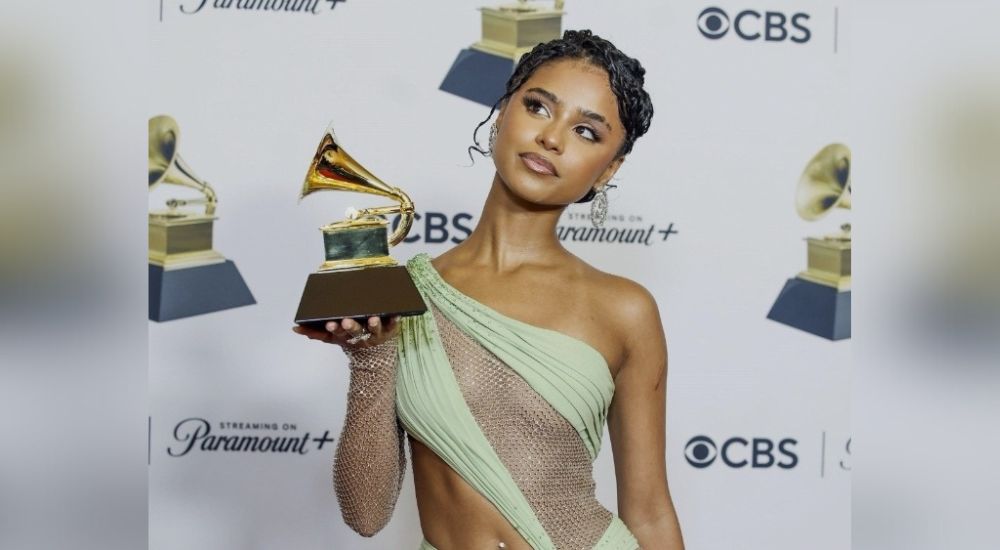
Tyla’s 2026 Grammy win for Best African Music Performance is her second in the category’s short three-year history. The first came in 2024 for Water, a song that spent 55 non-consecutive weeks at number one on the Billboard US Afrobeats Songs chart and eventually crossed one billion streams on Spotify, making Tyla the first African artist to achieve that milestone with a solo track. Push 2 Start followed a similar trajectory: it debuted at number four on the same Billboard chart in October 2024, climbed to number one, and held that position for 20 consecutive weeks before finally giving way. When it entered the Billboard Hot 100 at number 88 in January 2025, it was the highest debut among all songs led by women that week. Grammy voters don’t operate in a vacuum. Those numbers were the context they brought into their ballot decisions.
The Category Itself and How It Actually Works
The Grammy Award for Best African Music Performance was created by the Recording Academy in June 2023, with its first presentation at the 66th Annual Grammy Awards in February 2024. The Recording Academy described it as an award that recognises recordings which utilise unique local expressions from across the African continent, highlighting regional melodic, harmonic, and rhythmic musical traditions. It is not limited to any single genre.
The category sits in the Global genre field alongside Best Global Music Performance and Best Global Music Album. Unlike the general field categories that are voted on by all Grammy members, genre-specific categories are voted on by Recording Academy members who have identified expertise in that field. That means music professionals, including producers, engineers, artists, and industry executives, who have opted into the global music voting pool are casting ballots for this award.
What this means in practice is that the voter base for Best African Music Performance is not necessarily made up of Africans or people with deep familiarity with the internal hierarchies of African music. A significant portion of those voters will be weighing nominees based on what they have actually heard and engaged with in mainstream global markets, not what dominated Nigerian Twitter or Afrobeats streaming playlists in Lagos. That context matters when trying to understand why the outcome consistently favours Tyla.
What Push 2 Start Is and Why It Connected
Push 2 Start was released on October 11, 2024, as the lead single from the deluxe edition of Tyla’s self-titled debut album. The song runs for two minutes and 36 seconds and blends amapiano rhythms with pop, R&B, reggae, and elements of reggaeton. It was produced by Ari PenSmith, Mocha Bands, and Rayo, and written by Tyla alongside five other songwriters.
The song uses car metaphors to explore themes of attraction and commitment. Its production is restrained rather than busy, which keeps Tyla’s vocals at the centre. That restraint is deliberate and effective. Where many Afrobeats and amapiano productions layer heavily in the percussion and bass, Push 2 Start breathes more openly, which made it easier to crossover into radio formats designed for broader Western audiences.
It first became a TikTok phenomenon before achieving chart placement. By March 2025, Push 2 Start had crossed 100 million streams on Spotify. It went on to chart in multiple markets, including the United Kingdom, and its entry into the US Billboard Hot 100 as the week’s highest debut among women confirmed that it had achieved the kind of mainstream crossover reach that very few African songs manage.
The Nigerian Nominees and Why They Did Not Win
Nigeria brought significant firepower to the 2026 category. Burna Boy was nominated for Love, a track from his album No Sign of Weakness. Burna, who is Nigeria’s most decorated Grammy participant with 13 career nominations and one win (Best Global Music Album for Twice as Tall in 2021), also received a separate nomination for No Sign of Weakness in Best Global Music Album. Davido was nominated for With You, his collaboration with Omah Lay, drawn from his 5ive album. Ayra Starr was nominated for Gimme Dat, her collaboration with Wizkid.
All three Nigerian entries are strong records. The issue is not quality. The issue is crossover reach in the specific markets where Grammy voters pay attention. Grammy voters are predominantly US-based music professionals. The songs they encounter most, the songs that make it onto mainstream US playlists, radio, and entertainment press, carry more weight in their frame of reference when it comes time to vote.
Burna Boy is globally recognised and critically acclaimed, but Love did not generate the kind of sustained mainstream US chart presence that Push 2 Start did. Ayra Starr’s Gimme Dat featuring Wizkid performed well within African music spaces but did not break out into the broader US pop and radio ecosystem in the way Tyla’s single did. Davido’s With You, similarly, resonated deeply with Nigerian and diaspora listeners but did not achieve the crossover metrics that drive Grammy visibility.
None of this makes those songs lesser. It simply reflects a structural reality of how the Grammy voting process works and what kinds of international reach tend to produce wins.
Tyla’s Broader Career Trajectory Since Water
Tyla grew up in Edenvale on the East Rand in Johannesburg and signed with an international label in 2021. Water, released in 2023, was the track that changed everything. It swept TikTok, peaked at number seven on the Billboard Hot 100 in the United States, and introduced amapiano to a global audience that had not fully encountered the genre before. By the time it crossed a billion streams on Spotify, Tyla had entered a category of achievement that very few African artists ever reach.


Her self-titled debut album debuted in the top 25 on the Billboard 200, a ranking that reflects album sales and streaming across all genres in the United States. That is not a common milestone for African artists, and it confirmed that Tyla had built an audience beyond the African music listening base. She repeated as the top artist on the Billboard US Afrobeats Songs year-end chart in 2025, defending the title she had won in 2024 and becoming the first act to repeat the feat.
The Hybe partnership, announced in South Korea, extended her footprint further. She appeared as a Pandora brand ambassador and joined the cast of the Smurfs movie alongside Rihanna and Cardi B. These are not just celebrity milestones. They are indicators of how deeply she has embedded herself into mainstream international entertainment infrastructure, which increases her visibility among exactly the kind of global music professionals who sit on Grammy voting panels.
The Amapiano Argument
There is an ongoing conversation in Nigerian music circles about whether the Grammy voters have a genre preference that benefits South African amapiano over Nigerian Afrobeats. Tyla herself has addressed this before, stating that she represents African music broadly while promoting her South African amapiano roots. She has also argued for wider recognition of different African genres beyond the umbrella Afrobeats label.
That position is not irrelevant. The Grammy category was designed to recognise the full diversity of African music, not just the genre that happens to dominate in terms of global streaming numbers. From a purely definitional standpoint, an amapiano artist winning this category is consistent with the Recording Academy’s stated intent for the award.
What some Nigerian fans read as a bias might be more accurately described as a structural reality. Amapiano, as a genre, emerged with a distinctive, easily identifiable sonic profile that international audiences could latch onto quickly. Tyla’s particular blend adds pop and R&B accessibility on top of that foundation, making the crossover even smoother. Afrobeats has many more internal variations and subgenres, which can make it harder to package into a single Grammy-friendly sound.
The Fela Kuti Moment the Same Night
The 68th Grammy Awards had a significant Nigerian cultural moment the night before the main ceremony. Fela Anikulapo Kuti received a posthumous Lifetime Achievement Award at the Special Merit Awards on January 31, 2026. His children, Yeni, Kunle, Shalewa, and Femi Kuti, accepted the award on his behalf. It was the first time an African artist received a Lifetime Achievement Award from the Recording Academy.
That recognition was, for many Nigerians, a reminder of where African music’s deepest roots lie. Fela Kuti’s influence on global music, from James Brown and the funk tradition to contemporary Afrobeats producers, is undeniable. The posthumous honour did not soften the disappointment of Nigerian artists losing the performance category the following night, but it was a separate and historically meaningful moment.
What This Means for Nigerian Music Going Forward
Nigeria now has five Grammy nominations in the Best African Music Performance category in 2026 alone, with zero wins. Across the three years the category has existed, Nigeria has produced one winner: Tems, who won the 2025 award for her work. South Africa, with Tyla, holds two.
The pattern that emerges is not that Nigerian music is weak. The opposite is true. Nigerian music is generating more nominations than any other country in this category and is widely acknowledged as the dominant force in contemporary African music globally. The challenge is that generating nominations and winning are driven by different mechanics. Nominations reflect industry recognition of excellence. Wins reflect the voting patterns of a specific pool of music professionals, many of whom are based in the United States and calibrate their votes based on the international reach and visibility of the songs in front of them.
For Nigerian artists to convert their nomination frequency into wins in this category, the songs that make it onto the shortlist need to achieve deeper penetration in mainstream US markets and media. That is not a creativity gap. It is a market reach and distribution gap, which is a solvable problem with the right label infrastructure and international promotional strategy.
Burna Boy is already operating at that level of international infrastructure. Davido has made consistent inroads. Wizkid’s collaboration appearances on international projects have kept him visible. The wins may come. The nominations are already consistent. The gap between where Nigerian music is and where it needs to be to win consistently is narrower than the results currently suggest.
The Pattern is Clear, Even if the Outcome Stings
Tyla did not beat Burna Boy, Davido, Ayra Starr, and Wizkid because the Grammy voters are hostile to Nigerian music. She beat them because Push 2 Start achieved a specific kind of mainstream international reach in the eligibility period that none of the Nigerian entries matched. Her song topped the Billboard US Afrobeats Songs chart for 20 weeks, crossed 100 million Spotify streams during the same window, entered the Billboard Hot 100, and generated consistent playlist and radio placement in markets where Grammy voters pay attention.
She is also, by this point, an established Grammy winner. Grammy voters, across many categories, have a pattern of returning to artists who have already demonstrated the ability to deliver at that level. Tyla won in 2024, then sustained the trajectory that made her a credible repeat winner. That track record is not trivial.
Nigerian music has the talent, the output volume, and the cultural weight to win this category. What it needs is songs that achieve the specific kind of crossover into US mainstream markets that Push 2 Start managed to pull off. Until that happens more consistently, the nominations will keep coming, and Tyla or whoever matches that crossover formula will keep picking up the trophy.