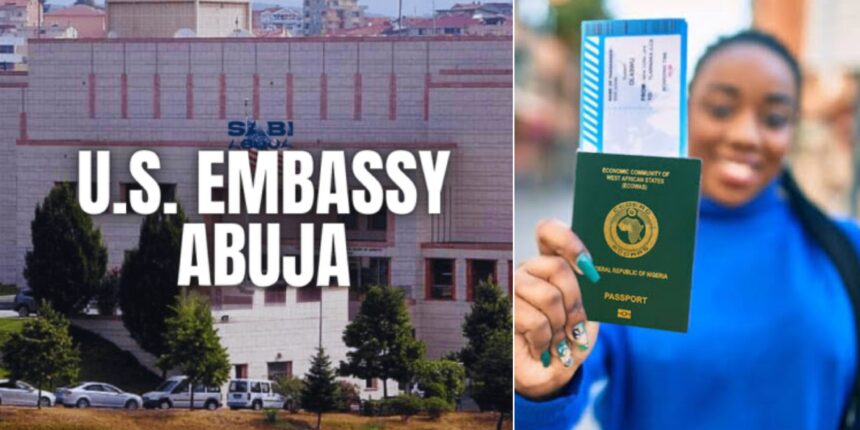
A sudden pause in visa appointments at the United States Embassy in Abuja during early April 2026 set off a wave of uncertainty that quickly spread far beyond the embassy gates, reaching students, workers, families, and travelers whose plans depended on a single interview slot that suddenly disappeared from the calendar. The change did not arrive with ceremony or long explanation, yet its effects were immediately felt across application systems, travel timelines, and scheduling platforms that rely on predictable embassy operations.
Between April 2026 and May 2026, what began as a quiet adjustment in consular operations evolved into a backlog situation that reshaped how applicants navigated both Abuja and Lagos visa processing channels. The suspension created a ripple effect that exposed how tightly linked security assessments, diplomatic staffing, and visa scheduling systems are within international consular environments.
Understanding this disruption requires more than a surface explanation of appointment cancellations. It involves tracing security developments, operational decisions, and administrative adjustments that unfolded step by step during a period marked by shifting risk assessments and recalibrated embassy functions across Nigeria’s diplomatic landscape.
Security Environment Leading Into March 2026
The months leading into April 2026 were shaped by updated international travel advisories issued for Nigeria, with particular attention placed on security conditions within Abuja and surrounding regions. During late March 2026, assessments referenced rising concerns related to kidnapping incidents, localized unrest in certain northern areas, and sporadic security disruptions that influenced diplomatic risk calculations.
By early April 2026, Nigeria remained under a Level 3 advisory classification, while specific regions were categorized at Level 4 designation, reflecting elevated caution levels. These classifications are part of a structured global framework used to guide diplomatic posture and consular operations, especially in locations where security conditions fluctuate.
Although these advisories do not directly halt visa services, they often form the background conditions that influence internal embassy decisions regarding staffing, movement, and public service capacity.
Operational Adjustment Phase
Between April 8 2026 and April 9 2026, a significant operational adjustment occurred at the United States Embassy in Abuja. Diplomatic sources confirmed authorization for non essential personnel and family members of staff to leave Abuja, a move typically associated with heightened precautionary measures within diplomatic missions.
This step reduced the embassy’s operational footprint and shifted focus toward essential diplomatic functions only. While core embassy responsibilities continued, the reduction in staffing capacity had direct implications for public facing services, particularly visa interview scheduling which depends heavily on trained consular officers.
This adjustment marked the transition from advisory based concern to operational restructuring within the embassy environment, setting the stage for changes in visa appointment availability.
Visa Appointment Suspension
On April 9 2026, the embassy implemented a suspension of all visa interview appointments in Abuja. Applicants were informed through official communication channels that previously scheduled interviews would be rescheduled and that further instructions would be provided via email.
At the same time, it was clarified that the United States Consulate in Lagos would continue operating fully, maintaining its visa processing capacity without interruption. This distinction became central to how applicants redirected their plans during the disruption period.
The suspension did not represent a permanent closure of visa services but rather a temporary halt in interview processing at the Abuja location. Essential services related to American citizens remained active, ensuring continuity of critical consular responsibilities.
Immediate Impact On Visa Categories
The suspension affected a wide range of non immigrant visa categories processed in Abuja. These included tourist visa applications under B1 and B2 classifications, student visa applications under F1 and J1 categories, and work related visa categories such as H1B processing. Routine interview scheduling for new applicants was also paused.
Applicants who had already secured appointments received rescheduling notifications, while new applicants were unable to enter the Abuja appointment system during the suspension period. This created an immediate halt in forward scheduling, effectively freezing the Abuja visa pipeline.
Lagos, as the alternative processing center, remained the only active location for standard visa interviews, absorbing redirected demand from applicants who could not wait for Abuja reopening timelines.
Development Of Backlog
Although the suspension officially began in April 2026, its impact extended well into May 2026 due to accumulated scheduling disruptions. A major factor was the cancellation and postponement of already booked appointments, which created a queue of applicants awaiting new dates.
The absence of new scheduling slots in Abuja meant that the entire April booking cycle collapsed, preventing normal flow of appointments for both first time applicants and rescheduled cases. This created a compounding backlog effect that carried into subsequent weeks.
Lagos experienced increased pressure as applicants attempted to switch locations, leading to extended waiting periods and reduced availability of interview slots. The redistribution of demand intensified scheduling congestion across the consular system.
Security Posture And Diplomatic Staffing Considerations
The underlying reasons for the suspension are closely linked to security posture evaluations conducted by diplomatic authorities. The decision to reduce staffing levels in Abuja reflected broader assessments of risk conditions, particularly in relation to urban security stability and regional volatility.
Embassy operations are structured around the principle of staff safety, which directly influences public service capacity. When staffing levels decrease, non essential services such as routine visa interviews are often the first to be scaled down in order to maintain essential diplomatic functions.
This mechanism explains why Abuja, as the primary embassy location, experienced the initial suspension of visa processing services.
Role Of Global Risk Classification Systems
The United States maintains a global travel advisory system that categorizes countries and regions based on security conditions. Nigeria remained at Level 3 during this period, indicating a recommendation to reconsider travel, while certain regions were placed at Level 4, indicating avoidance advisories.
These classifications do not automatically trigger service suspension but are frequently referenced when determining consular staffing and operational decisions. When combined with internal security assessments, they contribute to decisions regarding embassy service adjustments.
In the case of Abuja, these factors formed part of the broader decision making environment that led to temporary suspension of visa appointments.
Redistribution Of Visa Processing To Lagos
With Abuja operations reduced, Lagos became the primary processing center for visa interviews during the suspension period. This redistribution created a centralized demand structure, concentrating applicants in a single location.
The Lagos consulate continued full operations, but the sudden increase in applicant volume led to tighter scheduling availability. Applicants who previously planned to attend interviews in Abuja were required to adjust their travel plans, often resulting in longer waiting periods.
This shift highlighted the dependence of Nigeria’s visa processing system on multiple operational centers working in balance to manage national demand.
Impact On Applicants Across Categories
The suspension affected a wide range of individuals with varying timelines and obligations. Students preparing for academic programs faced uncertainty regarding admission deadlines, particularly those applying under F1 and J1 visa categories. Work related applicants under H1B classifications also experienced scheduling delays that impacted employment start dates.
Tourist visa applicants encountered rescheduling uncertainty, with many receiving notifications without immediate alternative dates. The absence of clear reopening timelines contributed to planning difficulties across all categories.
The Lagos system absorbed much of this demand but experienced increased congestion as a result.
Administrative Structure Behind Suspension
Embassy operations rely on a structured hierarchy of decision making that integrates security assessments, staffing evaluations, and consular workload management. The suspension of visa appointments in Abuja reflected a coordinated administrative response rather than a single policy directive.
Such decisions are typically implemented when operational capacity falls below the threshold required to maintain standard service levels. In this case, reduced staffing combined with security posture adjustments created conditions that necessitated temporary suspension of interview scheduling.
The structure of this response reflects standard diplomatic practice in environments where risk levels and operational capacity must be continuously balanced.
Broader Diplomatic Implications
The suspension of visa appointments in Abuja during April 2026 reflects broader themes in international diplomacy, particularly the relationship between security conditions and public service delivery. Embassy operations often function as indicators of broader geopolitical and security assessments.
While the suspension was limited to visa interviews, its impact extended into public perception of mobility, travel planning, and administrative reliability. It also highlighted the interconnected nature of diplomatic missions across different cities within a single country.
The Lagos consulate’s continued operation demonstrated the importance of distributed consular systems in maintaining continuity during localized disruptions.
Resolution Pathway And System Recovery
By late May 2026, efforts were underway to manage backlog conditions and stabilize scheduling systems. Applicants affected by the suspension were gradually reassigned or rescheduled based on availability in Lagos or future Abuja timelines once operational capacity allowed.
The recovery process depended on normalization of staffing levels and reassessment of security conditions within Abuja. These factors typically determine when suspended services can be gradually reinstated.
The system adjustment phase emphasized controlled restoration rather than immediate resumption of full appointment capacity.
Leaving With This
The suspension of visa appointments at the United States Embassy in Abuja during April 2026 emerged from a combination of security assessments, staffing adjustments, and operational restructuring that temporarily reduced consular capacity. While the decision was limited to interview scheduling, its effects extended into May 2026 through backlog accumulation and redistribution of applicants to Lagos.
The event illustrates how diplomatic missions operate within complex environments where security conditions, administrative decisions, and public service demands intersect. It also highlights the sensitivity of visa processing systems to operational changes, particularly in regions where embassy staffing levels directly influence service availability.
As the situation moved toward stabilization, the focus shifted to managing backlog recovery and restoring balanced processing between Abuja and Lagos, ensuring that applicants could continue their travel plans within a gradually normalizing system.