There was a time when getting a US visa from Nigeria was hard mostly because of the waiting. You filled the forms, paid the fees, sat in a chair at the consulate, answered a few questions, and hoped the officer believed you had reasons to come back home. That process still exists. But 2026 has added several layers on top of it that anyone trying to travel to America needs to understand before they pay a single naira in fees.
- The Step-by-Step Application Process
- What the 2026 Travel Ban Actually Means for Nigerians
- The Visa Bond That B1/B2 Applicants Now Have to Pay
- Documents to Gather Before Your Interview
- Abuja Embassy vs Lagos Consulate: Where to Apply and What to Expect
- Interview Waiver: Who Can Skip the Long Queue
- Processing Times and What Happens After Your Interview
- Section 214(b) Denials and How Nigerian Applicants Can Respond
- Navigating the US Visa Process as a Nigerian in 2026
Since January 1, 2026, Nigeria sits on a US travel restriction list under Presidential Proclamation 10998, signed by President Donald Trump on December 16, 2025. That proclamation partially suspended visa issuance for Nigerians seeking B1/B2 tourist and business visas, F and M student visas, J exchange visitor visas, and virtually all immigrant visas. Then, three weeks later, a separate bond requirement came into force, demanding that any Nigerian found eligible for a B1/B2 visa post a refundable financial guarantee of up to $15,000 before the visa can be issued. These are not rumours circulating on Twitter. They are active US government policy.
None of this means the door is permanently shut. Work visas like H-1B and L-1 are not suspended, just shortened in validity. Nigerians who held valid visas before January 1, 2026 were not affected. Certain national interest exceptions still exist. The consulates in Abuja and Lagos remain open and processing applications. But the landscape has changed significantly, and going in without understanding what those changes mean is how people waste money, accumulate visa denials on their record, and create problems for future applications.
How to Apply for a US Visa in Nigeria 2026
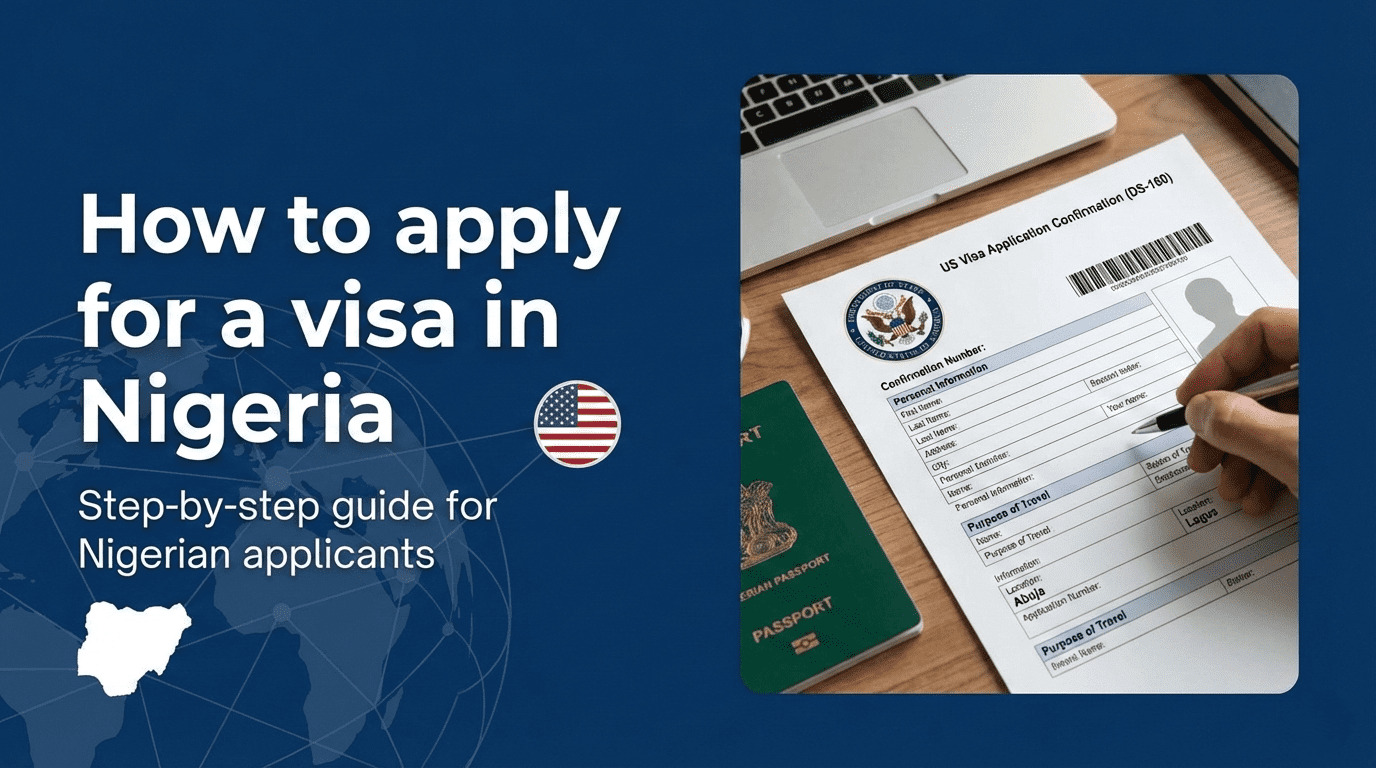

Applying for a US visa in Nigeria in 2026 follows the same foundational steps it always has, but several key requirements have shifted in ways that matter enormously. From the appointment booking system to the bond payment to how officers now assess ties to Nigeria, this guide covers what the process actually looks like on the ground right now.
The Step-by-Step Application Process
Everything starts online. The first thing to do is figure out what visa category you need. The US Embassy and Consulate in Nigeria have a Visa Wizard on their website at ng.usembassy.gov that helps you identify the right category based on your purpose of travel. For tourist and business visits, that is the B1/B2. For students heading to a US university, it is the F-1. For temporary skilled workers, H-1B or other work visa categories apply. Getting the category wrong wastes time and money because fees are non-refundable.
Once you know your visa type, the process runs in this order: pay the visa application fee, complete Form DS-160, then schedule your interview using the AVITS appointment system.
The visa application fee for B1/B2 tourist and business visas is $185. Student visas (F and M) also cost $185. Work visas like the H-1B carry higher fees. Payment can be made in naira at First Bank of Nigeria via cash deposit or electronic funds transfer using a payment slip generated from the AVITS portal, or directly by card in US dollars online. You have three days from generating the payment slip before it expires, so do not generate the slip until you are ready to pay. After a bank payment, allow one business day for processing before moving to the next step. Card payments are processed immediately.
After paying, fill out Form DS-160 at ceac.state.gov. This is the nonimmigrant visa application form. It asks for your personal details, travel history, employment background, family information, and the specific purpose of your trip. Be thorough and accurate. Inconsistencies between your DS-160 and what you say at the interview are one of the fastest ways to get denied. After submitting the form, you will receive a confirmation page with a barcode that begins with AA followed by two zeros. Print that page and keep it. You will need it.
Starting April 22, 2025, the US Mission introduced a rule that the DS-160 barcode on your confirmation page must exactly match the one tied to your appointment booking. If they do not match, you will be turned away at the gate before your interview even begins. If you discover a mismatch, log into your AVITS account at least ten days before your interview and raise a support ticket requesting correction. Do not wait until the day before. Correcting it after the fact requires rescheduling, which in Nigeria means going to the back of a very long queue.
To schedule your interview, create an account on the AVITS system at usvisaappt.com. This system replaced the old USTravelDocs platform in August 2024. If you have an account on USTravelDocs, it no longer works for new appointments. On AVITS, you enter your DS-160 confirmation number and payment receipt details, then choose your interview location and pick an available date. Both the US Embassy in Abuja and the US Consulate General in Lagos handle nonimmigrant visa interviews.
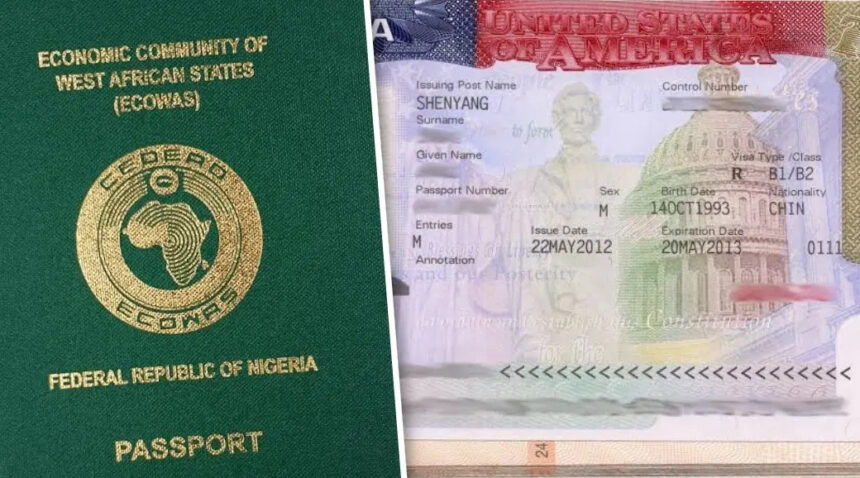
On the day of your interview, arrive at the embassy or consulate with your valid international passport (minimum six months validity beyond your intended stay, with at least two blank pages), your DS-160 confirmation page with the matching barcode, your visa fee payment receipt, two passport photographs meeting US visa photo specifications, and your supporting documents. You will provide fingerprints, and a consular officer will interview you. Do not bring mobile phones, laptops, cameras, or large bags into the premises. There is no storage facility on site.
What the 2026 Travel Ban Actually Means for Nigerians
Under Presidential Proclamation 10998, Nigeria falls in what the US government classifies as a partial suspension category. This is distinct from the full ban that applies to countries like North Korea or Syria, where nearly all entry is blocked. For Nigeria, the suspension targets specific visa categories rather than all travel.
What is currently suspended for new applicants: B-1 and B-2 visitor visas, which cover tourism, family visits, and short business trips. F visas for academic students. M visas for vocational and non-academic students. J visas for exchange visitors and au pairs. All immigrant visas, meaning green card applications through family or employment petitions, are also paused under a separate order that took effect January 21, 2026.
What is not suspended: H-1B and other work visa categories for people with employer sponsorship, L-1 intracompany transfer visas, O visas for those with extraordinary ability, and certain diplomatic categories. However, for all non-suspended nonimmigrant visa categories, the proclamation directs consular officers to reduce visa validity, often to single-entry visas valid for just three months. If you are renewing an H-1B, for instance, do not expect the usual multi-year multiple-entry validity you may have received before.
The proclamation does not touch people who already held valid visas on January 1, 2026. If your B1/B2 or F visa was valid before that date, it was not revoked. Green card holders are also exempt. Dual nationals traveling on a passport from a country not subject to the ban can apply under that passport without facing the same restrictions. An exception process also exists for case-by-case national interest determinations by the Secretary of State, though in practice this is a narrow pathway.
The US government stated reasons for including Nigeria specifically: an overstay rate of 5.56% for B1/B2 visas and 11.90% for F, M, and J visas, cited in official filings. Security screening difficulties linked to the presence of groups like Boko Haram in parts of the country were also stated. There were also concerns about cooperation on accepting repatriated nationals. These are the stated grounds, and they matter because they tell you what an officer is thinking about when they look at a Nigerian passport in 2026.
The proclamation has no expiration date built in, but the Secretary of State is required to review the restrictions every 180 days and report to the President. The US Mission in Nigeria confirmed as recently as March 2026 that the restrictions remain subject to review based on security and global conditions. That means change is possible, but there is no timeline for it.
The Visa Bond That B1/B2 Applicants Now Have to Pay
This is the part of the 2026 rules that has caught the most Nigerians off guard. Even if a consular officer decides you are eligible for a B1/B2 visa despite the partial suspension, you cannot receive that visa until you post a financial bond ranging from $5,000 to $15,000. The bond took effect for Nigerians on January 21, 2026.
The bond is not a fee. It is not money you hand over and lose. It is a refundable financial guarantee that you will comply with the terms of your visa and leave the United States before it expires. If you depart on time, the full amount comes back to you. If you overstay, the bond is forfeited to the US government. Think of it as a deposit the US government holds while you are on their soil.
The amount, whether $5,000, $10,000, or $15,000, is not fixed in advance. The consular officer at your interview determines the figure based on your individual circumstances: your financial profile, your ties to Nigeria, your travel history, your previous compliance with US visa rules. You will not know which amount applies to you until after you have had the interview and been found eligible.
To pay the bond, you must complete Department of Homeland Security Form I-352. Then, payment is made through the US Department of the Treasury’s official online platform, Pay.gov. The US Embassy has been explicit that applicants must not use any third-party website, agent, or individual claiming to facilitate bond payment. Do not pay before the consular officer gives you the instruction to do so. People have lost money to scammers operating in this space.
There is one more condition attached to the bond: applicants subject to it must enter and exit the United States through a commercial airport with CBP (Customs and Border Protection) presence. Charter flights, general aviation, land borders, and seaports do not qualify. In practice for Nigerians, this means flying through major US airports like JFK, LAX, ATL, ORD, or similar hubs. This is how most Nigerians travel anyway, but it is now a formal condition.
Under the current pilot program, visas issued under the bond requirement are valid for a maximum of three months and allow only a single entry into the United States, with a maximum authorized stay of 30 days. That is a dramatic reduction from the ten-year multiple-entry B1/B2 visas Nigerians could receive before 2026.
Documents to Gather Before Your Interview

The consular officer at your interview makes a decision in minutes. The documents in your folder are what give you any real chance of influencing that decision. Every document you bring should do one of two things: confirm who you are, or prove you have a reason to return to Nigeria.
The universal requirements are a valid international passport, the DS-160 confirmation page with the matching barcode, your AVITS appointment letter, your visa application fee receipt, and two US-specification passport photographs taken within the last six months. For student visa applicants, you will also need your school’s I-20 form and evidence of paying the SEVIS fee, which is $350 for F visa holders and $220 for most J visa holders.
Beyond the basics, the documents that actually move the needle are those that demonstrate your ties to Nigeria. These are what officers are looking for in 2026 specifically, given that Nigerian B1/B2 overstay rates are part of the official record that led to the restrictions. Bank statements showing consistent account history, not a sudden unexplained deposit right before the interview, are important. Three to six months of statements is the typical expectation.
Employment letters from your employer on official letterhead stating your role, salary, and that you have approved leave for the trip serve this purpose. Business owners should bring their CAC registration documents, recent business bank statements, and evidence that the business operates in Nigeria. Property ownership documents, land titles, a tenancy agreement in your name, or evidence of dependants in Nigeria who rely on you all strengthen the case that you have something substantial to come back to.
If you are a student in Nigeria or were recently admitted to a Nigerian university, bring your admission letter or school ID. For medical visits, bring the referral letter from a Nigerian doctor and documentation of the appointment or treatment you are traveling for. For business visits, bring the invitation letter from the US company or organisation you are visiting, along with documentation of your Nigerian business relationship with them.
One thing that will hurt your application regardless of how thick your folder is: inconsistency. If your DS-160 says you are employed at Company X earning a certain amount, and your bank statement does not reflect that, the officer will notice. If your stated purpose of travel does not match your financial documents, they will notice that too. The interview is short, but officers are trained to identify gaps.
Abuja Embassy vs Lagos Consulate: Where to Apply and What to Expect
There are two places in Nigeria where you can apply for a US visa: the US Embassy in Abuja, located at Plot 1075, Diplomatic Drive, Central Business District, and the US Consulate General in Lagos at 2 Walter Carrington Crescent, Victoria Island. Both handle nonimmigrant visa applications. Immigrant visa applications, to the extent they are still processing at all given the January 2026 pause, are handled exclusively in Lagos.
The wait time difference between the two locations is significant. As of mid-2025, the next available B1/B2 appointment in Abuja was roughly seven months out, while Lagos was running at thirteen months. Data from early 2026 suggests Lagos wait times for B1/B2 have stretched into the 250 to 400 day range. Abuja runs shorter queues, in the 200 to 300 day range for B1/B2. These numbers shift as the embassy releases new appointment batches, so checking the AVITS system regularly to catch newly released slots is genuinely useful strategy.
You should apply at the location in your country of residence or nationality. For most Nigerians, either location qualifies, but note that the DS-160 you fill must specify the same location where you book your interview. Mixing them up triggers the barcode mismatch problem mentioned earlier.
For immigrant visa applicants who are still permitted to proceed (those with case-by-case national interest exceptions), Lagos now operates a two-visit process that became mandatory from January 2025. The first visit is an in-person document review appointment, where consular staff check that your paperwork is complete. The consulate notifies you by email of this appointment date, which typically falls two to four weeks before your actual visa interview. You do not schedule the document review yourself. The second visit is the interview with a consular officer. If you miss or skip the document review, you will be required to reschedule your interview.
Business hours at both locations are Monday through Thursday, 7:00 a.m. to 4:00 p.m., and Friday 7:00 a.m. to 1:00 p.m. No consular services on Fridays. Do not bring any electronic device, large bag, or prohibited item to your appointment. Abuja has seen heightened security conditions in early 2026, with the US Mission authorising voluntary departure for non-emergency government staff, though consular operations for the public have continued at both sites.
Interview Waiver: Who Can Skip the Long Queue
Not everyone in Nigeria has to sit through the standard interview process. The US Mission in Nigeria offers an interview waiver, sometimes called the dropbox process, for qualifying applicants renewing their visa. If you qualify, you submit your documents without attending an interview, which cuts down the waiting substantially.
The eligibility window for the waiver was expanded in 2025 to 48 months, meaning if your most recent US visa expired within the past four years, you may qualify to renew without an interview. The conditions are specific and all must be met: your previous visa must have been issued in Nigeria, it must have been the same category as the visa you are now applying for, it must have been a full-validity multiple-entry visa, and you must have no adverse US immigration history.
You must also present all passports that cover the entire period since your previous visa was issued, along with the passport containing that visa. Each applicant meets the criteria individually. Parents cannot extend their eligibility to children who do not individually meet all the conditions. Minors qualify only if they personally satisfy every requirement on their own.
Even if you qualify for the waiver, processing takes up to two months. During that time, you cannot retrieve your passport. This is a hard practical consideration if you have domestic travel plans or need your passport for anything else. The waiver application is also processed through the AVITS system.
Given the 2026 restrictions, if your previous B1/B2 was valid on January 1, 2026 and it falls within the 48-month window, the waiver path may be the most viable route for obtaining a new B1/B2. The partial suspension applies to new applicants; the renewal pathway under the waiver has been used by some applicants, though the outcome still depends on consular officer discretion and the bond requirement still applies at the end of the process.
Processing Times and What Happens After Your Interview
The visa interview itself is usually short, sometimes just a few minutes. But the timeline from fee payment to having a visa in your passport is considerably longer in 2026. For context, Nigerians face some of the longest B1/B2 appointment wait times in the world right now, with Lagos regularly appearing alongside Mumbai and Mexico City on lists of embassies with the heaviest backlogs.
After your interview, if the officer approves your visa, you will not receive it immediately. Your passport goes through processing, and the visa is typically ready for pickup within one to three business weeks from the interview date. Some applications get flagged for what is called administrative processing, which involves additional background checks. When this happens, the timeline extends further, sometimes significantly, and there is no set duration for how long it takes. You will receive an email notification when administrative processing is complete.
For applicants subject to the bond requirement, there is an additional step between approval and issuance: you must pay the bond and submit Form I-352 through Pay.gov. The visa cannot be issued until that is done. Budget time for this. If there are technical difficulties with Pay.gov or delays in confirmation, it will affect when you receive your visa. The consular officer gives you instructions on how to proceed with the bond payment at the time of the interview.
Applicants whose cases require administrative processing may find that their bond period and payment window intersects awkwardly with the processing timeline. This is a genuinely new complication that did not exist before 2026. Getting clarity on next steps from the consulate directly, via the AVITS customer service line or email, is the practical way to manage this.
If your visa is denied, you will be told at the interview. You will not always receive a detailed explanation, but you will receive a written notice citing the legal basis for the denial. The most common basis is Section 214(b) of the Immigration and Nationality Act, which is covered in the next section. Keep the denial letter. It affects future applications and matters when you apply again.
Section 214(b) Denials and How Nigerian Applicants Can Respond
Under Section 214(b) of the US Immigration and Nationality Act, every foreign national applying for a nonimmigrant visa is presumed to be intending to immigrate permanently unless they can prove otherwise. This is the default starting position of every consular officer looking at a Nigerian passport in 2026. The burden of proof sits with the applicant from the first moment.
What satisfies an officer is evidence of what immigration lawyers call ties to Nigeria, specific circumstances in your life that create compelling reasons to return home after your visit. The stronger and more concrete those ties are, the more credible your application becomes. Abstract statements like ‘I intend to return’ carry no weight. Documentary evidence does.
Strong ties look different depending on your situation. A salaried employee with an active employment letter, consistent bank statements, a tenancy agreement in their name, and clear documentation of what the trip is for is a more credible applicant than someone who is self-employed with unclear income history, few assets on record, and a vague travel purpose. This is not about wealth. An officer does not need to see millions in a bank account. They need to see a coherent picture of a life in Nigeria that the applicant has reason to return to.
The 2026 environment has raised the bar on this. The official data cited in the proclamation shows that roughly one in eighteen Nigerians who received a B1/B2 visa overstayed it, and nearly one in eight F/M/J visa holders did the same. Those statistics inform how officers approach Nigerian applications at the interview stage, even for applicants who have no personal history of visa violations. Being aware of this context is not about feeling discouraged. It is about understanding what you are walking into and preparing accordingly.
If you receive a 214(b) denial, you can reapply. There is no mandatory waiting period for most denial types, but reapplying immediately with the same documents and the same circumstances produces the same result. The useful approach is to address specifically what weakened the previous application: stronger financial documentation, a clearer and more compelling purpose of travel, additional ties to Nigeria, or simply waiting until your circumstances genuinely improve.
It is also worth knowing that a visa denial is recorded. Future applications from other countries, including the UK and Canada, may ask about previous US visa denials. Answer honestly. Misrepresentation on a visa application is grounds for a lifetime ban, and it is the kind of complication that makes an already difficult situation irreversible.
Navigating the US Visa Process as a Nigerian in 2026
The US visa process for Nigerians has always been demanding. In 2026, it has become more so. The combination of the partial travel ban, the B1/B2 bond requirement, appointment wait times that stretch well past a year in Lagos, and heightened scrutiny under 214(b) means that anyone approaching this process casually is setting themselves up for disappointment.
That said, visas are still being issued. Work visas continue to move for Nigerians with employer sponsorship. Renewal applicants with previous compliance history have a pathway through the interview waiver. Dual nationals with passports from unrestricted countries have options. And the restrictions themselves are under 180-day review cycles, meaning the current restrictions are not necessarily permanent features of this process.
What practical preparation looks like right now: start your application process much earlier than you ever have before, given the wait times. Build your documentation specifically around demonstrating ties to Nigeria rather than just meeting the minimum checklist. If your purpose of travel is business, have a clear documented business case. Do not pay any bond or attempt to expedite your process through unofficial channels. Use only official government platforms: ceac.state.gov for DS-160, usvisaappt.com for AVITS, and Pay.gov for the bond if it applies to you. And keep a close eye on updates at ng.usembassy.gov because the policy environment has been moving quickly and is not finished moving.