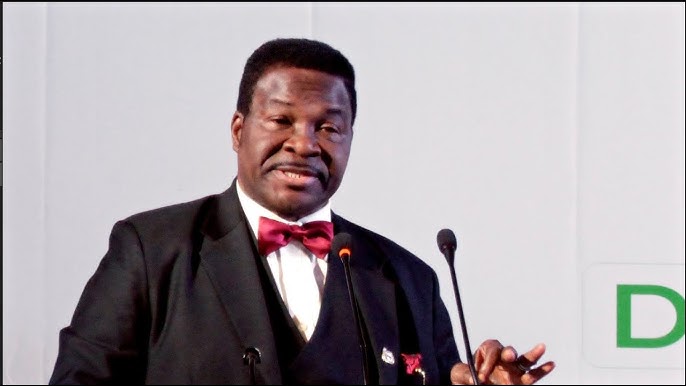
The Legal Practitioners’ Privileges Committee has suspended Chief Mike Ozekhome from the rank of Senior Advocate of Nigeria, one of the most consequential disciplinary actions to hit the Nigerian Bar in years.
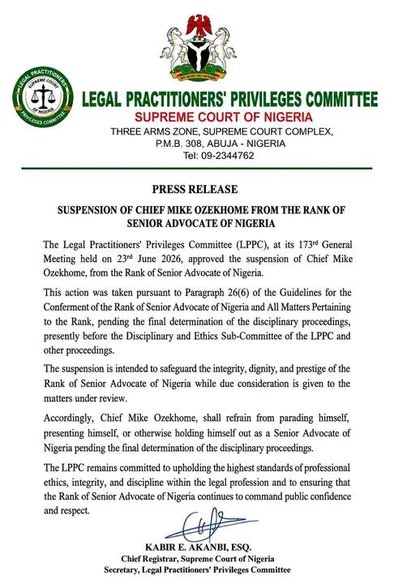
The decision came at the LPPC’s 173rd General Meeting on 23 June 2026 and was announced the following day in a statement signed by the Chief Registrar of the Supreme Court, Kabir Akanbi, who doubles as the committee’s secretary. Effective immediately, Ozekhome is barred from identifying himself as a SAN until the conclusion of disciplinary proceedings currently before the committee’s Disciplinary and Ethics Sub-Committee.
What the LPPC Actually Said
The committee did not mince words. Citing Paragraph 26(6) of the Guidelines for the Conferment of the Rank of Senior Advocate of Nigeria, the LPPC said the suspension was necessary to protect the rank’s integrity while the proceedings run their course.
“Chief Mike Ozekhome shall refrain from parading himself, presenting himself, or otherwise holding himself out as a Senior Advocate of Nigeria pending the final determination of the disciplinary proceedings,” the statement read.
The committee added that it remains “committed to upholding the highest standards of professional ethics, integrity, and discipline within the legal profession” and that the SAN rank must continue to command public confidence.
Critically, the LPPC noted the suspension is not a finding of guilt. It is an interim measure, not a verdict.

The London Property Case: How It All Started
To understand the suspension, you have to go back to a disputed house in North London, and a series of events that have drawn scrutiny from courts in two countries.
The property at 79 Randall Avenue, Neasden, London NW2, sits at the heart of everything. In August 2021, Mike Ozekhome applied to the UK’s First-tier Tribunal to have the property transferred into his name. His account was that a man known as Tali Shani gifted him the house in appreciation for legal services rendered.
That account was challenged almost immediately. Westfields Solicitors, acting for “Ms Tali Shani,” argued in September 2022 that she was the registered owner since 1993 and had never signed any transfer document. The situation became murkier as the tribunal dug into the identity documents attached to the competing claims.
What the UK tribunal found, in its September 2025 ruling, was damaging. Judge Paton concluded the case had been “built on forgery and deception.” Fraudulent Nigerian identity records had been used: a passport, a National Identification Number (NIN), and a Tax Identification Number (TIN), all allegedly created with the involvement of corrupt officials at the National Identity Management Commission, the Immigration Service, and the Federal Inland Revenue Service. The NIMC itself admitted in evidence that the NIN assigned to “Ms Tali Shani” was generated remotely from Monaco, with a forged photograph, bypassing biometric checks.
The tribunal ruled the property was actually part of the estate of the late Lieutenant General Jeremiah Useni, the former FCT Minister under Sani Abacha, who died in France in January 2025. Useni had testified by video link in 2024. His son, Ponfa Useni, would later become a co-defendant in the Nigerian criminal proceedings.
The Criminal Charges
Following the UK tribunal’s ruling, the Independent Corrupt Practices and Other Related Offences Commission launched an investigation, triggered by a petition from Olanrewaju Suraj of the Human and Environmental Development Agenda (HEDA).
In January 2026, criminal charges were filed against Ozekhome before the High Court of the Federal Capital Territory. The three-count charge covered the alleged receipt of property abroad in circumstances constituting a felony, the making of a false Nigerian passport in the name of Shani Tali, and the dishonest use of that same passport to press the ownership claim before the London tribunal.
The Attorney General of the Federation, Lateef Fagbemi, later took over the prosecution from the ICPC, with his office re-filing the charges and adding Ponfa Useni as a second defendant. The amended charges allege that Ozekhome and Ponfa Useni, along with the late General Useni, conspired to create a false Nigerian passport to support a fraudulent claim on the North London house.
Both defendants entered not guilty pleas and were granted bail of N10 million each, with conditions requiring them to surrender their passports and provide Abuja-based property sureties.
Meanwhile, the Federal High Court in Abuja ordered the final forfeiture of the London property to the Federal Government in March 2026, after no party successfully established ownership to the court’s satisfaction.
For his part, Ozekhome has maintained that the property was legitimately transferred to him and has pointed to his earlier cooperation with the EFCC, which had been investigating the matter before the ICPC stepped in.
Who Is Mike Ozekhome?
The name carries weight in Nigerian legal circles. Born on 15 October 1957 in Iviukwe, near Agenebode in Edo State, Ozekhome built a career across more than four decades that put him at the centre of some of Nigeria’s most high-profile constitutional and human rights battles.
He co-founded the Civil Liberties Organisation in 1987, Nigeria’s first formal human rights body, and helped establish the Nigerian Weekly Law Reports two years earlier, a publication that remains a core reference for practitioners. His law firm, Mike Ozekhome’s Chambers, has offices across multiple Nigerian cities and handled a wide range of electoral, constitutional, and civil rights cases, many of them, according to the firm, taken on a pro bono basis.
He was awarded the SAN rank in 2009 and went on to accumulate academic titles and fellowships while remaining a frequent commentator on national affairs. In August 2013, he was kidnapped on the Benin-Auchi expressway and held for nearly three weeks in an ordeal that resulted in the deaths of four police officers.
That history is why the LPPC’s decision has landed so loudly. This is not an obscure figure facing internal disciplinary scrutiny. This is one of the most recognisable lawyers in Nigeria.
What the Suspension Actually Means
The LPPC has the authority to suspend or withdraw SAN privileges where professional misconduct is alleged. That authority is rarely exercised. One of the few comparable cases in recent memory was the 2018 suspension of lawyer Joseph Nwobike, following his conviction on a case involving perversion of justice.
Ozekhome’s suspension is therefore a notable moment for the Nigerian Bar, and for how the legal establishment handles criminal allegations against its senior members before a court delivers a verdict.
The suspension does not strip him of his right to practise law. He can still appear in court as a barrister. What he cannot do is use the SAN title, or hold himself out as a Senior Advocate, for as long as the suspension holds.
All attention now falls on the LPPC’s Disciplinary and Ethics Sub-Committee. Its findings will determine whether the suspension is lifted, extended, or converted into something more permanent. The criminal trial at the FCT High Court runs on a separate track and could take considerably longer.
For Mike Ozekhome, a lawyer who spent decades defending others in courtrooms across Nigeria, the coming months will test his position from the other side of that fight.