Picture this: you are somewhere in Europe, your Nigerian passport expired six months ago, and you just got a call that a parent is in critical condition at a Lagos hospital. You need to get on a plane. You need it today. You go to the Nigerian embassy or consulate in your country with your expired document or nothing at all, not knowing whether anyone there will even talk to you or what you are supposed to bring. That panic is exactly what the Emergency Travel Certificate was designed to cut through.
- What the Emergency Travel Certificate Actually Is and Who Can Get It
- The Document Is Changing: STEP, NTP, and What 2026 Means for Emergency Travel
- Documents You Need Before You Even Step Into Any Embassy
- How the Application Process Works, Step by Step
- If Your Passport Was Lost or Stolen: Extra Requirements
- Children Traveling Without a Valid Passport
- Processing Times and What to Expect After You Submit
- Common Mistakes That Cause Applications to Be Rejected or Delayed
- The Clock Is Moving and So Is the System
The Emergency Travel Certificate, better known as the ETC, is not a full passport. It is not a replacement for the green booklet you have been carrying for years. What it is, is a lifeline for Nigerians caught in situations where they cannot wait out the standard passport renewal process, lost documents, expired passports, deportation orders, urgent family emergencies, situations that demand movement right now. The document gives you one way home and nothing more. But right now, that is exactly what matters.
What many Nigerians do not know is that this entire system is being restructured. Nigeria’s Immigration Service has been quietly overhauling emergency travel documentation since 2021, and the changes coming through 2026 mean the ETC you may have heard about five years ago is no longer quite the same document you will be applying for today.
How to Get Emergency Travel Certificate in Nigeria
Getting an emergency travel certificate Nigeria now looks different depending on where you are in the world when the emergency hits. Whether you are stranded in the UK, in the US, in a West African country, or even physically inside Nigeria dealing with a domestic travel crisis, the process and the documents required vary. This guide breaks down what the certificate actually is, who qualifies, what you need to bring, and what to expect when you show up at a Nigerian mission.
What the Emergency Travel Certificate Actually Is and Who Can Get It
The ETC is a paper-based or biometric travel document issued by Nigerian diplomatic missions abroad specifically for Nigerian citizens who cannot travel on a valid standard passport. The most common reasons someone ends up needing one: their passport expired while living overseas, their passport was lost or stolen, or they are in a country without the immigration status needed to apply for a full passport renewal in the normal timeline.

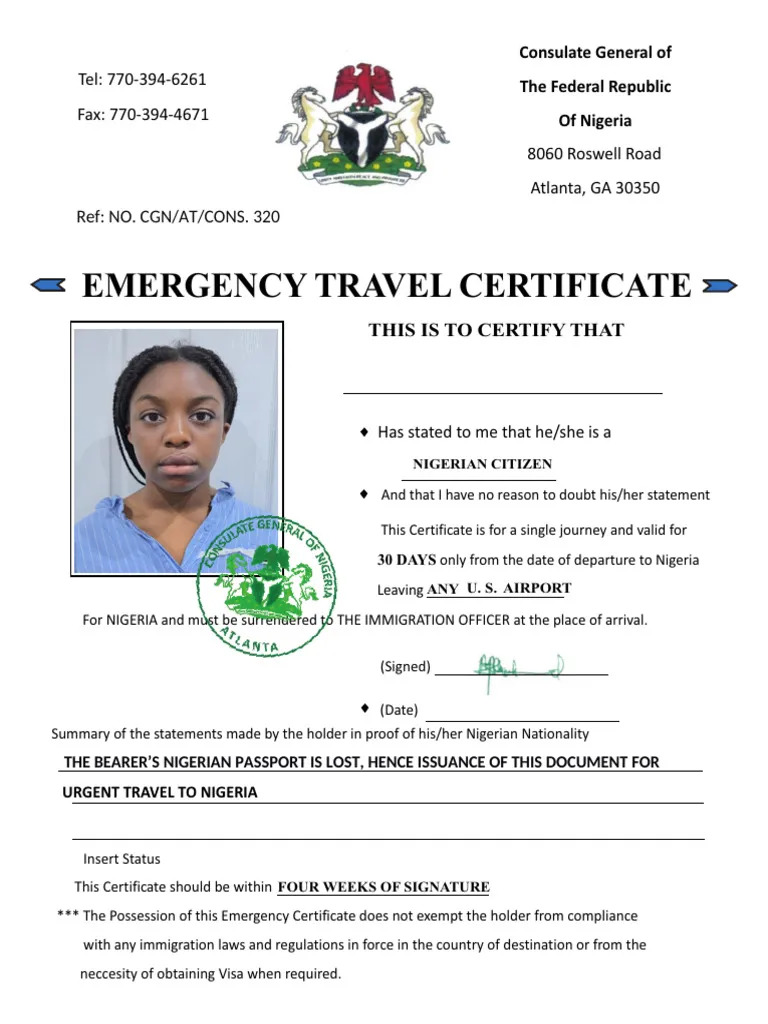
There is a key condition most people gloss over. The ETC is fundamentally a one-way document. It only works to get you into Nigeria. You cannot use it to transit through another country to a third destination, and you absolutely cannot use it to re-enter any foreign country once you have arrived home. At the Nigerian port of entry, immigration officers will collect it from you. That is the end of its life.
You also have to already have a flight. Nigerian consulates and embassies are generally clear on this point: you need to show a travel itinerary before the certificate can be issued. But most missions advise that you book rather than purchase your ticket before applying, because the ETC is not a guarantee. If your application is denied or delayed, a non-refundable ticket becomes a separate problem on top of everything else.
Who does not qualify is as important as who does. The ETC is not available to foreign nationals trying to enter Nigeria. It is specifically for Nigerian citizens. If you are a dual national and carry another passport, some missions may direct you to travel on that instead. And if you are inside Nigeria right now with no international travel concern, the ETC in its traditional sense is not relevant to you, you would be looking at normal passport services instead.
The Document Is Changing: STEP, NTP, and What 2026 Means for Emergency Travel
This is the part most current guides on the ETC get wrong by simply leaving it out. The Emergency Travel Certificate as it existed in its original paper form has been going through replacement for several years now, and 2026 is shaping up to be a significant shift.
In March 2021, the Nigeria Immigration Service launched the Nigeria Temporary Passport, or NTP, as an ICAO-compliant biometric replacement for the paper-based ETC. The NTP is a four-page dark blue booklet that functions on the same principle as the ETC, one-way journey back to Nigeria, surrendered at the port of entry on arrival, but it carries biometric data, meaning the applicant has to appear physically at the embassy to have biometric information captured. Not every Nigerian mission around the world rolled it out simultaneously, so in some countries the paper ETC remained the fallback option where the NTP was not yet available.
Then in November 2025, Comptroller-General of the Nigeria Immigration Service Kemi Nandap, speaking at a joint thematic meeting of the Khartoum, Rabat, and Niamey Processes held in Abuja and co-hosted with the Government of France, announced something further. According to a statement issued by NIS spokesperson ACI Akinsola Akinlabi, the service was preparing to introduce the Single Travel Emergency Passport, or STEP, to replace the existing Emergency Travel Certificate entirely. Nandap described STEP as a temporary travel document for Nigerians abroad whose passports have expired, been lost, or stolen, enabling them to return home in a secure and verifiable manner. The document was described as valid for a single entry and would be issued at designated Nigerian embassies and consulates abroad.
She repeated the announcement in December 2025, telling officers at a promotion ceremony in Abuja: “I am looking forward to 2026 as a year of significant reforms, including improvements to our visa processes, passport production, and the introduction of contactless solutions. The STEP will be biometric-based and designed to provide secure and seamless emergency travel for Nigerians.” (Kemi Nandap, Comptroller-General of Immigration, as reported by TV360 Nigeria, December 22, 2025.)
What this means practically for someone applying right now in 2026: the ETC in some missions has effectively become the NTP, and at some missions the transition to STEP may be underway or announced. Before you apply anywhere, confirm with the specific Nigerian embassy or consulate in your country exactly which document they are currently issuing for emergency travel, because the name and the process may differ from what you read on a two-year-old blog post.
Documents You Need Before You Even Step Into Any Embassy
This is where most ETC applications fall apart. People show up at the consulate having gathered some documents but not all of them, and they leave and come back, which in countries where consulate hours are limited to three or four days a week is a real problem. The core requirements are largely consistent across Nigerian missions worldwide, though the specific format or additional items can vary by country.
The first thing you need is a formal application or request letter addressed to the Head of Mission or Consul General at the specific mission you are visiting. This letter introduces you, explains clearly why you are applying for emergency travel documentation, gives your current address and contact number, and describes the nature of your emergency. It should be typed and signed. Handwritten letters are accepted at some missions but not all.
You also need proof of Nigerian citizenship. If your passport is expired but you still have it, bring the physical document and a clear photocopy of the data page. If your passport is lost or stolen, bring a copy of the data page if you have one saved somewhere, along with a birth certificate, or, if you have no birth certificate, any other recognized Nigerian identification. Some missions also accept a Global Machine-Readable Passport card or other government-issued Nigerian ID.
Two passport photographs are standard. Write your name on the back of each photo as most missions request this. The photographs need to meet standard passport photo specifications: plain background, full face visible, recent.
You need a travel itinerary. This is a printout of your planned flight to Nigeria, showing your departure date. The date on the ticket must be within 30 days of your application at most missions. Again, book but do not pay for the ticket as a completed purchase before you have the ETC in hand.
For those applying in the United States: missions in New York and Washington DC both require a money order of $150, payable to the specific mission. Only USPS money orders are accepted in New York. Washington DC accepts USPS, UPS, or FedEx. Cash is not accepted. If you are mailing your application rather than appearing in person, you also need a self-addressed prepaid return envelope, USPS Express Mail format in New York, next-day delivery in DC.
In the UK and in many European missions, the fee structure and accepted payment methods differ. Contact the specific High Commission or Embassy before assuming the US fee structure applies to your country.
How the Application Process Works, Step by Step
Once you have your documents assembled, the process at most Nigerian missions follows a similar path, though the specifics depend on whether the mission offers in-person submissions, mail-in applications, or online appointment booking.
The NIS homepage currently states that the emergency travel certificate in Nigeria is now within reach in under 72 hours for people dealing with a lost or stolen passport domestically. That processing window applies to the domestic NIS process. For Nigerians applying at missions abroad, processing typically takes longer: seven working days at the Washington DC Embassy, a few days at the New York Consulate, and varying timelines at other missions depending on volume and staffing.
In countries where the Nigerian mission uses an online appointment system, you need to book your appointment slot before going in. The Nigerian Embassy in Ukraine, for instance, moved to mandatory appointments beginning January 2025 and will not attend to walk-in consular applicants without a confirmed booking. Many other missions have followed similar protocols post-2023. Check the website of your specific mission before showing up.
At the appointment, your documents are reviewed. If you are applying for the NTP rather than the older paper ETC, you will need to have your biometric data captured on-site. This is why physical presence at the mission is mandatory for the NTP, you cannot mail a biometric application. The officer reviews your stated reason for emergency, checks your proof of citizenship, and confirms the travel itinerary. The certificate or temporary passport is then processed and either handed to you or mailed back via the prepaid return envelope you provided.
Upon arriving in Nigeria, hand the document to immigration officers at the port of entry. The document is retrieved at this point. Do not try to leave Nigeria again on the same document. The next step once you are home is to immediately begin a proper passport application or renewal through the NIS portal at immigration.gov.ng.
If Your Passport Was Lost or Stolen: Extra Requirements
Losing a passport abroad is its own category of crisis, and it comes with additional documentation requirements that a straightforward expired-passport application does not. The most important additional requirement is a police report.
You are expected to report the loss or theft of your Nigerian passport to the local police in the country where it happened, and you need to bring that police report to the Nigerian mission when you apply for the ETC or NTP. If the report is not in English, a certified translation into English must be attached. This is not optional at any mission that adheres to standard procedure, the report is how the mission confirms the circumstances of the loss and protects against fraudulent applications.
Without the original passport, citizenship proof becomes more critical. If you have a scanned or photographed copy of your passport data page stored anywhere, bring it printed out. If you do not have that, your birth certificate carries significant weight. Some missions may also accept an affidavit of identity sworn before a notary, particularly for long-term residents who can demonstrate their presence in the country through utility bills, residency permits, or employer letters.
Note also that a lost or stolen passport needs to be reported for your own protection beyond the ETC application. If someone finds or takes your Nigerian passport and uses it, you have no record of the loss unless you filed a police report. The NIS portal and Nigerian immigration checkpoints look at flagged documents, and having a formal report of loss on record is what distinguishes your situation from one that looks suspicious.
Children Traveling Without a Valid Passport
When a minor, meaning anyone under 18, needs emergency travel documentation to return to Nigeria, the requirements expand considerably. The child cannot apply on their own behalf.
Both parents must provide a signed consent letter addressed to the Consul General or Head of Mission at the relevant Nigerian mission. The signatures on those letters must match the signatures on the parents’ own passports. If only the mother’s name appears on the child’s birth certificate and the father is absent from the picture legally, the mother must provide an affidavit from a court confirming she holds sole custody. The New York Consulate is explicit on this point.
The passports or government-issued IDs of both parents must also be submitted as copies alongside the application. The child’s birth certificate is required in all cases. If there is no birth certificate, the mission will want to see other documentation that establishes the child’s Nigerian nationality and parentage.
For infants, the consent letter from the mother is the primary document. The child does not have a photo submitted separately in the same way an adult would, though the mission may require a photo that meets standard specifications depending on whether the document being issued is a paper ETC or the biometric NTP.
Processing Times and What to Expect After You Submit
Processing time is one of the biggest sources of anxiety in an already stressful situation, and it varies more than most people realize. The NIS website’s claim of under 72 hours applies to domestic processing inside Nigeria. For Nigerians applying at missions abroad, the realistic window is different.
Washington DC has published a seven-working-day processing time. New York states the certificate is typically issued within a few days. Missions in Europe vary: some process within 48 to 72 hours for urgent cases, others take longer based on staffing levels and appointment backlogs. Dublin’s Embassy handles emergency travel documents for Nigerians being deported from Ireland, a different pathway than a voluntary return, and processing for those cases moves at the pace of the host country’s immigration process rather than the Nigerian mission’s standard timeline.
The most useful thing you can do after submitting is follow up. Keep the name and email address of the consular officer who handled your file. Some missions provide a reference number. Others simply tell you to wait for a call or email. Either way, contact the mission again after three working days if you have not heard anything, particularly if your travel date is approaching.
One practical note: if you mailed your application, track the envelope. USPS, UPS, and FedEx all provide tracking numbers. Do not assume a mailed application has been received until you confirm it. Loss of mailed applications at busy consulates is a real inconvenience that delays everything, and you cannot afford that when you are working against an emergency timeline.
Common Mistakes That Cause Applications to Be Rejected or Delayed
The first mistake is buying a fully paid, non-refundable ticket before you have the emergency certificate in hand. Missions across the board advise against this. Book an itinerary, print it, bring it as your travel plan, but do not commit money you cannot recover until the document is issued.
The second mistake is submitting passport photographs that do not meet the standard. Photos taken from a phone screen, printed on regular paper, or with a patterned background are rejected. Use a proper photo service. In many cities outside Nigeria, pharmacies and photo shops offer passport-standard prints for a few hundred naira equivalent in local currency.
Third: not including the police report for a lost passport. Some people hope this requirement is optional or that the mission will overlook it. It is not optional. Missing it means your application is returned or rejected, costing you time you may not have.
Fourth: writing a vague application letter. “I need the ETC to travel to Nigeria” tells the mission nothing they need to make a decision. The letter should name the emergency specifically, whether it is a family bereavement, a medical crisis, a job-related urgency, or a passport expiry that did not allow enough time for standard renewal. Missions use the stated reason to assess the legitimacy and urgency of each application.
Fifth: assuming every mission operates exactly the same way. The Nigerian Embassy in Brussels and the Nigerian Consulate in Atlanta do not have identical procedures, accepted payment methods, or document requirements. Before submitting anything, visit the official website of the specific mission in your country, not a third-party blog, not a WhatsApp group rumour. The official mission websites have the current requirements listed, and some missions update them regularly as policies shift.
The Clock Is Moving and So Is the System
Nigeria’s emergency travel documentation is in genuine transition. The paper ETC that Nigerians have relied on for decades is being phased out in favour of biometric, ICAO-compliant documents that airline systems and border control agencies around the world can actually read and verify electronically. That is a necessary change. But for anyone currently in a travel emergency, the transition creates a layer of uncertainty about exactly which document is current and valid at any given Nigerian mission.
The clearest action anyone in this situation can take right now is to go directly to the official website of the Nigerian embassy or consulate in their country, confirm which emergency travel document they currently issue, note the exact list of requirements and fees, and then book an appointment. Do not send anyone else on your behalf without confirming the mission allows representation. Do not mail documents to the wrong address or in the wrong format. And do not book a paid ticket until that document is physically in your hands.
The urgency of an emergency does not excuse poor preparation. Nigerian missions abroad deal with hundreds of consular requests weekly, and a complete, correctly assembled application is the fastest route through that queue. Gather everything, arrive or mail early, and follow up. That is the realistic path home.