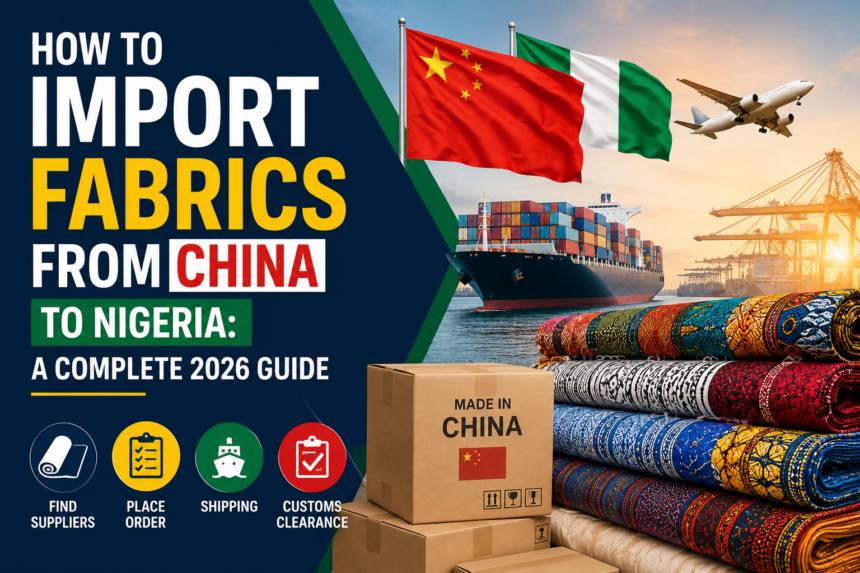
Walk through Balogun Market on any weekday and you will see the evidence. Rolls of ankara, brocade, lace, chiffon, and polyester satin stacked ceiling-high in stalls stretching hundreds of metres in every direction. A significant portion of that fabric did not start its journey in any Nigerian warehouse. It came off a ship at Apapa or Tin Can Island, cleared customs at the port, and landed in the hands of traders who understand one thing very well: China makes fabric cheaper, faster, and in more variety than almost anywhere else on earth. For Nigerian entrepreneurs in fashion, tailoring, interior decoration, or textile retail, that supply chain is the difference between a viable business and one that cannot compete.
- Why China Remains the Go-To Source for Nigerian Fabric Traders
- The Markets You Need to Know in China
- Finding and Vetting the Right Supplier
- Sorting Out Your Money: Payment Methods and Form M
- Documents You Must Have Before Your Shipment Moves
- Sea or Air: Choosing the Right Shipping Method for Fabric Imports
- What Happens When Your Fabric Arrives at the Port
- Duties, Taxes, and What It Actually Costs to Land Fabric in Nigeria
- Common Mistakes Nigerian Fabric Importers Make
- Getting Started Without Losing Your Capital
- The Real Work Begins Before the Fabric Ships
The trade route between China and Nigeria for textiles is not new, but the conditions around it keep shifting. Exchange rate pressures, updated customs procedures, a new digital single window system introduced by Nigerian Customs, and tighter documentation requirements have all changed how the process works compared to even two years ago. Getting it right in 2026 means understanding the current rules, not the ones that applied in 2022 or 2024.
This guide covers the full journey from sourcing fabric in China to clearing it at a Nigerian port, including where to buy, what to pay, which documents you need, and where importers consistently lose money.
How to Import Fabrics from China to Nigeria
The decision to import fabrics from China to Nigeria is one of the more straightforward entry points into international trade for Nigerians, but straightforward does not mean simple. The process involves supplier selection, payment logistics, freight arrangements, customs compliance, and port clearance, each with its own requirements and failure points. Getting fluent in how each stage works is what separates the importers who build sustainable businesses from those who lose money on their first or second shipment.
Why China Remains the Go-To Source for Nigerian Fabric Traders

China’s dominance in global textile production is not accidental. The country has spent decades building an integrated manufacturing ecosystem where raw material supply, weaving, dyeing, printing, and finishing all happen within the same industrial clusters. The result is a cost structure that countries competing with them simply cannot match. At Keqiao’s China Textile City in Shaoxing, Zhejiang Province, the total transaction volume in 2025 reached 441.386 billion RMB, a year-on-year increase of over 10 percent, and the market’s sales network now covers more than 200 countries. That scale translates directly into pricing power for buyers.
For Nigerian importers specifically, the attraction is not only price. Chinese fabric suppliers can produce in almost any quantity, meaning a trader in Aba or Lagos can order ten rolls of a particular ankara-adjacent print and receive exactly that, without being forced into a minimum order that would lock up their capital. Chinese manufacturers are also fast at adapting to trends. A style that circulates on TikTok or Instagram today can be in production in Guangzhou within weeks.
China is Nigeria’s largest trading partner overall, and textiles form a substantial portion of that bilateral trade. Nigeria imports cotton fabrics, synthetic fabrics, lace, embroidery fabrics, brocade, jacquard, and home textiles from Chinese suppliers at price points that domestic manufacturers in Nigeria struggle to compete with. The contrast is starkest at the retail level: a Nigerian-made George fabric sold at a premium while a Chinese-produced equivalent with similar aesthetic appeal sits at a fraction of the price in the same market.
That price gap has policy implications. The Nigerian government has at various points tried to protect the domestic textile industry through tariff structures. But demand for affordable fabric among Nigerian consumers, tailors, and fashion producers has kept the import trade alive and growing. For the individual importer, this means the business case is strong, as long as the logistics side is handled properly.
The Markets You Need to Know in China
Not all of China’s fabric market infrastructure is in the same place, and the market you source from should match the type of fabric you want to import. The two most relevant regions for Nigerian buyers are Guangzhou and Shaoxing, with Yiwu offering a useful alternative for smaller or more diversified orders.
Guangzhou’s Zhongda Fabric Market in the Haizhu District is probably the most well-known destination for African buyers sourcing fabric in China. It covers approximately 3 million square metres and comprises 59 sub-markets housing over 23,000 individual shops. The range is comprehensive: cotton, lace, brocade, polyester, chiffon, embroidery fabric, curtain cloth, and accessories all under one sprawling district. Traders from West Africa are a regular presence there, and many vendors have experience dealing with Nigerian buyers including an understanding of the colour palettes, prints, and fabric weights that sell in Nigerian markets. For brocade, lace, and aso-ebi fabrics in particular, Zhongda is where most serious Nigerian importers start.
Shaoxing’s China Textile City in Keqiao is the other major stop, and it serves a different purpose. Keqiao is where you find fabric at the source level closest to manufacturing. The market covers the entire supply chain from chemical fibre through weaving, printing, and dyeing to finished fabric. If you want to order custom prints or need specific technical specifications for fabric weight or composition, Keqiao gives you access to suppliers who can produce to order rather than just selling off the shelf. It is better suited to importers who have established demand and want to go beyond buying generic stock.
Yiwu International Trade City in Zhejiang Province is the third option worth knowing. The market spans over 4 million square metres with more than 75,000 booths across five districts. Yiwu is not primarily a fabric market, but it carries a significant volume of fabric and textile accessories at very competitive prices. Its advantage is for importers who want to consolidate a mixed container, combining fabrics with other small commodities in a single shipment. In 2026, many African buyers are using this mixed-container approach to reduce per-unit shipping costs while testing multiple product categories.
If travelling to China is not an option, working with a sourcing agent based in Guangzhou or Yiwu is increasingly common among Nigerian importers. These agents charge a commission, typically between 3 and 10 percent of the order value, but they handle supplier negotiation, quality inspection, and packaging verification on your behalf. For a first-time importer, that fee often saves significantly more in potential losses from poor-quality shipments.
Finding and Vetting the Right Supplier
The platforms Nigerian importers use most frequently to identify Chinese fabric suppliers are Alibaba, Made-in-China, and 1688.com. Of these, 1688 operates primarily for the Chinese domestic market and lists prices in RMB, meaning you will typically need a sourcing agent or a WeChat contact who can facilitate the transaction. Alibaba and Made-in-China are built for international buyers and offer supplier verification features, trade assurance protections, and communication in English.
Supplier verification matters a lot in textile imports specifically. Fabric quality issues, including thread count misrepresentation, colour inconsistency between samples and bulk orders, and fabric weight discrepancies, are among the most common complaints from Nigerian importers. The standard practice is to order samples before committing to a bulk order. Request samples from at least two or three suppliers for the same fabric type, compare them physically, and only place a large order with the supplier whose sample matches your requirements. Spending money on samples is not optional if you are serious about protecting your capital.
When evaluating a supplier on platforms like Alibaba, check the number of completed transactions, the age of the account, buyer feedback, and whether they have Gold Supplier or Verified Supplier status. These markers are not guarantees of quality but they do indicate that the supplier has been operating legitimately for a period of time. A supplier with a one-year-old account and minimal transaction history should be treated with more caution than one with five years of operation and hundreds of completed orders.
For orders above a certain value, many importers hire a third-party inspection company in China to check the goods before shipment. Companies operating in Guangzhou and Yiwu offer pre-shipment inspection services where they visit the supplier’s warehouse, check the actual goods against the order specifications, count the rolls, test samples from the batch for weight and composition, and send you a report with photographs. The cost is typically a few hundred dollars depending on the size of the order, and it is far cheaper than discovering problems after the goods have landed in Lagos.
Communication with suppliers also matters. State your specifications in writing, include measurements in both metres and yards since Chinese suppliers often work in different units, specify fabric weight in gsm, and be explicit about colour codes if print consistency matters. Vague instructions produce inconsistent results. Get all terms confirmed in writing before making payment.
Sorting Out Your Money: Payment Methods and Form M
Paying a Chinese supplier from Nigeria involves two separate considerations: how the payment gets to the supplier, and how you document that payment for Nigerian regulatory purposes.
On the payment side, the most common methods Nigerian importers use for Chinese suppliers are Telegraphic Transfer (T/T), Western Union or Wise for smaller amounts, Alibaba Trade Assurance for platform-based transactions, and in some cases, payment through Nigerian-based freight agents who have established credit relationships with Chinese suppliers. T/T is the standard for larger orders and most reputable suppliers will expect it. Alibaba Trade Assurance offers buyer protection, holding payment until you confirm receipt and satisfaction with the goods, which makes it worth using even if the supplier charges slightly more for it.
Avoid 100 percent advance payment to a new supplier for a large order. The standard structure for an established relationship is 30 percent deposit before production and 70 percent before shipment. For a new supplier, some importers pay 50 percent up front and 50 percent after an independent pre-shipment inspection. This structure gives both sides some protection.
The Form M is where Nigerian regulatory requirements come in. It is a mandatory Central Bank of Nigeria document that must be opened at a Nigerian commercial bank before your shipment departs China. Without a valid Form M, your goods can be held indefinitely at the port, incurring storage and demurrage charges while you scramble to sort the documentation. The Form M was introduced as part of Nigeria’s foreign exchange monitoring framework and has persisted through decades of policy changes. As of January 2026, the CBN issued a directive allowing Authorized Dealer Banks to process Form M applications using NAFDAC licences that had expired as of December 2025, providing a two-month window to deal with system migration issues. That window is now closed, so current compliance requirements should be confirmed directly with your bank before you ship.
The process of opening a Form M requires you to present your proforma invoice from the Chinese supplier to your Nigerian bank. The bank then registers the Form M in the Nigeria Customs Service system and you receive the document with a reference number. Keep this document and its reference number accessible, because your clearing agent will need it at the port.
Documents You Must Have Before Your Shipment Moves
Nigeria’s customs documentation requirements became more stringent in 2026 with the rollout of the national Single Window for Trade portal, known as the B’Odogwu platform, which integrates the Nigeria Customs Service, the Central Bank of Nigeria, NAFDAC, and the Standards Organisation of Nigeria into a single digital interface. All importers are now required to register on this portal and submit documentation through it. Physical document submission alone is no longer accepted for most cargo categories.
The core documents required for every commercial fabric shipment into Nigeria are: the Form M opened at your Nigerian bank, the Pre-Arrival Assessment Report (PAAR) generated by the Nigeria Customs Service through NICIS II, a commercial invoice from your Chinese supplier showing the full description of goods, HS tariff code, country of origin, unit value, and total CIF value in US dollars, a packing list that corresponds exactly to the commercial invoice, a Bill of Lading for sea freight or Airway Bill for air freight, and an import duty payment receipt processed through the NICIS II e-payment gateway. Cash payments are no longer accepted at Nigerian ports.
The commercial invoice must state the correct value. Undervaluation is flagged by the NCS’s risk assessment systems and triggers physical inspection. It is also a criminal offence under Nigerian trade law. Many importers have historically under-declared fabric values to reduce duty liability, and this practice has become significantly more difficult to execute as NCS systems have improved.
The HS code on your documents determines your duty rate, so it needs to be correct. Fabric falls under Chapters 50 to 63 of the Harmonized System, which covers silk, wool, cotton, man-made filaments and staple fibres, and various woven and knitted fabrics. Cotton woven fabrics fall under Chapter 52, man-made filaments under Chapter 54, knitted or crocheted fabrics under Chapter 60. If your fabric is a blend, the classification depends on which fibre predominates by weight. Getting this wrong can result in delays, penalties, or the wrong duty rate being applied. When in doubt, ask your clearing agent to confirm the HS code before your invoice is raised.
Any discrepancy between the commercial invoice and the packing list is a primary trigger for physical examination at the port. Keep these documents consistent, and make sure the quantities and descriptions on both match exactly what the supplier actually packed.
Sea or Air: Choosing the Right Shipping Method for Fabric Imports
For anyone planning to import fabrics from China to Nigeria in commercial quantities, sea freight is almost always the right choice on cost grounds. Fabric is relatively bulky by volume and not highly time-sensitive in most trading contexts, which makes it well-suited to ocean shipment rather than air cargo.
Sea freight from China to Lagos operates primarily through Apapa Port and Tin Can Island Port. The Lekki Deep Sea Port, built by Chinese investment and operational since April 2023, has expanded Lagos’s port capacity with an annual handling capacity of 1.2 million standard containers, though most commercial fabric importers still clear through Apapa or Tin Can. Transit time from South China ports like Shenzhen and Guangzhou to Lagos runs 30 to 40 days, while shipments originating from East China ports like Shanghai or Ningbo take 35 to 45 days. In March 2026, logistics providers noted that container equipment was tightening and advised early booking to secure space, partly due to Cape rerouting from global shipping disruptions affecting vessel schedules.
For smaller shipments, Less than Container Load (LCL) is the practical option. You share container space with other shippers and pay based on the volume your cargo occupies. In 2025–2026, LCL rates on China to Nigeria routes typically range from about $80 to $150 per cubic metre for base freight, and can reach $150 to $220 per cubic metre when destination charges, peak season demand, or congestion fees are included. LCL also adds handling time and can extend transit by about 5 to 10 days compared to Full Container Load (FCL) due to consolidation at the origin and deconsolidation at the destination.
Once shipment volume exceeds roughly 12 to 15 cubic metres, FCL typically becomes more cost-effective. In recent China–Nigeria market conditions, a 20-foot FCL container averages about $2,000 to $4,500, while a 40-foot container ranges roughly from $2,500 to $6,500, depending on season, carrier availability, and port conditions. Unlike simplified estimates, 40-foot containers are generally significantly more expensive than 20-foot units, often by 30% to 70%.
Air freight makes sense only for very specific scenarios: urgent stock replenishment for a fast-moving season, high-value specialty fabrics where the cost-per-kilo can be absorbed into the selling price, or fabric samples being shipped ahead of a bulk order. Air freight from China to Nigeria runs approximately $4.20 to $14.99 per kilogramme for general cargo, with most shipments arriving at Lagos’s Murtala Muhammed International Airport within 3 to 10 days door to door. For rolls of fabric that weigh hundreds of kilogrammes, the math on air freight rarely works.
Delivered Duty Paid (DDP) shipping is an option some importers choose specifically to simplify the clearance process. Under DDP terms, the freight forwarder or logistics provider handles customs clearance and pays duties on your behalf, and you receive the goods at your warehouse without having to manage the port process yourself. This is especially popular among importers who are new to the process or who prefer not to maintain an in-house relationship with a clearing agent. The cost is higher than managing clearance yourself, but it provides predictability and reduces the risk of costly delays from documentation errors.
What Happens When Your Fabric Arrives at the Port
When your shipment arrives at Apapa or Tin Can Island, the customs clearance process begins. This is the stage where most delays happen for importers who have not prepared their documentation properly, and where port charges start accumulating quickly if things go wrong.
Your clearing agent submits your import documents through the Direct Trader Input (DTI) system, which feeds into NICIS II, the Nigeria Customs Service’s digital platform. If your documentation is complete and consistent, the system generates an Assessment Notice containing the duties and charges payable, and the notice is sent to your bank. You pay the customs duty through the bank, the payment confirmation is relayed to NCS, and your agent then requests release of the consignment.
After the release request, customs officers inspect your goods. The inspection timeframe can range from one day to one week depending on the type of cargo and whether other government agencies need to be involved. For fabric imports, the NCS inspection is typically the main one, though in some cases the Standards Organisation of Nigeria may inspect if there are questions about labelling or textile standards compliance. After inspection, you collect an Exit Note from the Terminal Operator, and the cargo can be moved out of the port.
Port charges in Lagos are a significant part of the total cost of importing. Terminal handling charges, container examination fees if your cargo is physically examined, demurrage charges if you do not collect your container within the free time allowed, and inland transport from the port to your warehouse all add to the landed cost. Many importers underestimate these charges when calculating their landed cost, and then discover that their profit margin has been compressed at the final stage. Get a complete breakdown of port and destination charges from your freight forwarder before the shipment arrives so you are not caught off guard.
Working with an experienced clearing agent who knows the procedures at Lagos ports specifically is not a luxury. Lagos port operations have a reputation for complexity, with multiple agencies, informal processes, and documentation checks that vary based on the specific terminal and the nature of the goods. An agent who operates regularly at Apapa or Tin Can has relationships and knowledge that genuinely reduces clearance time and protects you from unnecessary charges.
Duties, Taxes, and What It Actually Costs to Land Fabric in Nigeria
Understanding the full duty structure before you import is essential for calculating whether a deal makes business sense. The common mistake is to look at the Chinese supplier’s price, add shipping, and assume that is the landed cost. The actual landed cost is higher, sometimes significantly.
Nigeria’s import duty on textiles and fabric falls under the ECOWAS Common External Tariff. Fabric classified under most chapters of the textile section attracts duty rates ranging from 10 to 35 percent depending on the specific HS code and fabric type. As a worked example from a customs calculation tool: importing textiles with a CIF value of $15,000 at a 10 percent duty rate would produce an import duty of $1,500, a surcharge of $105 (7 percent of the duty), a Financing Customs Services charge of $600 (4 percent of the CIF value), an ETLS levy of $75 (0.5 percent of CIF value), and VAT of $1,350 (7.5 percent applied to CIF plus all the charges above). Total customs charges on that $15,000 shipment would reach approximately $3,630, bringing your total landed cost before inland delivery to around $18,630.
The VAT rate is currently 7.5 percent, and as of May 2026 there is no implemented increase under any approved tax reform law, though policy discussions continue. Always confirm the current rate with your clearing agent before finalising your cost calculations.
The surcharge of 7 percent on the import duty, the FCS charge of 4 percent of CIF value, and the ETLS levy of 0.5 percent of CIF value are often overlooked by importers calculating their duty exposure. Including only the headline duty rate in your cost model will underestimate your actual customs charges. Nigeria’s customs system requires payment in Naira at the prevailing exchange rate, which means exchange rate movements between the time you place your order and the time your goods are cleared can affect your costs in ways that are difficult to predict.
The practical implication is that your selling price needs to account for all of these layers, not just the supplier price plus freight. Build a landed cost spreadsheet before you commit to any order. Include supplier cost (CIF), freight, port charges, clearing agent fees, inland transport, and all customs levies. Then work backwards to see whether the selling price you can realistically achieve in the Nigerian market justifies the import.
Common Mistakes Nigerian Fabric Importers Make
The first and most damaging mistake is placing a large first order without a sample. A supplier’s catalogue photograph and the actual fabric you receive can be very different things, especially when it comes to print quality, colour accuracy, and fabric weight. The cost of testing samples is minimal compared to the cost of receiving a full container of fabric that does not match what buyers want.
The second common error is incorrect HS code declaration. Importers who guess at their HS code, or who use a code that is technically inaccurate but attracts a lower duty rate, expose themselves to penalties and extended clearance delays. NCS assessors are trained to identify misclassified goods, and an incorrect HS code on your documentation is one of the triggers for physical examination and post-clearance audit.
Undervaluing the shipment on customs documents is the third persistent problem. It is tempting, especially when the official duty rates feel punishing, but the risk is not worth it. The NCS uses reference pricing databases and compares declared values against known market prices for fabric. A shipment declared at a value that is clearly inconsistent with prevailing market rates will be flagged and reassessed. The resulting penalties, additional charges, and delays typically cost more than the duty that was being avoided.
A fourth mistake specific to fabric imports is not specifying the fabric composition correctly. If your commercial invoice says ‘mixed fabric’ without specifying the fibre content percentages, Nigerian customs will assess your duty based on the tariff rate that maximises revenue, not the one that benefits you. Always ensure your commercial invoice from the Chinese supplier states the fabric composition clearly: for example, 60 percent polyester and 40 percent cotton, because that determines which HS code applies and consequently the duty rate.
Finally, many importers do not account for port delays in their business cash flow planning. If your goods sit at Apapa for two extra weeks due to a documentation issue or inspection queue, you are paying demurrage and possibly storage charges every day. That money comes directly out of your margin. Plan for clearance to take longer than expected, hold enough working capital to cover two to three weeks of port charges beyond your expected clearance date, and factor this buffer into your landed cost calculation.
Getting Started Without Losing Your Capital
For someone importing fabric from China to Nigeria for the first time, the most important decision is scale. Starting small, with a shipment that you can afford to lose if everything goes wrong, is not a sign of lack of ambition. It is how experienced importers approach a new supply chain. A first order at LCL volume, between five and ten cubic metres, gives you a real test of the entire process, including supplier reliability, shipping timelines, port clearance, and product acceptance in the Nigerian market, without betting your full capital on an untested chain.
Register your business with CAC before you import. A registered business entity makes it easier to open a Form M at a commercial bank, and it is the correct basis for operating commercially in Nigeria. Banks are unlikely to process Form M for purely individual transactions without business documentation backing the import.
Engage a freight forwarder and a clearing agent early, before you even place your order with the Chinese supplier. A good freight forwarder will advise you on the correct HS code for your fabric, help you understand what your customs charges will be before you commit, and guide you through the documentation requirements. The China to Nigeria trade route has specific complexity at the Nigerian port end, and an experienced agent who knows Lagos port procedures is a core part of making the import work.
Build relationships with multiple suppliers rather than depending on one. The fabric market in China is competitive and prices fluctuate with demand, exchange rates, and input costs. Having two or three vetted suppliers for your main fabric types gives you flexibility when one supplier cannot meet your timeline or has raised their prices. It also protects you against the risk of a single supplier failing to deliver.
Track your numbers on every shipment. Know your exact cost per metre of fabric landed in Nigeria, and compare it against what the same fabric sells for in Balogun, Oshodi, or your target market. The business only works if the margin between your landed cost and your selling price is sufficient to cover your operating costs and leave you with profit. As your volumes increase and your processes become more efficient, that margin should improve. But it starts with knowing the numbers precisely on every single order from the beginning.
The Real Work Begins Before the Fabric Ships
Importing fabric from China to Nigeria is a legitimate, scalable business. Thousands of Nigerian traders, fashion entrepreneurs, and retail operators build their livelihoods on this supply chain every year. What separates the ones who thrive from the ones who lose money is almost never luck or access. It is preparation.
The process has become more structured in 2026, which is actually good news for importers who do things properly. The digitalisation of Nigeria’s customs procedures through the Single Window portal, the NICIS II payment system, and the mandatory Form M process all create a more auditable, predictable environment when you comply. It is the informal shortcuts that have become riskier, not the legitimate route.
Start with solid supplier vetting, get your documentation right before your goods sail, work with people who know Lagos ports specifically, and build your cost model with every charge accounted for. The fabric trade between China and Nigeria is not going anywhere. The question is whether your operation is set up to participate in it profitably.