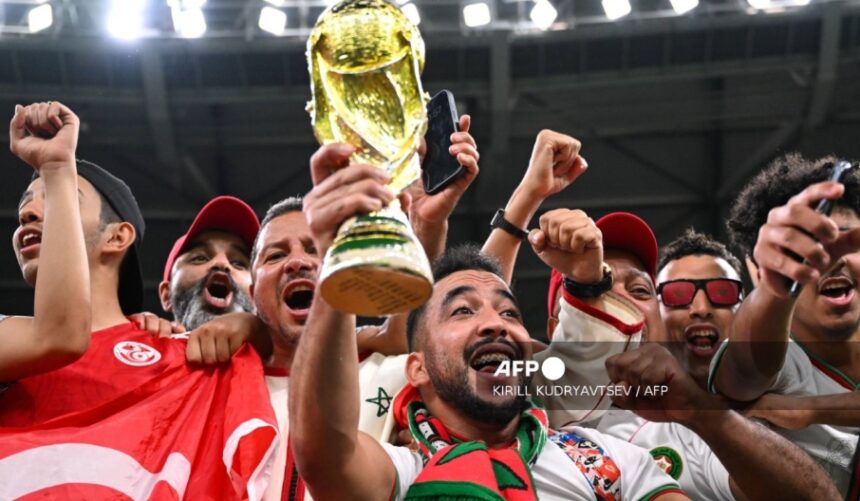
The countdown to the 2026 FIFA World Cup in North America has heightened expectations that Africa could finally produce the tournament’s first champion from outside Europe and South America, ending a dominance that has remained intact since the competition began.
With 48 nations set to compete for football’s biggest prize, several African sides arrive with growing confidence following years of steady development in talent, tactical organisation and international competitiveness.
Long regarded as underachievers on the global stage despite their abundant talent, African teams now appear better equipped to challenge traditional powerhouses, with Morocco and Senegal emerging as the continent’s leading contenders.
The progress made by African football was underlined during the 2025 Africa Cup of Nations, where teams displayed improved technical quality, tactical discipline and cohesive styles of play that drew favourable comparisons with major European competitions.
Morocco, whose historic run to the semi-finals of the 2022 World Cup in Qatar remains the best performance by an African nation, continues to benefit from a generation of players competing at the highest levels of club football.
Creative midfielder Brahim Diaz has become a central figure for the North Africans, while Paris Saint-Germain defender Achraf Hakimi remains one of the team’s standout performers at both ends of the pitch.
Currently ranked eighth in the world, Morocco has maintained strong form and remains unbeaten in competitive matches in 2026, recently earning a 1-1 draw against Norway after the Scandinavians scored a late equaliser.
Senegal also retains the experienced core that has driven much of its recent success, including Sadio Mane, Kalidou Koulibaly, Idrissa Gana Gueye and Edouard Mendy.
The quartet’s experience at elite club level has provided leadership for a younger generation, helping the Teranga Lions maintain consistency against top opposition.
Senegal’s balanced squad combines defensive strength with attacking versatility, making them less dependent on individual brilliance and more difficult to contain as a collective unit.
Their credentials were reinforced last year when they secured a notable 3-1 victory over England on English soil.
A significant factor behind Senegal’s progress has been the influence of coach Pape Thiaw, whose ability to blend experienced players with emerging talents has strengthened the team’s cohesion.
Since taking charge in 2024, Thiaw has overseen a defensive structure that has conceded only 11 goals while guiding Senegal to success in both tournaments he has managed, including AFCON 2025 and the African Nations Championship.
Beyond Morocco and Senegal, other African nations are also expected to contribute to the continent’s challenge for global honours.
Ivory Coast continues to develop a promising squad featuring players attracting interest from leading European clubs and recently produced a surprise result against World Cup finalists France in a preparatory fixture.
Egypt and Algeria also bring valuable experience to the tournament, with the Algerians particularly motivated to build on the resilience they demonstrated during their previous World Cup appearance.
Ghana returns to football’s biggest stage with attacking threat provided by Antoine Semenyo, while the experience of Thomas Partey and Jordan Ayew is expected to support the squad under coach Carlos Quiroz.
South Africa, DR Congo, Tunisia and debutants Cape Verde are also viewed as potential dark horses capable of producing unexpected results during the competition.
External factors could further influence the tournament, with many players arriving after demanding club campaigns that have stretched across approximately 60 matches.
The effects of fatigue on leading football nations may create opportunities for African teams to exploit throughout the competition.
Environmental conditions in North America could also become an important factor, as high temperatures and matches played at altitude are expected to test players’ endurance and adaptability.
Such conditions may offer a relative advantage to African teams, many of whom are familiar with similar climates and physical demands, as well as to several South American sides.
While concerns have already emerged regarding organisational and host-related issues surrounding the tournament, optimism remains that African representatives possess both the quality and resilience required to compete with the world’s best.
Whether that progress ultimately results in a first World Cup triumph for the continent remains uncertain, but Africa enters the 2026 tournament with stronger credentials and greater belief than ever before.