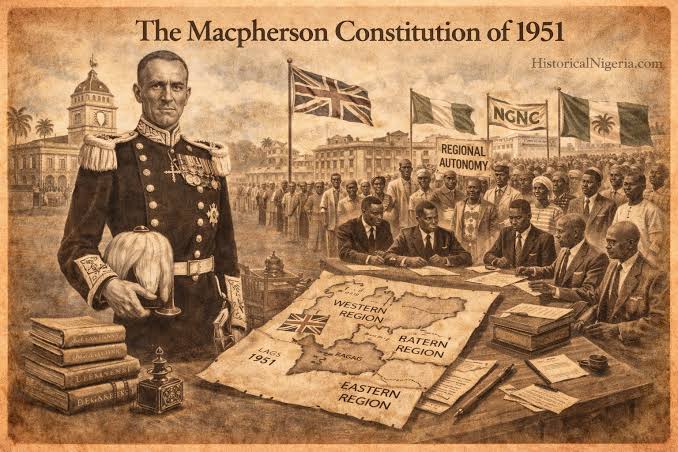
On June 29, 1951, the Nigeria (Constitution) Order in Council, the legal document which made Macpherson Constitution official was promulgated/signed in London by His Majesty King George VI in Council at Buckingham Palace.
- June 29, 1926 : Linguists and others from Africa and Europe met in London and launched the International Institute of African Language and Culture
- June 29, 2005: Nigeria and the Paris Club reached a historic agreement on an $18 billion write-off of Nigeria’s Paris Club debt
- June 29, 1991: William Keeling, a correspondent for the British daily Financial Times was expelled from Nigeria and declared persona non grata
The Order gives legal force to the Macpherson Constitution drafted at the 1950 Ibadan Conference. It replaces the Richards Constitution and transfers greater legislative power to Nigerians.
Federal structure: Nigeria divided into Northern, Western, and Eastern Regions, each with its own House of Assembly.
Council of Ministers: 12 Nigerians appointed as ministers, 4 from each region, to advise the Governor-General.
House of Representatives: 136 elected members replace the old Legislative Council.
Colonial Secretary Mr. J. Griffiths told Parliament the Order is “designed to give a greatly increased measure of responsibility to Nigerians for the conduct of their own affairs”. b7b0
Elections for the new regional and central legislatures will begin immediately. The regional Houses are expected to meet before December, with the central House of Representatives convening in January 1952.
Sir John Macpherson, Governor-General, described it as “the first constitution made by Nigerians for Nigerians.”
June 29, 1926 : Linguists and others from Africa and Europe met in London and launched the International Institute of African Language and Culture
Linguists, missionaries, and educators from across Africa and Europe gathered in London today and inaugurated the International Institute of African Languages and Cultures.
The meeting, held at the School of Oriental Studies, marks the first coordinated effort to study, standardize, and promote African languages on a scientific basis.
Major roles include documenting grammar, vocabulary, and oral traditions of African languages, training of teachers, producing textbooks in vernacular languages, and advising colonial governments on language use in schools and administration
Professor Diedrich Westermann of Germany was named Director. Delegates included Dr. Edwin Smith, African scholars, missionary representatives, and colonial officials.
Speakers argued that African languages were key to education and development, not obstacles to be ignored. The Institute will publish a journal, ‘Africa’, and begin fieldwork immediately.
June 29, 2005: Nigeria and the Paris Club reached a historic agreement on an $18 billion write-off of Nigeria’s Paris Club debt
On June 29, 2005, Nigeria and the Paris Club, agreed to write off $18 billion of the country’s external debt in the largest such deal ever granted to an African nation.
The agreement, announced in Paris after months of negotiations, saw the 15-member Paris Club cancel 60% of Nigeria’s $30.4 billion debt.
In return, Africa’s largest oil producer will pay the remaining $12.4 billion upfront to settle the account completely.
President Olusegun Obasanjo described the deal as “a turning point for Nigeria’s economic future,” saying it would free resources for critical infrastructure, health and education.
Finance Minister Dr. Ngozi Okonjo-Iweala, who led Nigeria’s negotiating team, said the relief was conditional on Nigeria implementing key economic reforms and adopting an IMF-monitored Policy Support Instrument.
June 29, 1991: William Keeling, a correspondent for the British daily Financial Times was expelled from Nigeria and declared persona non grata
On June 29, 1991, Nigeria’s military government has expelled William Keeling, Lagos correspondent for the Financial Times, and declared him persona non grata following his report on the country’s oil earnings during the Gulf War.
Mr Keeling, 34, was ordered to leave the country within 48 hours on Monday after an analysis published last week calculated that Nigeria earned an extra $5 billion from oil exports between January and June 1991, as global crude prices spiked due to the conflict in Kuwait and Iraq.
In the dispatch, Keeling said half of the “windfall” was being spent on funding ECOMOG’s intervention in Liberia’s civil war, hosting a lavish OAU Summit in Abuja this June, and making a down payment on an aluminium smelter plant in Akwa Ibom.
Government officials in Lagos accused the correspondent of “reckless speculation” and “misrepresentation of Nigeria’s finances.”
The Ministry of Information said the article was “calculated to embarrass the Federal Military Government and damage investor confidence.”
The Financial Times_said it “regretted” the expulsion and stood by Mr Keeling’s reporting, which was based on Central Bank of Nigeria data and other official sources. The paper has withdrawn Mr Keeling from Lagos pending a review.
The incident is the first expulsion of a British correspondent from Nigeria since the return to military rule in 1983. The British High Commission said it was “seeking clarification” from the Nigerian authorities.
Mr Keeling, who had been based in Lagos for three years, is now in London. He declined to comment beyond a brief statement: “I reported what the figures showed.”
Human rights and press freedom groups criticized the move as a setback for media freedom under General Ibrahim Babangida’s administration, which has promised a transition to civilian rule by 1993.