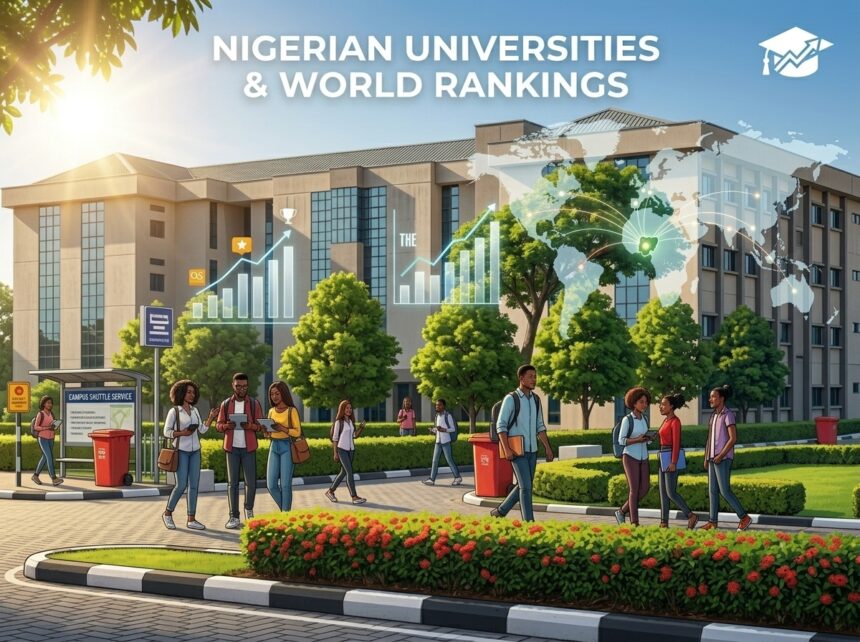
Nigeria has just posted its best result yet in the Times Higher Education World University Rankings, with 24 universities making the 2026 global list, three more than the 21 that featured in both 2024 and 2025. It is the highest number any country in Sub-Saharan Africa has placed in a single edition of the rankings, and it comes at a time when there has been a lot of debate about the state of public education in the country.
- University of Ibadan Reclaims the Top Spot
- Bayero University Kano Breaks Into Top Three
- Landmark University’s First Top-Ten Finish
- Nigeria’s Top 10 Universities in the THE World Rankings 2026
- Full List: All 24 Nigerian Universities in the THE 2026 Rankings
- What the THE Rankings Actually Measure
- Government Response: NESRI and the Reform Argument
- Where Nigeria Stands in Africa
- The Bigger Picture
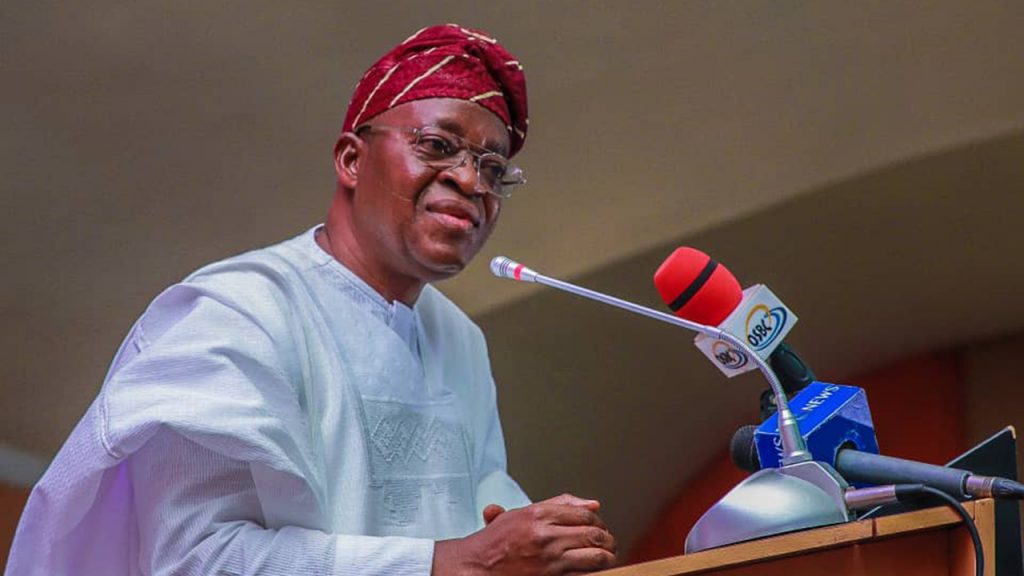
The announcement was made by the Minister of Education, Dr. Maruf Tunji Alausa, who called it the country’s strongest performance in the history of the THE rankings. Beyond the headline number, another 27 Nigerian universities participated in this year’s assessment process without making the final rankings table, a figure the minister pointed to as evidence of growing institutional commitment to international benchmarking.
University of Ibadan Reclaims the Top Spot
The reshuffle at the top of the national table is one of the more interesting stories from this year’s rankings. The University of Ibadan, Nigeria’s oldest university, has reclaimed first place after dropping to second in 2024. It now sits joint-top alongside the University of Lagos, a pairing that reflects strength in different areas of the THE evaluation framework.
UI, founded in 1948 and home to Africa’s largest postgraduate school, placed in the 801–1000 global band. With 16 faculties and a student population of around 36,851, its research output and citation impact helped it pull ahead of the private institutions that dominated the top spot in recent years.
The University of Lagos matched UI’s global band placement and actually recorded the highest research quality score among Nigerian universities, 66.7, according to THE data. UNILAG’s location in Lagos, Nigeria’s commercial nerve centre, has long given it an edge in industry engagement and international collaboration, and that shows in its 2026 numbers.
The biggest shake-up at the top is Covenant University’s fall from first in 2024 to fourth in 2026. The Ota-based private institution, which built its reputation on a disciplined academic model and consistent research productivity, still ranks among Nigeria’s best. But this year, it lost ground to both public universities and a rival private institution making its top-ten debut.
Bayero University Kano Breaks Into Top Three
One of the more telling developments in this year’s rankings is the rise of Bayero University Kano to third place nationally, and its entry into the 1001–1200 global band. With roughly 29,362 students and a student-to-staff ratio of 16.9, BUK has built genuine academic depth across disciplines including health and pharmaceutical sciences, and its performance in international outlook this year reflects active engagement with global research networks.
That a northern Nigerian institution sits in the national top three says something about how competitiveness in Nigerian higher education is no longer concentrated in Lagos and the south-west.
Landmark University’s First Top-Ten Finish
Landmark University, the private Christian institution established in 2011 by Living Faith Church Worldwide in Kwara State, entered the top ten for the first time in 2026. With only 3,426 students, among the smallest populations in the rankings — Landmark maintained one of the better student-to-staff ratios at 13, and THE’s data flagged it alongside Ahmadu Bello University for strong research quality performance.
The University of Ilorin slipped two places to eighth, while the University of Nigeria, Nsukka rounded out the top ten at tenth, down from seventh in 2024. UNN, founded in 1955 by Nnamdi Azikiwe and Nigeria’s first indigenous university, operates four campuses, runs 82 undergraduate programmes and 211 postgraduate programmes, and holds one of the best student-to-staff ratios in the entire Nigerian rankings at 11.1.
Nigeria’s Top 10 Universities in the THE World Rankings 2026
| Position (Nigeria) | University | Type | Global Band |
|---|---|---|---|
| 1 | University of Ibadan (UI) | Federal | 801–1000 |
| 1 | University of Lagos (UNILAG) | Federal | 801–1000 |
| 3 | Bayero University, Kano (BUK) | Federal | 1001–1200 |
| 4 | Covenant University | Private | 1001–1200 |
| 5 | Landmark University | Private | 1201+ |
| 6 | Ahmadu Bello University (ABU) | Federal | 1201+ |
| 7 | Federal University of Technology, Minna | Federal | 1201+ |
| 8 | University of Ilorin | Federal | 1201+ |
| 9 | University of Jos | Federal | 1201+ |
| 10 | University of Nigeria, Nsukka (UNN) | Federal | 1201+ |
Full List: All 24 Nigerian Universities in the THE 2026 Rankings
The complete contingent of 24 ranked institutions spans 17 federal universities, three state universities, and four private universities.
| # | University | Ownership |
|---|---|---|
| 1 | University of Ibadan | Federal |
| 2 | University of Lagos | Federal |
| 3 | Bayero University, Kano | Federal |
| 4 | Covenant University | Private |
| 5 | Landmark University | Private |
| 6 | Ahmadu Bello University | Federal |
| 7 | Federal University of Technology, Minna | Federal |
| 8 | University of Ilorin | Federal |
| 9 | University of Jos | Federal |
| 10 | University of Nigeria, Nsukka | Federal |
| 11 | Babcock University | Private |
| 12 | Delta State University, Abraka | State |
| 13 | Ekiti State University | State |
| 14 | Federal University of Agriculture, Abeokuta | Federal |
| 15 | Federal University of Technology, Akure | Federal |
| 16 | Federal University of Technology, Owerri | Federal |
| 17 | Federal University Oye-Ekiti | Federal |
| 18 | Ladoke Akintola University of Technology | State |
| 19 | Lagos State University | State |
| 20 | Nnamdi Azikiwe University | Federal |
| 21 | Obafemi Awolowo University | Federal |
| 22 | University of Benin | Federal |
| 23 | University of Calabar | Federal |
| 24 | University of Port Harcourt | Federal |
The list includes specialised institutions — federal universities of technology and agriculture — not just the traditional comprehensive universities. That spread matters. It means the rankings are picking up on research and academic activity happening across different types of institutions, not just the old-guard flagship universities.
What the THE Rankings Actually Measure
The THE World University Rankings 2026 assessed 2,191 universities across 115 countries and territories. Institutions are evaluated using 18 performance indicators organised under five broad pillars:
- Teaching — the learning environment, student-to-staff ratios, institutional income
- Research Environment — reputation, volume and income from research
- Research Quality — citation impact, research strength and excellence
- Industry — knowledge transfer and income from industry
- International Outlook — proportion of international students, staff, and research collaborations
Nigeria’s two highest-ranked institutions, UI and UNILAG, are the only Nigerian universities to have made it into the global top 1000. UNILAG led all Nigerian institutions in research quality with a score of 66.7.
Government Response: NESRI and the Reform Argument
The minister framed the 24-university result as evidence that the Federal Government’s education reform programme is working. He pointed specifically to the Nigerian Education Sector Renewal Initiative (NESRI), which is being implemented under President Bola Tinubu’s administration.
The NESRI is aimed at making Nigerian universities centres of innovation, research, and talent development. Alausa argued that the rankings improvement is not just about international prestige, it shows that government investments in research, digital transformation, infrastructure, and quality assurance are producing measurable results.
He also made a point that often gets missed in rankings coverage: the participation rate. Twenty-seven additional Nigerian universities joined the assessment process this year, even though they did not make the final ranked list. Getting more institutions into the evaluation pipeline is how you build a broader base for future rankings growth.
Where Nigeria Stands in Africa
Nigeria’s 24-university presence in the 2026 THE rankings makes it the most represented country in Sub-Saharan Africa. For context, South Africa has historically dominated African university rankings tables, but Nigeria’s growing volume of institutions, its large postgraduate research base, and the sheer scale of its higher education sector are now translating into global visibility.
The Times Higher Education also publishes a dedicated Sub-Saharan Africa University Rankings, in which Nigerian institutions feature separately. The 2026 THE Africa Rankings covered more than 150 institutions across the continent.
The Bigger Picture
Getting 24 universities into the THE rankings is genuinely good news. Nigeria has one of the youngest and fastest-growing populations in the world, and the demand pressure on its university system is immense. The fact that institutions ranging from established federal universities to newer private outfits and specialised technology universities are all gaining international recognition suggests the sector is diversifying in the right direction.
That said, no Nigerian university has yet cracked the global top 500. UI and UNILAG sit in the 801–1000 band, strong by African standards, but still some distance from the upper tier of global rankings. The path from here likely depends on whether research funding increases, whether brain drain slows, and whether the reforms being talked about translate into sustained institutional investment over time.
The numbers this year are the right kind of start.