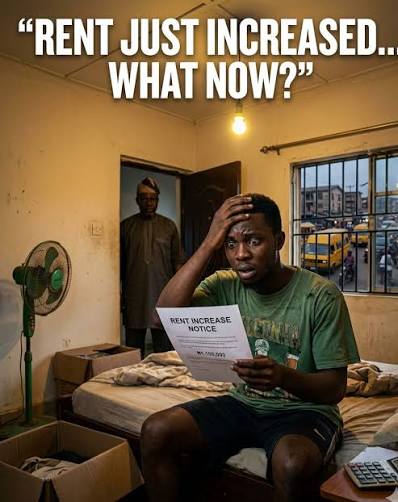
There is a version of this story that most Nigerian tenants already know. Rent is due for renewal. The landlord or his agent sends a message, sometimes written formally, sometimes scrawled on a torn piece of paper, sometimes just delivered as a verbal declaration in the compound. The rent is going up. Fifty percent. Double. No explanation, no negotiation, no warning served ahead of time. Pay or pack. The assumption behind these increases, enforced everywhere from face-me-I-face-you compounds in Surulere to estate apartments in Gwarinpa, is that the tenant has no real recourse. That the landlord owns the property, so the landlord makes the rules.
- What Nigerian Law Actually Says About Rent Increases
- The Notice Requirement: What a Landlord Must Do Before Raising Rent
- Section 37 of the Lagos Tenancy Law: The Right to Go to Court
- What the Lagos 2025 Tenancy Bill Proposes to Change
- For Tenants Outside Lagos: Abuja, Rivers, and Other States
- The Economic Pressure Behind the Increases
- What to Do When Your Landlord Raises Rent Arbitrarily
- Rights on Paper, Reality in the Room
That assumption is wrong in law, even if it is often true in practice. The Nigerian rental market has been in genuine crisis. Average residential rents across major urban centres rose between 25 and 55 percent in 2025, according to data compiled by private property advisory firms. By mid-2025, two-bedroom apartments in neighbourhoods like Lekki Phase 1, Gbagada, and Yaba that were going for between N1.8 million and N2.2 million in 2024 had crossed N3 million. Tenants in Lagos, Abuja, and Port Harcourt now spend more than 60 percent of their earnings on rent, far above the 30 percent affordability benchmark that housing experts use as a standard. The economic pressure landlords face is real. So is the legal framework that governs what they can and cannot do.
The problem is not that tenants lack rights. The problem is that most tenants do not know what those rights are, and most landlords are counting on exactly that. Understanding the legal position is not just about winning arguments. It is the difference between knowing when a landlord has acted within the law and knowing when he has not.
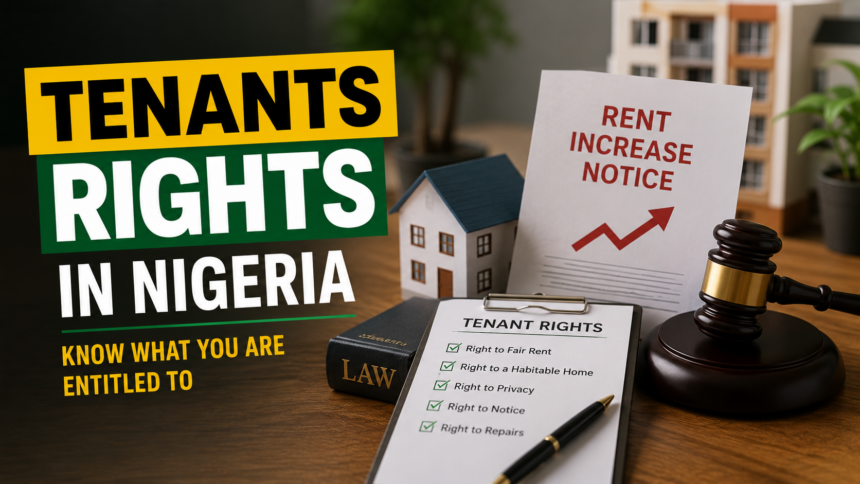
Tenants Rights in Nigeria When a Landlord Increases Rent Arbitrarily


Understanding tenants rights in Nigeria when a landlord increases rent is not as simple as pointing to a single law. Nigeria has no federal rent control legislation that caps how much a landlord can raise rent by or how often. What exists instead is a patchwork of state tenancy laws, common law principles, and court precedent that together define where a landlord’s authority ends and a tenant’s legal protection begins. The gap between what the law says and what most tenants experience on the ground is significant, but it is not unbridgeable.
What Nigerian Law Actually Says About Rent Increases
The starting point that most Nigerians miss is this: there is no law in Nigeria that tells a landlord the maximum percentage by which he can raise rent. The federal government has not passed any rent control legislation. The Land Use Act governs land ownership, not rent pricing. Rent, at its legal core, is a matter of contract between the parties.
Bernard Onigah, a lawyer who spoke to the Foundation for Investigative Journalism in 2025, put the position plainly. The landlord-tenant relationship, he explained, is primarily a commercial one regulated by market forces. There is no law setting a limit on the rent a landlord can charge, though calls for such legislation have been made. He noted that he doubted it would materialise because it would essentially interfere with commercial transactions.
That is the free-market reality. But the law does not stop there. What Nigerian courts and state tenancy laws do regulate is the process by which a rent increase happens, not the amount, but the manner. A landlord cannot unilaterally impose a new rent on a sitting tenant without following certain steps. If he does, the increase is legally unenforceable. The key Court of Appeal decision in Jovinco Nigeria Ltd & Anor v. Emeka Ibeozimako addressed exactly this question: whether a landlord could raise rent on a sitting tenant without that tenant’s consent. The court’s reasoning has since guided how Nigerian judges assess rent disputes.
The principle that emerges from Nigerian case law is straightforward: a rent increase is an offer. The landlord proposes a new rent. The tenant is free to accept it or reject it. If the tenant rejects it and the landlord wants to force the matter, he has to go through a legal process. He cannot simply lock the door, cut the power, or march in with thugs. Any attempt to take self-help measures against a tenant disputing a rent increase exposes the landlord to legal liability of his own.
The Notice Requirement: What a Landlord Must Do Before Raising Rent
Before a valid rent increase can take effect, a landlord is required to give written notice of the proposed increase. This is not always spelled out explicitly in every state’s tenancy statute, but it is a legal requirement that courts consistently uphold. The length of that notice depends on the type of tenancy.
For a yearly tenancy governed by an oral agreement, the convention accepted by Nigerian courts is three months’ notice before the end of the current tenancy term. This is not a statutory ceiling, but it reflects what courts have consistently treated as reasonable and fair. It gives the tenant enough time to consider the proposed increase, make other arrangements, or open a negotiation. For written tenancy agreements, the notice period should be whatever the agreement specifies. Where the agreement is silent, courts apply a reasonableness standard.
Beyond the notice period, courts have also developed an expectation that the proposed increase should be objectively justifiable. When evaluating a challenged rent increase, judges look at factors like the condition of the property, the prevailing market rate in the area, the location, and whether the landlord has made improvements to the premises. A landlord who has done nothing to the property, offered no repairs, and is simply riding a wave of inflation still faces scrutiny when a tenant decides to push back through the courts.
In practical terms, a landlord who sends a message on WhatsApp saying rent doubles next month has not followed due process. The notice must be written and formally served. The timing must respect the tenancy period. The increase must be something a court, if asked, would consider reasonable. Most of the rent increases that Nigerian tenants complain about fall outside these standards. The question is whether tenants know to challenge them.
Section 37 of the Lagos Tenancy Law: The Right to Go to Court
Lagos has the most developed tenant protection framework in the country. The Tenancy Law of Lagos State 2011 puts the right to challenge a rent increase directly into statute. Section 37 of that law states that any existing tenant may apply to the court for an order declaring that the increase in rent is unreasonable. The vehicle for doing this is Form TL 11, an official court form that the tenant files at the Magistrates’ Court or High Court, depending on the rental value of the property.
Once a tenant files the application, the court issues a hearing notice to the landlord in Form TL 12 and considers the increase against specific statutory grounds. These grounds include the condition of the property, local market rents, witness testimony, and special circumstances related to the premises. If the court finds the increase unreasonable, it has the power to set a new rent, substituting what it considers fair for what the landlord demanded.
One of the most important protections in this process is what happens while the case is pending. The landlord cannot evict the tenant while the court application is ongoing. This is significant because the most common landlord tactic after a dispute is to begin eviction proceedings simultaneously. Under Section 37, that move is blocked from the moment a tenant files. The tenant gets to stay in the property and continue paying the old rent while the court decides whether the new one is valid.
The Lagos Tenancy Law 2011 also carries a separate protection that most tenants are unaware of. Section 4 of the law makes it unlawful for a landlord or his agent to demand or receive from a sitting tenant more than six months’ rent in advance for a monthly tenancy, or more than one year’s rent for a yearly tenancy. The landlord who demands two years upfront, a practice that became widespread in Lagos during the inflation surge, is already on the wrong side of that law.
There is, however, a significant gap in the 2011 law. It explicitly excludes several high-value areas of Lagos: Ikoyi, Victoria Island, Apapa, and Ikeja GRA. Tenants in those areas are subject to the older Recovery of Residential Premises legislation, which provides far weaker protections. This exclusion has been a source of justified criticism, since many of the most aggressive rent increases happen in those very districts.
What the Lagos 2025 Tenancy Bill Proposes to Change
The Lagos State Tenancy and Recovery of Premises Bill 2025 is the most significant proposed reform to landlord-tenant law in Nigeria in over a decade. Introduced in July 2025, the bill passed its second reading at the Lagos State House of Assembly on July 10, 2025, and was referred to the Housing Committee for review. It has not yet become law, but its provisions reveal the direction Lagos intends to take.
The bill directly addresses the exclusion problem. If passed, it will apply uniformly to all premises in Lagos State, including Ikoyi, Victoria Island, Apapa, and Ikeja GRA. There will no longer be a protected tier of landlords who can do as they please because their properties sit in historically exempted areas.
On rent advances, the 2025 bill tightens the current rules. The 2011 law allows landlords to collect up to six months in advance from monthly tenants. The proposed bill reduces that to three months. Demanding more than three months would expose the landlord or agent to a fine of one million naira or three months’ imprisonment. The bill also caps agent commissions at five percent and requires agents to be registered with the Lagos State Real Estate Regulatory Authority (LASRERA), targeting the unregulated agency market that has been extracting additional costs from tenants for years.
On rent increases specifically, the bill maintains the reasonableness standard already in the 2011 law and retains the tenant’s right to challenge increases in court. It adds that during any such court challenge, the landlord remains prohibited from evicting the tenant. Where a court finds an increase unreasonable, it may substitute a rent it considers fair after reviewing statutory factors. The bill also introduces virtual hearing sessions for tenancy disputes, a practical modernisation given how backlogged Lagos courts have become.
Critics of the bill raise a legitimate concern: laws without enforcement are just documents. Even if the bill passes, the informal rental market, which is where most Nigerians actually live, will continue to operate largely outside any regulatory framework. Unregistered agents, verbal agreements, and tenants too economically vulnerable to risk a court fight all limit how much even a well-drafted law can accomplish on the ground.
For Tenants Outside Lagos: Abuja, Rivers, and Other States

Lagos has the most cited tenancy law, but it is not the only state with tenant protections. Housing regulation in Nigeria operates at the state level, which means the protections available to a tenant in Abuja differ from those in Lagos, and those in Enugu differ from both.
In Abuja, tenancy matters are governed primarily by the Federal Capital Territory Administration’s Rent Control and Recovery of Premises Act. The FCT legislation provides for advance rent restrictions similar to Lagos, standardised eviction notice periods, and tenant protections against unlawful eviction. Tenants in the FCT can also challenge rent increases they consider unreasonable through the courts, though the procedural framework is not as specifically developed as Lagos’ Form TL 11 system.
Rivers State, Ogun State, and Enugu State each have their own tenancy regulations that similarly prohibit unlawful eviction, require formal notice before terminating a tenancy, and give courts jurisdiction to assess disputes. Enugu’s Landlord and Tenant Law 2008 is frequently cited as one of the more tenant-protective frameworks in the south-east. The general principles that courts apply across all states remain consistent: rent changes require the tenant’s consent, notice must be given, and self-help evictions are illegal.
Across all jurisdictions, two protections are essentially universal in Nigerian tenancy law. First, a landlord cannot forcibly remove a tenant without a court order, regardless of the reason. This applies even if the tenant has refused to pay a new, higher rent. The landlord must go to court, get an order, and execute it through lawful means. Second, a tenant has the right to pay disputed rent into court. If a landlord refuses to accept the old rent while a dispute is ongoing, the tenant can deposit the money with the court, demonstrating good faith while the case is resolved. This matters because one of the landlord’s strongest arguments in a court case is that the tenant defaulted on rent.
The Economic Pressure Behind the Increases
Understanding tenant rights also means understanding why landlords are pushing increases so aggressively. The picture is not simply one of greed, though greed is certainly present. Nigeria’s construction costs rose sharply from 2023 onward, driven by currency devaluation, diesel prices, and the removal of fuel subsidies. A bag of cement that cost around N7,500 in late 2025 was selling at between N11,500 and N15,000 in early 2026. Steel, sand, tiles, and aluminium followed the same trajectory. Landlords who own older properties are not building new ones, but they are benchmarking their rents against what it would cost to replace the structure, and that figure has doubled in some cases.
Nigeria’s housing deficit, estimated at between 22 and 28 million units by multiple sources, means demand in major cities will remain structurally stronger than supply for the foreseeable future. Urbanisation continues to push people into Lagos, Abuja, and Port Harcourt faster than the housing stock can absorb them. Tenants who cannot afford new rents in prime locations are moving to peripheral areas, accepting longer commutes. Some Lagos residents have relocated to Ibadan entirely.
But the market pressure does not erase the legal framework. What it does is shift the power dynamics in ways that make enforcement harder. When a tenant knows that five other people will gladly pay the higher rent the moment he vacates, going to court to challenge an increase feels like a gamble. The landlord has leverage beyond what the law gives him, and everyone in the transaction knows it.
Even some landlords have discovered that aggression backfires. A property manager in Lagos, Gab Egeruo, was quoted in Leadership newspaper in December 2025 describing a pattern he observed in the market: landlords pushed rents hard and then watched tenants walk away. His observation was that a vacant property is the most expensive property a landlord can own. Rental income actually collected, he suggested, had become less predictable than headline rents implied. The illusion of higher returns masked growing vacancy rates beneath the surface.
What to Do When Your Landlord Raises Rent Arbitrarily
The first thing a tenant in this situation needs is a written record of everything. Every notice received, every payment made, every response sent, needs to be documented. If a landlord has been communicating via WhatsApp, save and back up those conversations. If rent has been paid in cash, insist on a receipt every time, because the Lagos Tenancy Law 2011 makes it a criminal offence for a landlord to fail to issue one. A landlord who cannot prove the old rent was accepted will struggle in court.
Second, check what your tenancy agreement actually says. Many tenants in Nigeria sign agreements without reading them carefully. Some agreements include a rent review clause that specifies how increases work, sometimes giving the landlord more latitude than the general law would otherwise allow. If such a clause exists and the tenant signed it, the tenant’s position is weaker. If no such clause exists, or if the agreement is entirely oral, the general legal standard applies.
Third, if the increase was not properly noticed, a tenant can refuse it and continue paying the existing rent. This requires some nerve because the landlord may respond with threats. But the law is clear that the tenant’s refusal of an improperly served increase is not a default. The landlord who then issues a quit notice without having properly served a rent increase notice has added another procedural error to the dispute, one that weakens his case in court.
For Lagos tenants specifically, the route to court is through Form TL 11. Filing this application at the Magistrates’ Court or High Court is the formal exercise of the right under Section 37 of the 2011 law. A lawyer is helpful but not strictly required. Once the application is filed, eviction proceedings are blocked while the case is heard. Legal aid services are available through the Lagos State Citizens’ Mediation Centre and other ADR bodies, though access in practice varies.
Finally, if the landlord refuses to accept rent while a dispute is ongoing, pay it into court. This step demonstrates that the dispute is about the amount, not the payment. A tenant who stops paying entirely, even in good faith, gives the landlord grounds to argue rent default. Paying into court keeps that argument off the table.
Rights on Paper, Reality in the Room
Nigerian tenants are not powerless. The law does not allow a landlord to simply announce a new rent and demand immediate compliance. It does not allow eviction without court orders. It does not allow self-help measures. In Lagos, it specifically gives tenants a statutory right to challenge an increase they believe is unreasonable, with procedural protection against eviction while the challenge runs its course. The Lagos 2025 Tenancy Bill, if it passes, will extend those protections to areas that have long been excluded and tighten the screws on exploitative advance rent demands.
The harder truth is that rights require the capacity to use them. A tenant who cannot afford a lawyer, who does not know that Form TL 11 exists, who fears that fighting back means ending up on the street anyway, is not in a position to exercise his legal protections even when they are clear. The structural problem, a housing deficit measured in tens of millions of units, a legal system where cases move slowly, a rental market where supply will not catch up with demand for years, is not something any individual court filing can solve.
What knowing the law does provide is the ability to make informed decisions. A tenant who understands that a 100 percent rent increase without proper notice is legally contestable is not at the same disadvantage as one who believes the landlord has absolute authority over the property. Knowledge of rights shifts negotiating dynamics. It changes what questions a tenant asks before signing a new agreement, what they keep documented during a tenancy, and what options they understand to be available when a landlord overreaches. That is not nothing. In the current market, it may be the most practical form of protection available.