When President Bola Tinubu signed the National Minimum Wage (Amendment) Act 2024 into law on July 29, 2024, the immediate story was about the jump from N30,000 to N70,000. That was the easy part. The harder question, the one that matters more for any worker actually trying to budget their month, was never going to be what the law says. It was always going to be what their state government actually pays.
- Imo State Leads the Country at N104,000
- Ebonyi Pushes to N90,000 After August 2025 Review
- Lagos and Rivers at N85,000: The Cost-of-Living Rationale
- The States Paying N80,000: Oyo, Niger, Enugu, Akwa Ibom, and Bayelsa
- Ogun at N77,000 and the N75,000 States: Edo, Kebbi, Osun, and Benue
- Just Above the Floor: Ondo, Kogi, Kaduna, Kano, and Gombe
- States Still at N70,000 and Those Still Working Toward It
- Why the Differences Exist: Revenue, Politics, and Implementation Gaps
- Labour’s Next Move: N154,000 and Renegotiation Starting July 2026
- What the Wage Map Means for Nigerian Workers
Almost two years on, the answer varies enormously depending on where you work. Some states moved fast and went high. Others announced figures, then stalled on implementation. A few are still clearing arrears from the original N70,000 increase while labour unions are already calling that number obsolete. The picture across Nigeria’s 36 states is not tidy, and it tells you a great deal about the gap between policy and paycheck in the Nigerian public sector.
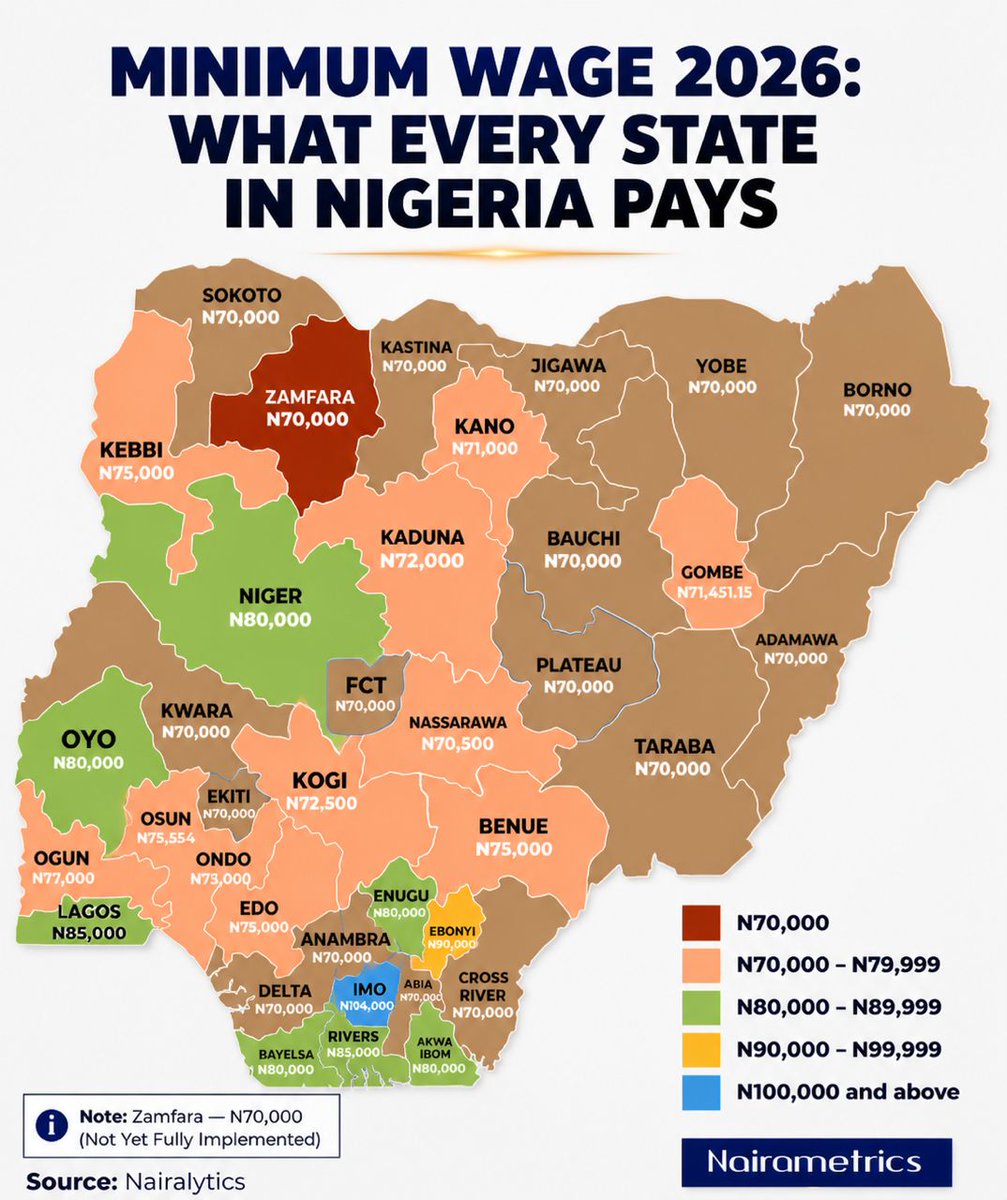
As of May 2026, verified data from Nairametrics Research tracking official state government pronouncements shows that at least 20 states are paying above the N70,000 federal floor, while others remain at that baseline or are still negotiating their way toward it.
Which Nigerian States Pay Above N70,000 Minimum Wage in 2026?

The N70,000 minimum wage in 2026 is not what it looks like on paper. State-by-state variation has produced an entirely fragmented wage landscape, where a civil servant in Imo State earns nearly 49% more than a counterpart doing the same job in a state still anchored to the federal floor. Understanding where each state stands matters, because the difference is not trivial, and for workers comparing their options or tracking what their government has actually committed to, the full picture is worth knowing.
Imo State Leads the Country at N104,000
The highest minimum wage in Nigeria right now belongs to Imo State. Governor Hope Uzodimma’s administration officially commenced payment of N104,000 as the new minimum wage in October 2025, placing the state significantly ahead of every other government in the country. The increase was not only at the base level. Under the revised framework, medical doctors in Imo State public service are paid N513,000, and entry-level lecturers in state tertiary institutions receive N220,000.
The timing of Imo’s wage revision is notable. It came more than a year after the federal government set N70,000 as the national floor, in a climate where several states had still not reached that level. Uzodimma’s government positioned the increase as part of a broader worker welfare push, with payment alerts confirming the new structure had actually reached civil servants’ accounts by early October 2025.
Whether the private sector and local government employees in Imo State are seeing equivalent adjustments is a separate question, and one that state governments across the board have been less transparent about. The N104,000 figure applies to state civil servants specifically, which remains the case for most wage announcements out of state capitals.
Ebonyi Pushes to N90,000 After August 2025 Review
Ebonyi State comes in second nationally, paying N90,000 per month after Governor Francis Nwifuru’s government announced an upward review on August 27, 2025. The announcement took effect immediately, raising the state’s minimum from the N70,000 it had been paying to N90,000, a 28.6% increase applied in one move.
The Southeast has generally performed better on minimum wage implementation than several other geopolitical zones. Both Imo and Ebonyi’s decisions to move above the national average came in the second half of 2025, after it became clear that the purchasing power of the N70,000 wage had already been seriously eroded by inflation. Enugu State, also in the Southeast, is paying N80,000.
Lagos and Rivers at N85,000: The Cost-of-Living Rationale
Lagos and Rivers states both pay N85,000, and both arrived at that figure within about a month of each other in late 2024. Governor Babajide Sanwo-Olu announced Lagos’s N85,000 minimum on October 16, 2024, specifically citing the city’s high cost of living as the reason for going N15,000 above the federal floor. Governor Siminalayi Fubara of Rivers State followed on October 18, 2024, approving N85,000 for state civil servants, with the increase taking effect from November 2024.
The reasoning behind Lagos’s figure was straightforward. The commercial pressures Lagos workers face, from rent to transport to food costs, are categorically different from what applies in lower-density states. A single room in many Lagos neighbourhoods costs more per month than the entire N85,000 wage in some calculations. Sanwo-Olu had mentioned a target of reaching N100,000 by January 2025, but that revision has not materialised.
What has materialised, as of May 1, 2026, is the NLC Lagos State Council demanding N225,000. The union’s chairperson, Funmi Sessi, made the demand at the 2026 Workers’ Day celebration held at Mobolaji Johnson Arena, arguing that the current wage structure can no longer protect workers from the compounding pressure of inflation and rising living costs. The gap between what Lagos pays and what labour says is needed is not a small one. It is a ratio of more than 2.5 to 1.
The States Paying N80,000: Oyo, Niger, Enugu, Akwa Ibom, and Bayelsa
Five states are currently paying N80,000: Oyo, Niger, Enugu, Akwa Ibom, and Bayelsa. Oyo State’s N80,000 structure has been supplemented in 2026 with additional monthly support allowances introduced by the state government, making the effective take-home higher than the headline figure for some categories of workers.
Bayelsa’s implementation has moved forward, but not without complications. Governor Douye Diri announced the N80,000 structure from November 2024 and reaffirmed commitment to it during the 2025 May Day celebrations. The state government indicated in June 2025 that implementation had commenced, including efforts to clear outstanding salary arrears. Reports from April 2026 described implementation as progressing, though outstanding adjustments for certain categories remain.
Niger State’s N80,000 wage puts it in a tier that includes some of Nigeria’s more commercially active states, even though Niger’s own revenue base is far more dependent on federal allocations than Lagos or Rivers. Enugu and Akwa Ibom complete this group, with both states having moved to N80,000 and largely sticking to that structure through 2025 and into 2026.
Ogun at N77,000 and the N75,000 States: Edo, Kebbi, Osun, and Benue
Ogun State is paying N77,000, placing it between the N80,000 tier and the cluster of states at N75,000. Edo State has moved from its earlier N70,000 position to N75,000 after an upward review. Kebbi State is also at N75,000. Osun State’s minimum wage works out to N75,554.28, the precision of that figure reflecting an adjusted salary structure rather than a round-number announcement.
Benue State approved a N75,000 wage structure for certain categories of workers, though reporting on full cross-category implementation has been mixed. The state has faced fiscal pressure that complicates consistent payout across all worker groups, a challenge it shares with several other states in the North Central zone.
These states represent a middle tier that chose to go modestly above the federal floor without committing to the larger increases made by states like Imo or Lagos. In relative terms, a N5,000 or N7,000 premium over N70,000 does make a difference to individual workers, but it also reflects the fiscal caution of governments managing tight FAAC allocation schedules month to month.
Just Above the Floor: Ondo, Kogi, Kaduna, Kano, and Gombe
Several states are paying amounts that technically clear the N70,000 mark but by a fairly narrow margin. Ondo State pays N73,000. Kogi pays N72,500 and Kaduna N72,000. Kano State is at N71,000. Gombe State, in a development announced for May 2026, ordered full implementation of N71,451.15 as its minimum wage. Nasarawa State is at N70,500.
These figures matter because they show that some state governments have gone through the process of calculating differentiated wage structures without arriving at dramatically higher numbers. The variation in Gombe’s figure, N71,451.15, suggests an internally calculated adjustment rather than a political round number. Whether that precision translates into consistent monthly payment is a different matter entirely.
Kano is a significant case. As Nigeria’s most populous northern state and a major commercial centre, a minimum wage of N71,000 for state civil servants reflects both fiscal constraint and a different cost-of-living calculus than applies in Lagos or Abuja. Northern states have generally implemented smaller premiums over the federal floor, with several remaining exactly at N70,000.
States Still at N70,000 and Those Still Working Toward It
A significant number of states remain at the federal benchmark of N70,000 with no upward revision. These include Delta, Kwara, Adamawa, Anambra, Abia, Borno, Yobe, Ekiti, Sokoto, Plateau, Taraba, and Bauchi. The reasons vary. Some states cite revenue constraints linked to declining federal allocations. Others point to ongoing negotiations with labour unions over consequential adjustments, which are the ripple effects of a minimum wage increase on salaries across the broader civil service pay scale.
Consequential adjustments are where minimum wage implementation gets complicated and expensive. Raising the floor to N70,000 or above does not just affect the lowest-paid civil servant. It is supposed to trigger upward movement across all salary grades to maintain differentials. Many states have announced the N70,000 minimum but have been slower to implement the full consequential adjustment cascade, meaning senior civil servants in those states may also be earning less than they should be under the revised structure.
Beyond those at N70,000, reports from April 2026 indicate that some states had still not achieved full implementation of the national minimum wage for all categories of workers, including local government staff and primary healthcare workers. The NLC and TUC’s May Day 2026 joint statement noted that some workers were marking Workers’ Day through protests rather than celebrations precisely because their governments had not cleared the arrears owed under the 2024 wage law.
Why the Differences Exist: Revenue, Politics, and Implementation Gaps
The variation in minimum wages across Nigerian states is fundamentally a function of revenue. States that can comfortably pay N80,000 or more are generally those with higher internally generated revenue or larger derivation-based allocations from the Federation Account. Lagos, Rivers, and Oyo are among Nigeria’s top internally generating states. They have the fiscal flexibility to move above the federal floor without waiting for FAAC month-end to clear it.
Poorer states face a structurally different situation. Their public sector wages are largely funded through FAAC allocations, which fluctuate with crude oil prices, output, and exchange rates. When oil revenues are down or the naira weakens, the real value of what these states can pay narrows. A state that technically approves N72,000 but regularly delays payment by two or three months is in a worse position than a state that pays N70,000 on the first of every month.
There is also a political dimension. Governors who announce higher wages before elections or in response to labour pressure sometimes struggle to sustain those commitments when their fiscal situation tightens. Several of the states currently listed at their announced figures are still managing arrears from earlier wage cycles, making the gap between announcement and actual payment a chronic feature of the system rather than an exception.
Labour’s Next Move: N154,000 and Renegotiation Starting July 2026
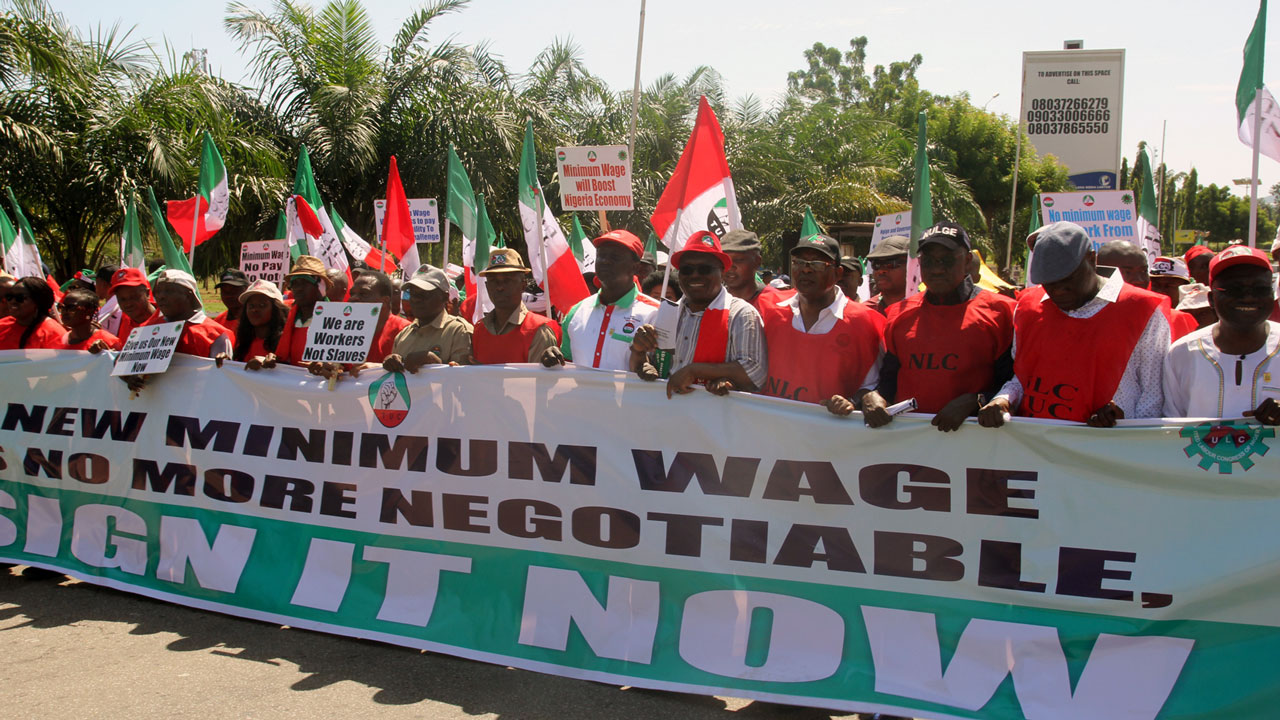
Whatever the current wage map looks like, it is already being overtaken by events. On May 1, 2026, at the Workers’ Day celebration in Abuja, NLC President Joe Ajaero and Trade Union Congress President Festus Osifo jointly announced that the process of renegotiating the national minimum wage would commence in July 2026. Their position was direct: the N70,000 figure, which took months of industrial action to extract from the federal government in 2024, has been consumed by inflation faster than most expected.
The NLC’s national demand is for N154,000. In Lagos, where cost-of-living pressures are most acute, the state council went further. Speaking at the May Day celebration at Mobolaji Johnson Arena, NLC Lagos Chairperson Funmi Sessi demanded that the Lagos State Government adopt a new minimum wage of N225,000, citing rising costs of food, transport, housing, healthcare, and education. The Lagos government, represented at the event by Deputy Governor Obafemi Hamzat, acknowledged the concerns without committing to a figure.
The NLC’s argument is not without basis. The National Minimum Wage Act 2024 reduced the wage review cycle from five years to three years, meaning a statutory review is not technically due until 2027. But labour’s position is that inflation has already made waiting until 2027 unreasonable. Joe Ajaero, in his New Year 2026 message, put it plainly: workers’ income must guarantee life, not mere survival. That standard, by most measures, is not being met at N70,000 in 2026 Nigeria.
What the Wage Map Means for Nigerian Workers

For a Nigerian civil servant trying to decide whether their state government has treated them fairly, the comparison is stark. A public school teacher in Imo State earns at least N104,000 a month. The same grade teacher in Borno State earns N70,000. Same federation, same job description, different government commitments. That gap is not explained by skills or productivity. It is explained by fiscal capacity and political will, in roughly equal measure.
The states that have moved meaningfully above the N70,000 floor are not all oil-producing or economically dominant. Ebonyi, for instance, is not among Nigeria’s wealthiest states by internally generated revenue, yet it moved to N90,000. That decision reflects a choice, not just a fiscal reality. States still anchored at N70,000 could make similar choices at different spending priorities.
What complicates any reading of the current wage map is that it is moving. Labour renegotiation is starting in July 2026. Inflation, while showing some signs of moderating in early 2026, has not reversed the erosion in purchasing power that workers have experienced since the 2024 increase. Several states are announcing May 2026 wage awards and allowances on top of existing structures, which blurs the line between the minimum wage and the actual take-home.
Nigerian workers, particularly those in the public sector, are living with a policy system where the difference between a good month and a bad one often depends not on their performance or sector, but on which state they happen to work in. Until federal enforcement of minimum wage implementation improves, that reality will continue to define the working conditions of millions of Nigerians regardless of what the law formally requires.