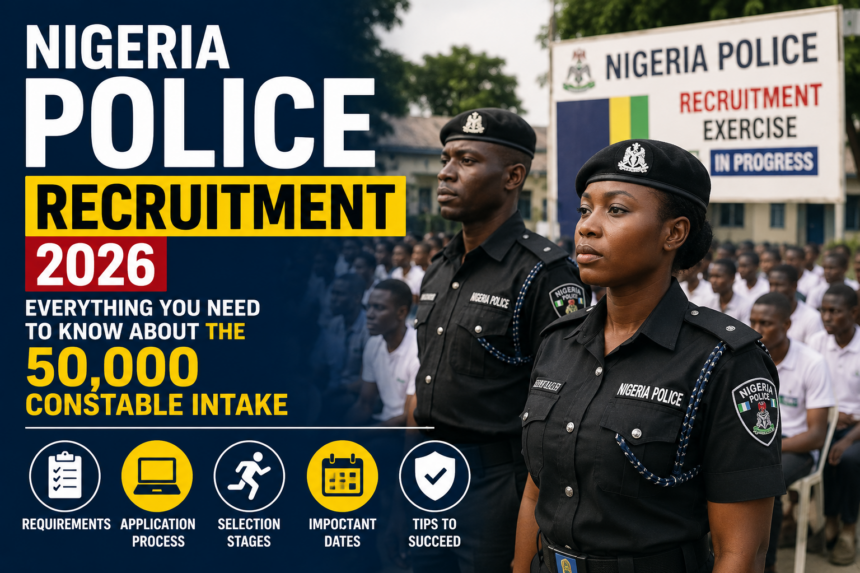
When President Bola Tinubu declared a nationwide security emergency on November 26, 2025, and ordered the recruitment of 50,000 new police officers, the announcement landed on a country that already knew it was understaffed. The Nigeria Police Force has approximately 371,800 officers spread across a nation of over 237 million people. That ratio is bad enough on paper, but the reality is worse: a November 2025 report by the European Union Agency for Asylum estimated that more than 100,000 of those officers were not even available for public policing. They were assigned to protecting politicians and VIPs, leaving communities across Nigeria even thinner on the ground than the headline numbers suggest.
- Why Nigeria Is Recruiting 50,000 Officers at Once
- How the Application Process Actually Worked
- Who Was Eligible to Apply
- The Documents You Needed to Get Right
- What the Portal Numbers Revealed After It Closed
- What Happens at the Nigeria Police Recruitment 2026 Screening
- The Scam Problem and Why the PSC Kept Warning About It
- What Comes After Screening for Successful Candidates
- The Bigger Picture This Recruitment Reflects
So when the Police Service Commission opened the application portal in December 2025, Nigerians responded in a way that reflected something deeper than just the search for a government job. Over 616,000 people applied. Young men and women from Adamawa to Anambra, from Kebbi to Lagos, logged onto npfapplication.psc.gov.ng to take a shot at one of 50,000 constable positions. That is roughly 12 applicants competing for every single slot. The competition was not abstract. It was the kind that gets people waking up before 6am, clutching white flat files stuffed with O’Level certificates and NIN printouts, hoping their paperwork was right.
For anyone who applied, is still waiting on results, or is curious about what actually happened at every stage of this process, this guide breaks it all down. Not just the requirements, but the numbers, the complications, the disqualification traps, and what comes next.
Nigeria Police Recruitment 2026


The Nigeria Police recruitment 2026 exercise was, by any measure, the largest single intake of constables this country has attempted in years, and it unfolded across multiple overlapping phases spanning four months. The portal opened December 15, 2025. Physical screening started March 9, 2026, and runs through April 18, 2026. In between those dates, hundreds of thousands of Nigerians navigated an application system that had its share of glitches, deadline extensions, and last-minute document surprises. Here is the full picture, from the moment Tinubu gave the order to what qualifying candidates can expect to face before they get a badge.
Why Nigeria Is Recruiting 50,000 Officers at Once
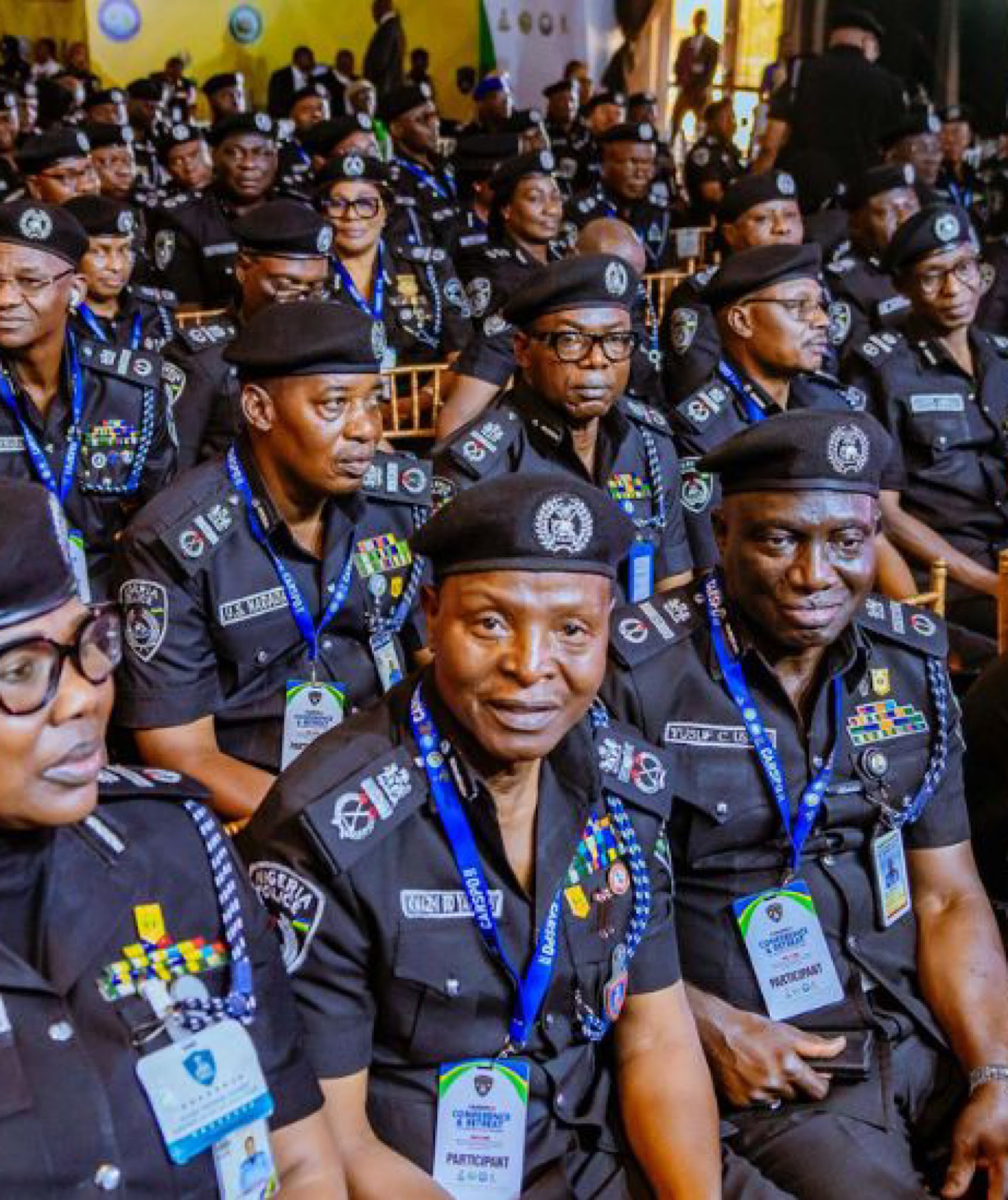
The number 50,000 did not come from a staffing committee’s spreadsheet. It came from a security emergency. On November 26, 2025, President Tinubu declared a nationwide security emergency and instructed the Nigeria Police Force and armed forces to take aggressive steps to address escalating violence. The directive to recruit 50,000 new officers was central to that response. Earlier in the year, government planning had anticipated an annual intake of 30,000 new officers, with Senator Ahmad Abdulhamid Malam Madori, Chairman of the Senate Committee on Police Affairs, publicly confirming that figure. The November escalation changed the calculus, pushing the 2026 target to 50,000 in a single exercise.
The context behind this urgency is not hard to understand if you look at the numbers. Nigeria’s police-to-population ratio is one of the most strained in the world. With about 371,800 officers serving a population that has crossed 237 million, the country already falls far short of the United Nations’ recommended ratio of one officer per 450 citizens. But the EU Agency for Asylum’s November 2025 report made the situation look even more dire. It found that more than 100,000 of those officers were effectively removed from public-facing duties because they were attached to VIP and political protection details. Inspector-General Kayode Egbetokun had twice ordered the withdrawal of mobile police from VIP assignments, in June 2023 and again in April 2025, but the practice persisted.
Beyond the VIP problem, there is the simple matter of attrition. Officers retire, die in service, or leave the force every year. Without consistent recruitment, the numerical gap between Nigeria’s policing needs and its actual capacity grows steadily wider. The 50,000 intake is partly catch-up, partly expansion, and partly a political statement that the Tinubu administration recognizes the security problem as structural, not just circumstantial. Plateau State Governor Caleb Mutfwang, speaking to reporters in Abuja around the time of the announcement, said Nigeria was in ‘dire need of more boots on the ground’ and welcomed the recruitment as a necessary intervention.
The target is ambitious. Plans already in motion envision growing the NPF from its current strength to 650,000 officers, which would require adding roughly 280,000 recruits over multiple recruitment cycles. The 50,000 constables selected in this exercise are just the first major tranche of that longer national project.
How the Application Process Actually Worked
The PSC and NPF ran the application entirely online through a dedicated portal at npfapplication.psc.gov.ng. No physical application forms, no office queues. This was deliberate. The commission wanted a system that could handle large volumes, reduce human contact points, and limit the opportunities for middlemen to extract fees from desperate applicants. The portal went live on December 15, 2025, and the original closing date was January 25, 2026.
But the PSC ran into an early problem. Some states were not sending in strong numbers relative to their population size and security needs, Lagos being a notable case. After consultations with NPF leadership and other stakeholders, the commission approved a two-week extension, moving the closing date to February 8, 2026. The intervention worked. When retired Deputy Inspector-General of Police Taiwo Lakanu, Chairman of the PSC Standing Committee on Police Matters, briefed reporters at the PSC headquarters in Abuja, he reported that 616,873 total applications had come in by the time the portal closed. That figure broke down as 348,974 general duty applicants and 85,630 specialist applicants, with the remainder reflecting incomplete or later-stage submissions.
The gender breakdown Lakanu shared was telling. Of the 616,873 applications, 442,592 came from male applicants and 114,640 from female applicants. He described this as a reflection of sustained interest among Nigerian youth in policing as a career path. Adamawa State produced the highest number of applications of any single state, which stood out given that states like Lagos and Kano typically dominate federal recruitment statistics.
Who Was Eligible to Apply
The PSC published its eligibility requirements on psc.gov.ng and through the official recruitment portal. For the General Duty cadre, applicants had to be Nigerian citizens by birth, between 18 and 25 years of age, physically and mentally fit, and free from any criminal record. Height minimums applied to General Duty candidates specifically: 1.67 metres for males and 1.64 metres for females. The academic requirement for General Duty was a minimum of five O’Level credits, including English Language and Mathematics, in no more than two sittings.
The Specialist cadre had slightly different terms. The age ceiling extended to 28 years for specialists, reflecting the fact that many of these roles require prior professional experience. Academically, specialists needed a minimum of four O’Level credits (including English and Mathematics) and at least three years of verifiable experience in their specific trade, backed by trade test certificates. The roles covered under the Specialist cadre were wide: drivers, mechanics, auto-electricians, dispatch riders, medical assistants, communication and IT technicians, forensic assistants, marine deckhands, divers, boat mechanics, K9 dog handlers, horse riders for the mounted troop unit, electricians, plumbers, welders, air conditioning and refrigeration technicians, tailors, and band section musicians.
A few additional conditions applied across both cadres. Applicants had to be free from financial embarrassment, which is standard language in federal recruitment that essentially means no outstanding debt judgments or bankruptcy proceedings. Female applicants were required to not be pregnant at the time of training. And the recruitment was explicitly merit-based. The PSC also made clear that the Federal Character principle applied, meaning slots were distributed across all 36 states and the FCT, not simply given to whichever states produced the most applicants.
The Documents You Needed to Get Right
Documentation was where a significant number of applications fell apart. The PSC’s official statement required candidates who made it to screening to arrive with both original and duplicate copies of their credentials, neatly arranged in two separate white flat files, each with a recent passport photograph attached. The specific documents required were: a National Identity Number printout or physical NIN card issued by NIMC, O’Level certificate(s), a birth certificate or Declaration of Age, and a local government or state of origin certificate.
Candidates also had to print specific forms from the portal before arriving at the screening venue. These were the Guarantor’s Form, the Application Submission Slip, the Invitation Slip, the Credential Screening Form, and the Physical Screening Form. Missing any of these from the printed documents package could result in being turned away at the gate. The Guarantor’s Form deserves particular attention because of a detail many applicants missed: the form explicitly stated in block letters that a photocopy of the guarantor’s official identity card must be attached. A guarantor form submitted without that ID copy was considered incomplete.
Specialist applicants had an additional layer: trade test certificates confirming the relevant skills they claimed. No certificate, no consideration under the Specialist cadre, regardless of how many years of experience the applicant stated on the form. The dress code at the physical screening was also non-negotiable: white canvas shoes, white T-shirts, white shorts, and white stockings. Arriving in any other attire was grounds for being turned away without assessment.
What the Portal Numbers Revealed After It Closed
The PSC’s post-closure analysis of the 616,873 applications produced numbers that are worth examining carefully. Of the total applications received, 434,604 applicants were found to have met the initial requirements and were shortlisted for the March 9 physical screening. That means roughly 70 percent of everyone who applied made it past the online stage. The remaining 30 percent fell into two categories: 121,596 were classified as outright unqualified, and 60,673 submissions were deemed invalid.
The distinction between unqualified and invalid is meaningful. Unqualified means the applicant simply did not meet the stated requirements: wrong age, insufficient O’Level credits, not a Nigerian citizen by birth, or some other clear eligibility failure. Invalid submissions were a different problem. These were entries where data was incomplete, contradictory, or submitted in a form the system could not process. Some of these may have been technical failures, others were likely applicants who attempted to submit without all required information filled in.
The 434,604 who qualified are now competing for 50,000 places. That is still more than eight qualified, screened applicants for every available slot. The police force applies the Federal Character principle at this final selection stage, so the distribution of those 50,000 positions across states will not be purely based on who scored highest nationally. Each state and the FCT has an allocation, and recruitment from each state must stay within that allocation, regardless of how many applicants from that state qualified.
What Happens at the Nigeria Police Recruitment 2026 Screening
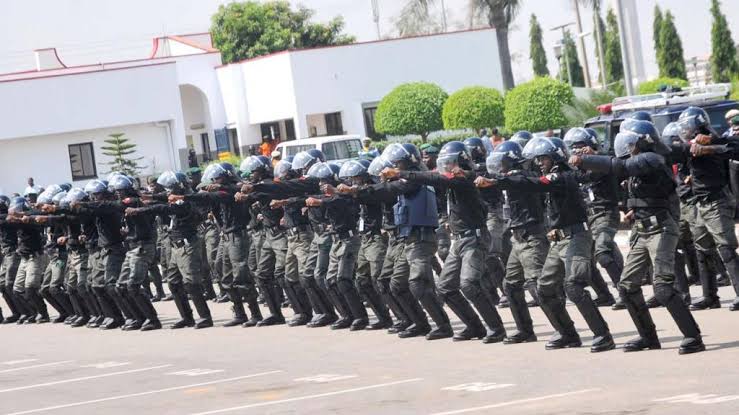
The physical and credential screening started on March 9, 2026, and runs through April 18, 2026, across all 36 states and the FCT. Each candidate’s invitation slip specifies the exact venue, date, and time they are assigned to. Attending a different state’s screening centre from the one indicated on the slip leads to automatic disqualification. There are no exceptions made for travel distance or logistical difficulty.
At the venue, the screening covers two parallel tracks happening simultaneously: physical and medical assessment, and document verification. Officers assess height, body fitness, and visible physical health. Applicants who appear medically unfit may be referred for further checks or dismissed at the spot. Pregnancy results in disqualification on the day. The document verification happens at the same time, and this is where many candidates who otherwise would have passed physically lose their spot. Inconsistencies between what was submitted online and what appears in physical documents flag the application for rejection. Missing pages, unofficial certificates, or a guarantor form without the required ID copy can end the process.
Screening days typically begin early. Many applicants arrive before 6am to manage crowd pressure and avoid the chaos of the later hours. The PSC’s Rivers State Police Command spokesperson, CSP Grace Iringe Koko, confirmed in a March 5, 2026 press release that applicants should check their portal-assigned date and time strictly, and present themselves only on the day specified. CP Olugbenga Adepoju, the Rivers State Commissioner of Police at the time, urged shortlisted applicants to conduct themselves in an orderly manner and avoid any acts that could undermine the process.
One thing the screening does not forgive is incomplete documentation. Regardless of how physically fit or academically qualified a candidate is, failing to present the full package of required documents, in the correct format, leads to immediate non-consideration. The police force sees document completeness as a test of an applicant’s attention to detail and instruction-following ability, not just a bureaucratic hurdle.
The Scam Problem and Why the PSC Kept Warning About It
The PSC did not warn about scammers once. They warned repeatedly, across multiple official statements, from the time the portal opened in December 2025 all the way through the screening period. Torty Njoku Kalu, PSC Head of Protocol and Public Affairs, issued notices stressing that the recruitment is entirely free at every stage. No payment is required to apply, no payment is required to check your status, no payment is required to print your screening forms, no payment is required to be shortlisted.
The PSC also specifically warned against cyber cafes and agents who were charging applicants to fill in their application forms on the portal. While there is nothing wrong with paying a business centre to use their computer, some operators were charging inflated fees under the guise of processing or submitting applications, when the submission itself remains free and accessible to anyone with internet access. PSC chairman Hashimu Salihu Argungu reaffirmed publicly that the recruitment was free of charge and that applicants caught bribing anyone at any stage of the exercise faced penalties, not just disqualification.
The portal itself experienced some technical issues during the screening period, with reports of some candidates logging in and seeing another person’s information displayed on their profile screen. The PSC acknowledged this as a temporary glitch and advised candidates to log out, wait, and try again after confirming their NIN input was correct. Any update or instruction not coming through the official PSC website (psc.gov.ng), the official NPF website (npf.gov.ng), or the recruitment portal (npfapplication.psc.gov.ng) should be treated as unofficial and likely fraudulent.
What Comes After Screening for Successful Candidates
Passing the physical and credential screening does not mean a constable badge is in your hand. The screening is the filter, not the finish line. Candidates who clear the March 9 to April 18 exercise will still go through aptitude testing, a full medical examination, and background verification before final selection. The aptitude tests assess basic cognitive ability, literacy, and situational judgment. The medical examination goes deeper than what happens at the screening venue, covering things like vision, chest X-rays, and blood tests. Background checks involve verifying everything stated on the application form, including the guarantor’s identity and relationship to the candidate.
Those who make it through all stages will then proceed to the Nigeria Police Academy or designated training facilities for basic constable training. Training is residential, structured, and physically demanding. It is where the uniform is earned, not just handed over. The length of the training course and the facilities candidates are sent to will depend on the batch scheduling and available training capacity. Given the scale of this intake, 50,000 recruits entering the system simultaneously will require significant coordination across the NPF’s training infrastructure.
This exercise is also happening under a new IGP. Tunji Disu, born April 13, 1966, and now 59 years old, was appointed by President Tinubu as Acting Inspector-General on February 24, 2026, following the resignation of Kayode Egbetokun the previous day. Disu was confirmed as the substantive 23rd Inspector-General of Police at a Nigeria Police Council meeting on March 2, 2026, and sworn in at the Presidential Villa on March 4, 2026. Speaking at his decoration ceremony, Disu stated that his tenure would be defined by three commitments: professionalism, modernism, and accountability. The recruitment exercise falls squarely within that mandate.
The Bigger Picture This Recruitment Reflects
Over 616,000 Nigerians applied for a police constable position. That number says something about where the country is, economically and security-wise. It says that federal employment still carries weight in a job market where private sector stability is hard to guarantee. It says that for many young Nigerians, wearing a police uniform is not just about income. It is about belonging to something permanent and state-backed in an environment that feels uncertain in almost every other direction.
But the scale of this exercise also puts a responsibility on the PSC and NPF that extends beyond filling slots. Lawyers from the Nigerian Bar Association’s Benin Zone publicly urged that the process be handled by a committee of retired officers and relevant agencies, specifically to prevent recruitment from becoming a tool for settling political debts. That concern is not new in Nigerian federal recruitment, but it is more pointed here because of how visibly the government has tied this exercise to its security credibility.
Plans to grow the NPF to 650,000 officers over time depend on this exercise working the way it is supposed to. Not just recruiting bodies, but selecting people who meet the physical, academic, and character requirements that community policing actually demands. Fifty thousand officers dispatched to communities across Nigeria with proper training and the right disposition would make a measurable difference. The same 50,000 recruited through connection or cash payment would compound the exact problem this exercise is meant to fix.
For the 434,604 candidates now in the screening pipeline, the immediate task is clear: show up to the right venue on the right date, dress correctly, have every document in order, and let the process run its course. There is no shortcut that is worth the risk of permanent disqualification, and there is certainly no legitimate agent or unofficial contact who can guarantee anyone a slot. The PSC has said this repeatedly. It bears repeating here too.