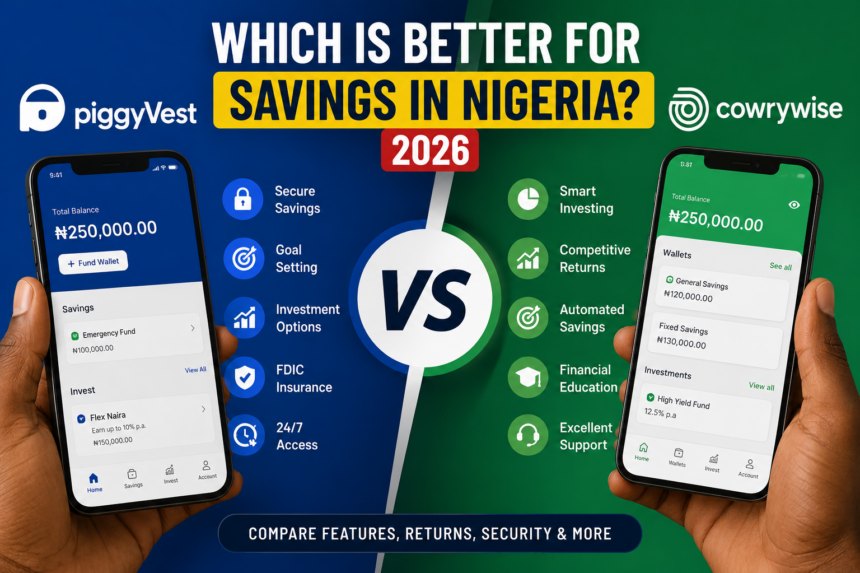
For a long time, saving money in Nigeria meant hiding cash under a mattress, giving a trusted friend a fixed amount every month, or joining a cooperative you prayed would not scatter by December. Then two apps came along and quietly changed the whole thing. Today, millions of Nigerians think about savings differently, not because banks got better, but because PiggyVest and Cowrywise made the idea of saving feel possible, trackable, and even exciting.
- Two Apps That Changed How Nigerians Think About Saving
- The Core Difference: Saver’s App vs Investor’s App
- Interest Rates and What Your Money Actually Earns
- How Each App Handles Your Temptation Problem
- Investment Options: Where Cowrywise Goes Deeper
- What About Your Money’s Safety?
- Dollar Savings and the Naira Devaluation Problem
- The Real Answer Is Knowing What You Need
The question of which app is better has been running since both platforms gained serious traction. But in 2026, the comparison is sharper and more loaded than it used to be. Both apps have matured, rates have moved, features have expanded, and Nigerians now have enough lived experience with both to make honest calls. The real question is not which app is generally better, but which one is better for what you are actually trying to do.
In April 2026, PiggyVest marked ten years and announced it had processed over N3 trillion in savings across more than 6 million users. Cowrywise, which followed a year later in 2017, has stayed quieter about headline numbers but has built a reputation as the more investment-forward platform. They are not the same product, and that is the thing most comparison articles miss.
PiggyVest vs Cowrywise: What Has Changed and What Still Matters

The PiggyVest vs Cowrywise debate is one of the most searched personal finance topics in Nigeria, and for good reason. Both platforms have been around long enough to develop real track records, real user complaints, and real standout features. Understanding exactly where they differ, and where one pulls ahead of the other, is the only way to put your money in the right place.
Two Apps That Changed How Nigerians Think About Saving
PiggyVest launched on January 7, 2016, when it was still called Piggybank.ng. The founders, Somto Ifezue, Odunayo Eweniyi, and Joshua Chibueze, drew inspiration from a viral Twitter post where a woman shared how she had saved N1,000 every day for a year in a wooden box and counted the results at the end. The idea was straightforward: build a digital version of that discipline. Lock people’s money away from themselves, add interest, and let them collect at the end of a set period.
Cowrywise came the following year, in 2017, with a slightly different pitch. Where PiggyVest’s early identity was built around savings as a behavioural challenge, Cowrywise arrived as a wealth management platform. Its founders were thinking about investment access, not just savings automation. The mutual fund structure that Cowrywise built into its core product from the start is the clearest sign of this difference. From day one, Cowrywise was designed to put your savings to work in regulated investment vehicles, not just keep them locked in a digital box with interest attached.
Both platforms have since expanded well beyond their original scope. PiggyVest now runs Investify, an investment marketplace where users can access agriculture, real estate, and commercial paper deals. Cowrywise has added NGX stock access, allowing users to buy shares of over 140 companies listed on the Nigerian Stock Exchange. But the foundational identity of each platform still shapes how they feel to use. PiggyVest still feels like a savings-first product. Cowrywise still feels like a wealth management tool that also does savings.
That difference matters more than most people realise when they sit down to choose.
The Core Difference: Saver’s App vs Investor’s App
Here is the most important thing to understand before diving into features and interest rates: PiggyVest is primarily built to help you save. Cowrywise is primarily built to help you invest. The two things look similar on the surface because both involve putting money aside and watching it grow, but the mechanics underneath are very different.
When you put money into PiggyVest’s SafeLock, you are locking a fixed naira amount for a fixed period at a fixed interest rate. The rate is predetermined, the growth is guaranteed, and you know exactly what you will collect at maturity. When you put money into a mutual fund through Cowrywise, your returns are tied to the performance of underlying assets, usually money market instruments like treasury bills and commercial papers. The returns are typically competitive, sometimes better than PiggyVest’s fixed rates, but they are not locked in the way SafeLock is.
This is not a criticism of Cowrywise. It is a structural reality that affects which platform fits your needs. If you are saving your rent money for six months and you cannot afford any variation in what you will collect at the end, PiggyVest’s fixed return model gives you certainty. If you are saving for a goal three to five years out and you are comfortable with some movement in returns in exchange for potentially better performance, Cowrywise’s mutual fund structure can serve you better.
Cowrywise itself put it simply in its own product documentation: savings on the platform are invested in low-risk financial instruments, held by Zenith Nominees, and registered with the Securities and Exchange Commission. What this means for an ordinary user is that your money is professionally managed rather than sitting as a pure fixed deposit. For some people, that is a feature. For others, especially those who want absolute certainty on a specific number, it adds a layer of uncertainty they did not bargain for.
Interest Rates and What Your Money Actually Earns
This is where the comparison gets concrete, and where Nigerians understandably spend the most time. Let’s go through the current verified rates on both platforms.
On PiggyVest, as of early 2026, the Piggybank plan earns 18% per annum. This is the core automated savings feature where you can set up daily, weekly, or monthly deposits. Interest accrues daily and is paid into your account on the first of every month. The SafeLock plan, which is PiggyVest’s fixed savings product, pays up to 22% per annum, with interest paid upfront when you lock your funds. The longer the lock period, the higher the rate, up to 365 days. Flex Naira, the more liquid wallet you can dip into more freely, earns 12% per annum, though you lose that month’s interest if you withdraw more than four times in a month. Flex Dollar earns 7% per annum on dollar-denominated savings.
Odunayo Eweniyi, PiggyVest’s COO and co-founder, has explained that the platform’s rates are not static. They are dynamic and tied to movements in the Central Bank of Nigeria’s Monetary Policy Rate. When the CBN adjusts its MPR, PiggyVest responds accordingly. This explains why the rates have moved upward notably since 2024, when the CBN maintained an elevated MPR as part of its inflation-fighting posture.
Cowrywise’s savings plans sit in a different range. Based on verified figures from TechCabal’s November 2025 rate comparison, the emergency fund savings plan on Cowrywise earns 13.27% per annum. Goal-oriented plans such as the House Rent, Study, and Car savings plans earn 13.85% per annum. These rates are tied to underlying money market fund performance, which means they can shift with market conditions rather than being fixed the way PiggyVest’s SafeLock rate is.
On the mutual fund side, Cowrywise’s returns depend entirely on the specific fund and market performance. Conservative money market funds tend to deliver returns that beat savings account rates at traditional banks while preserving capital. The platform is transparent about this: estimated returns shown on their website are based on the average historical performance of conservative mutual funds from 2019 onwards, and future performance is not guaranteed. What Cowrywise offers here is access, not a promise.
The honest verdict on rates: for fixed, guaranteed returns over a defined period, PiggyVest’s SafeLock wins clearly. For diversified investment exposure where your money has the potential to grow across different asset classes over time, Cowrywise’s mutual fund products make a stronger case.
How Each App Handles Your Temptation Problem
One reason both apps became popular so quickly in Nigeria is that they take the temptation problem seriously. The biggest savings killer for most Nigerians is not income, it is access. When money is sitting in your bank account, it gets spent. Both apps were designed to put friction between you and your money.
PiggyVest’s approach is layered. The Piggybank plan has a quarterly free withdrawal structure: you get one free withdrawal window every 90 days. If you try to break out early, you lose the interest earned up to that point. SafeLock is more extreme. Once you lock your money in SafeLock and choose to receive interest upfront, you cannot touch those funds until the lock matures, full stop. There is no emergency override. If you choose the option where interest is paid at maturity, the lock can be broken after 90 days, but you forfeit all accrued interest. For Target Savings, early withdrawal before the set date costs a 1% fee and all accrued interest.
Cowrywise’s discipline mechanism is simpler in structure but equally firm. When you create a savings plan on Cowrywise and set a maturity date, you cannot access those funds before that date. The platform does not offer a break option the way PiggyVest does. You set the date, you wait. This simplicity is what many Cowrywise users actually prefer. There is no weighing of whether to break early and lose some interest. The decision is made for you when you create the plan.
For someone who is genuinely struggling with impulsive spending, the Cowrywise model’s binary nature can be more effective. But for someone who might face a legitimate emergency and needs flexibility, PiggyVest’s structure at least gives you an escape valve, even if it costs you some interest. Neither approach is wrong. They serve different personalities.
Investment Options: Where Cowrywise Goes Deeper
If your goal is not just savings but actual investment exposure, this is where the platforms diverge most sharply. Cowrywise was built around mutual fund access from the start and has arguably the largest collection of SEC-registered mutual funds available on a single consumer app in Nigeria. You can invest with as little as N1,000 in naira-denominated funds or $10 in dollar mutual funds. The platform categorises its funds by risk level: conservative money market funds where capital is preserved, and higher-risk funds that include equities and balanced portfolios. Cowrywise also gives users access to NGX-listed stocks, allowing you to buy shares in over 140 companies on the Nigerian Stock Exchange directly from the app.
PiggyVest has Investify, its investment marketplace, which covers agriculture, real estate, transportation, and commercial papers. The returns on Investify can reach up to 35% per annum, which is genuinely attractive. The limitation that has been noted by users for years is availability: Investify slots sell out fast, often in minutes. The investment opportunities are vetted and limited in volume, so the experience of a typical user checking the app outside a release window is that there is nothing available to invest in. This creates a first-come-first-served dynamic that does not suit everyone.
Cowrywise’s mutual funds, by contrast, are always available. You can open the app at 2am on a Tuesday and start investing in a money market fund. There are no slots, no countdown timers, no scrambling. This consistent availability is a significant operational advantage, and it is one of the clearest reasons why Cowrywise is the better choice for someone whose primary goal is building an investment portfolio, not just enforcing savings discipline.
What About Your Money’s Safety?
Before you trust any platform with your salary, your business capital, or your emergency fund, the question of safety is not optional. Here is what is actually true about both apps in the Nigerian regulatory context.
Both PiggyVest and Cowrywise are registered with and regulated by Nigeria’s Securities and Exchange Commission. Neither platform is a commercial bank. This is an important distinction because it means your deposits with these platforms are not covered by the Nigeria Deposit Insurance Corporation’s standard N5 million deposit guarantee in the same way that a CBN-licensed bank deposit would be. What protects users on these platforms is the regulatory oversight of the SEC, the quality of the underlying asset managers, and the custodial structures both companies use.
PiggyVest operates through licensed microfinance bank partners and has built its regulatory relationships over a decade. At its 10th anniversary event in April 2026, PocketApp CEO Ayo Akinola acknowledged the role of the CBN, NDIC, and SEC as partners in the company’s growth, noting that regulatory scrutiny, though sometimes difficult, had forced the platform to operate at higher standards. The company has now processed over N3 trillion in user funds since launch.
Cowrywise is structured as a licensed fund manager under the SEC. All mutual funds available on its platform are managed by professional fund managers who are independently registered with the SEC. User funds in mutual funds are held by a third-party custodian, Zenith Nominees, which separates them from Cowrywise’s own operational assets. This custodian structure is an important safety feature: even if Cowrywise as a company faced financial trouble, the assets held under mutual fund structures would not be treated as company assets.
The safety picture on both platforms is reasonable for the Nigerian fintech environment, but it is not the same as banking with a CBN-licensed deposit bank. If you are someone who needs absolute NDIC insurance coverage on your funds, your deposit bank remains the only fully compliant option. If you understand that fintech savings platforms carry a different risk profile and you are comfortable with that in exchange for significantly higher returns, both PiggyVest and Cowrywise have reasonable regulatory standing.
Dollar Savings and the Naira Devaluation Problem
Any honest conversation about savings in Nigeria in 2026 has to include the naira issue. Since 2023, the official exchange rate has moved dramatically, and Nigerians saving purely in naira are watching the real purchasing power of their savings erode even when the interest rates look impressive on paper. An 18% annual return in naira looks less exciting when the currency itself has lost significant value against the dollar over the same period.
Both platforms offer dollar-linked options, but the approach differs. PiggyVest’s Flex Dollar allows users to save in US dollars and earn 7% per annum. You can fund this wallet by purchasing dollars at the platform’s available exchange rate. It is a relatively simple, accessible way to park money outside of naira exposure.
Cowrywise also offers dollar mutual fund access, where users can invest in dollar-denominated funds with as little as $10. The returns on these funds are variable and depend on fund performance, but the primary appeal is not the interest rate, it is the currency exposure. For a Nigerian professional who receives naira income but wants to build some dollar reserves over time without going through a traditional bank’s foreign currency account process, Cowrywise’s dollar mutual fund access is a meaningful feature.
Neither platform fully replaces a proper dollar savings strategy if you are managing significant forex exposure. But for the average Nigerian salary earner looking to put aside a small dollar reserve every month, both apps make the process easier than it used to be.
The Real Answer Is Knowing What You Need
The question of whether PiggyVest or Cowrywise is better for savings in Nigeria has no universal answer, and anyone who tells you otherwise is selling you something. The two platforms were built with different purposes, and they deliver on those purposes differently.
If you are someone who needs strict, enforced discipline to actually keep money saved, particularly for a defined goal like rent, school fees, or business capital, PiggyVest is probably your best match. SafeLock’s fixed rates, unbreakable locks, and upfront interest payment give you certainty and protection from yourself. The 18% to 22% per annum rate range is competitive enough to genuinely beat inflation in most scenarios, and the quarterly withdrawal structure on PiggyBank is strict without being punishing.
If you are building a savings habit and want that money to do more over time, if you are thinking about diversification, if you want exposure to mutual funds without navigating the full complexity of direct fund investment, and if you want consistent availability of investment options rather than scrambling for Investify slots, Cowrywise serves that need more cleanly. The returns on savings plans are slightly lower than PiggyVest’s fixed rates, but the investment depth more than compensates if your horizon is long enough.
The smarter play, which many Nigerian personal finance practitioners have settled on, is to use both. PiggyVest for disciplined locking of money tied to specific near-term goals. Cowrywise for building an investment position that grows alongside your savings. They are not rivals fighting for the same job. They are different tools, and your financial life is complex enough to need both.