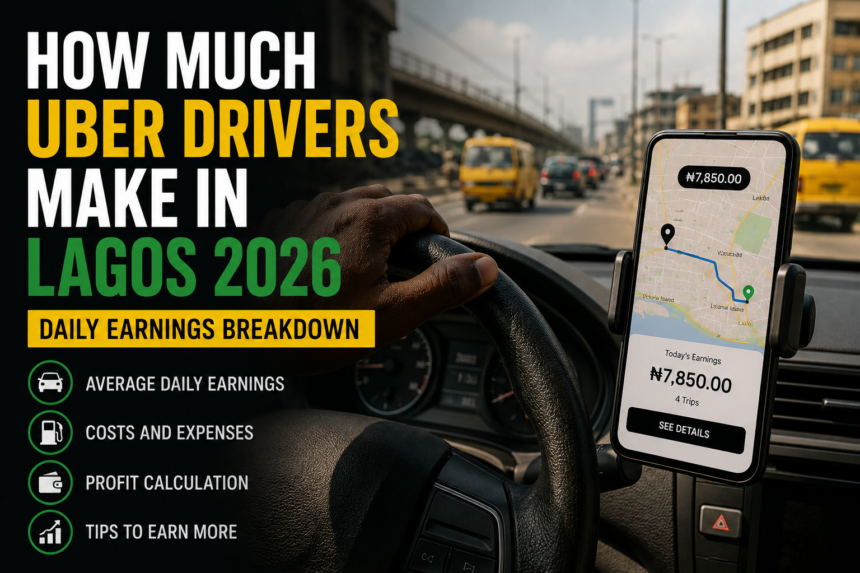
There is a number that ride-hailing companies love to throw around when they are trying to recruit new drivers in Lagos. Sixty thousand naira. One hundred thousand naira a day. The ads make it sound almost easy: just wake up, put your car on the road, accept trips, and watch the money come in. For people who are weighing their options in a city where steady employment is hard to come by and fuel prices change faster than the apps update their fares, that figure is enough to make someone seriously consider the business.
- What the Numbers Look Like on a Typical Day
- The Commission Cut: What Uber Takes Before You Count Anything
- Fuel Is the Biggest Problem on the Ground Right Now
- The Real Take-Home: What Actually Reaches a Driver’s Pocket
- How Timing and Location Shape What You Earn in Lagos
- Owner-Driver vs. Fleet Driver: Who Keeps More
- The March 2026 Strike and What It Revealed About Driver Economics
- What You Need to Get Started as an Uber Driver in Lagos
- Is Driving Uber in Lagos Worth It in 2026?
- What the Earnings Picture Tells You
The reality, as anyone who has actually driven on these platforms will tell you, is something else entirely. The gross earnings are real. The expenses that eat into those earnings are also real, and they are significant. A Lagos Uber driver who pulls in N60,000 on a good day is not taking home N60,000. By the time fuel, platform commission, and daily operating costs are removed, the actual profit can look very different from what the recruitment banners promised. In March 2026, that frustration boiled over into a three-day strike that shut down Uber, Bolt, and inDrive across Lagos and Ogun State. The story of what Uber drivers actually earn in Lagos is the story of that gap.
How Much Do Uber Drivers Make in Lagos (2026)


Understanding how much Uber drivers make in Lagos requires looking past the gross figures that circulate on social media and recruitment pages. The real picture sits in the daily breakdown: what goes in, what gets taken out, what is left. This article works through those numbers with the operational costs, platform fees, and driver accounts that define the business in 2026.
What the Numbers Look Like on a Typical Day
A Lagos Uber driver on a full working day can generate anywhere from N40,000 to N100,000 in gross trip earnings. The lower end reflects a slow or short shift; the higher end requires a driver to be on the road for ten to twelve hours, hitting surge windows during the morning rush along the Island corridor, then picking up airport runs, then catching the evening rush back out of Victoria Island and Lekki. To consistently pull N80,000 to N100,000 a day, a driver has to be strategic about timing and location, not just sitting online and hoping trips come.
The N60,000 figure that circulates most widely is probably the closest thing to a realistic average for a driver who puts in a full day in a high-demand area. A TikTok video by a Lagos e-hailing driver identified as @engr_timmaj, which went viral in April 2026, used that N60,000 figure as the starting point for his breakdown. He was clear about what it means: it is a starting point, not a salary. What happens to that N60,000 after the day ends is where the conversation gets uncomfortable.
On bad days, which are more common than the recruitment posts suggest, earnings can fall to N20,000 or N30,000 gross. Rain sometimes kills demand in certain parts of the city. Traffic so bad that drivers spend an hour covering three kilometres means the per-minute earnings tick up, but the per-kilometre earnings stall, and the fuel consumption stays constant. Public holidays can cut demand in half depending on the neighbourhood. Drivers who picked up the business expecting consistent six-figure days find that the average, across a full working month, is considerably more modest.
The Commission Cut: What Uber Takes Before You Count Anything
When a rider pays for a trip on Uber in Lagos, the driver does not receive the full amount. Uber deducts its service fee directly from the fare before the driver sees the money. That commission is currently sitting at 25% to 30%, depending on the arrangement and the market conditions at the time. Drivers on TechCabal in 2025 reported that Uber had been pushing toward the 30% end while simultaneously cutting base fares to compete with inDrive, which operates on a lower commission structure of around 10% to 13%.
What that means in practice: on a N60,000 gross day, Uber takes between N15,000 and N18,000 off the top. The driver is immediately working with N42,000 to N45,000 before touching a single litre of fuel. There is also the matter of a VAT charge that has been added more recently, which drivers flagged during the March 2026 strike as an additional cost that had not been factored into their original decision to join the platform. The commission structure is one of the core demands AUATON presented to the companies: reduce the percentage, or at minimum, stop cutting fares while taking the same commission rate.
Bolt operates a similar commission range, and according to drivers who work across both apps, Bolt tends to set somewhat higher base fares, which at least partially offsets the commission. InDrive, which allows passengers to negotiate trip prices, keeps a lower commission but the negotiated fares often come in so low that many drivers feel they end up earning less per kilometre than they would on Uber or Bolt. It is a trade-off that each driver resolves differently depending on the areas they work and the rider behaviour they experience.
Fuel Is the Biggest Problem on the Ground Right Now
If commission is the structural problem, fuel is the daily one. The cost of petrol in Nigeria has risen sharply in 2026, with the Techcrier reporting in March 2026 that prices had jumped by close to 50% over a two-week period amid global energy market volatility. For an Uber driver, this is not an abstract headline. Fuel is the largest single operating cost every single day, and it comes out of earnings before anything else.
The breakdown from @engr_timmaj in April 2026 put daily fuel spend between N20,000 and N25,000. He noted that buying N25,000 worth of fuel barely moves the gauge on some vehicles, which gives a sense of how badly the current fuel price environment is hitting transport operators. That N20,000 to N25,000 leaves a N60,000-gross-day looking like N35,000 to N40,000 before anything else is deducted. For a driver whose car drinks more, or one who works in areas with more traffic, the fuel bill can edge higher.
The fuel problem is compounded by the fact that Uber’s fare structure has not kept pace with the cost increases. In the past, when petrol prices went up, drivers who owned yellow taxis or worked the go-slow buses simply raised their prices. App-based drivers cannot do that. The fares are set by the platform. The algorithm may adjust for surge during busy periods, but the base fare, the price a rider pays for a ten-kilometre trip at two in the afternoon on a Wednesday, is not automatically recalibrated because diesel got more expensive. This is the mismatch that has been driving the frustration since 2024 and that finally pushed drivers to walk off the apps in March 2026.
The Real Take-Home: What Actually Reaches a Driver’s Pocket
Working with the numbers that have been verified through driver accounts and media reports, a Lagos Uber driver on a N60,000 gross day ends up with roughly the following after core deductions: subtract N20,000 to N25,000 in fuel, then subtract 25% to 30% in platform commission, which amounts to another N10,000 to N15,000. That leaves the driver with somewhere between N20,000 and N30,000.
Out of that, there are other costs that do not appear in a single-day calculation but are real costs of the business. Routine car maintenance, which becomes expensive quickly when a vehicle is covering 100 to 200 kilometres daily, averages out to several thousand naira per week. Oil changes come up more frequently. Tyres wear out faster. If the car is on a hire-purchase arrangement, a portion of daily earnings has to go toward the repayment schedule. Some drivers also pay a wash or clean fee daily to keep the vehicle presentable enough for five-star ratings.
Jaiyesimi Azeez, the AUATON Lagos chapter chairman, made a point during the March 2026 strike that cuts to the centre of the issue. He said that while the platforms told the public that drivers were earning N200,000 or N500,000, the reality for some drivers was that they struggled to go home with N2,500 in a day. That figure represents the worst-case scenario, but it reflects a real group of drivers: those with expensive car notes, those working through a fleet manager who takes a further cut, and those whose daily expenses consume everything the trip earnings generate.
On a genuinely good day, a driver with a fuel-efficient car, no loan repayment overhead, and solid positioning across high-demand areas can net N20,000 to N30,000 after everything. Consistently hitting that across a working month of roughly 22 to 25 days would produce a monthly net of N440,000 to N750,000. That is not an unreasonable income in Lagos, but it requires twelve-hour days, strategic discipline, and a vehicle that is not costing a fortune to maintain.
How Timing and Location Shape What You Earn in Lagos
Lagos is not one market. It is several markets stacked on top of each other, and the earnings difference between driving in Badagry and driving in Victoria Island on a Thursday morning can be enormous. The highest-earning zones consistently reported by drivers are Victoria Island, Ikoyi, Lekki Phase 1, and the Ikeja business district, particularly around the airport. These areas generate longer trips, higher-value fares, and a customer base that is more likely to tip or rate positively.
The airport corridor is particularly valuable. A single trip from Murtala Muhammed International Airport to Victoria Island or Lekki can generate N8,000 to N15,000 depending on traffic, surge, and the service type. Drivers who position themselves at the airport during early morning international arrivals can cover much of their daily fuel cost on two or three trips before nine in the morning. The waiting time is the trade-off: the queue at the airport can be long, and a driver who waits forty minutes for a trip that pays N8,000 has to calculate whether that was a better use of time than taking shorter trips from a busy junction.
Morning and evening rush hours are the obvious peak windows. The six to nine window in the morning catches workers heading to the Island from Mainland areas like Yaba, Surulere, Maryland, and Ojota. The five to eight window in the evening reverses the flow. Surge pricing activates during these periods, which meaningfully raises earnings per trip. A driver who can work both rush windows, then manage mid-day trips efficiently, is structurally better positioned than one who drives randomly throughout the day. This is one reason experienced drivers consistently emphasise strategic driving over simply being online for as many hours as possible.
Owner-Driver vs. Fleet Driver: Who Keeps More
There is an important distinction in the Lagos ride-hailing market between drivers who own their vehicles and drivers who are working a car owned by someone else. The owner-driver keeps 100% of whatever remains after platform commission and fuel. The fleet driver, someone who has rented or is working a vehicle under a daily or weekly remittance agreement with a fleet owner, is giving another portion of the daily earnings to the car owner before anything else.
Fleet arrangements in Lagos typically work on a daily target system: the driver hands a fixed amount to the car owner each day and keeps whatever is left. Those daily remittances can range from N15,000 to N30,000 depending on the agreement, the vehicle, and how long the arrangement has been running. For a driver generating N60,000 gross, the maths after commission, fuel, and fleet remittance can leave almost nothing. Some drivers in this position end up in the exact situation that Jaiyesimi Azeez described: gross earnings that look impressive on paper, with a take-home that barely covers their personal expenses.
Owner-drivers face a different but related pressure. The vehicle is an asset that depreciates with every kilometre, and the cost of keeping a car in condition for daily commercial use over multiple years adds up significantly. An engine overhaul, a gearbox repair, or a major suspension issue can wipe out weeks of net earnings. Drivers who entered the business with tokunbo vehicles bought at stretched budget often find that the maintenance cycle, particularly if the car has mileage problems, is more expensive than they planned.
The March 2026 Strike and What It Revealed About Driver Economics
The three-day strike that AUATON called from March 16 to 18, 2026 was not the first time Lagos ride-hailing drivers had walked off the apps. But the March 2026 action was broader and more visible than previous ones. Drivers across Lagos and Ogun State logged off Uber, Bolt, inDrive, and Lagride simultaneously, with strike monitoring teams deployed at the airport, major commercial districts, and transport hubs to encourage compliance. The disruption was significant enough that Uber was compelled to issue a public statement within days.
Uber’s response leaned on a figure from its 2023 Economic Impact Report for Nigeria: that drivers on its platform collectively earn an estimated N6.1 billion annually in additional income. The figure was meant to demonstrate the platform’s economic contribution, but it landed badly with drivers. Steven Iwindoye, AUATON’s public relations officer, had already summarised the situation in terms that cut past aggregate statistics: “Thousands of drivers now struggle to earn a sustainable income despite working long hours.” The N6.1 billion spread across thousands of drivers across multiple cities produces a much less impressive individual figure.
Uber, for its part, responded to the strike with a statement that it remained committed to engaging constructively with drivers through roundtable discussions. The demands AUATON presented included an immediate upward review of base fares to reflect current fuel costs, a reduction in commission percentages, the introduction of a regulated minimum base fare to prevent extremely low-paying trips, improved rider verification, functional emergency panic buttons, and comprehensive accident and health insurance coverage for active drivers. The outcome of negotiations after the strike had not been publicly resolved as of the end of March 2026, leaving drivers and platforms in a continued standoff.
What You Need to Get Started as an Uber Driver in Lagos
For anyone considering joining the platform, the requirements in Lagos are more specific than in other Nigerian cities. Beyond the basics that apply nationwide, Lagos has its own regulatory overlay that adds time and cost to the setup process.
On the personal documentation side, you need a valid Nigerian driver’s licence, a Lagos State Drivers Institute (LASDRI) card, a LASRRA card, a professional profile photo, and you must be at least 21 years old. The LASDRI card is specific to Lagos and represents the state government’s requirement that commercial drivers pass a licensing process through the institute. On the vehicle side, you need a four-door car no older than 15 years with functional air conditioning, a roadworthiness certificate, a vehicle inspection report from an Uber-approved partner such as Cars45, comprehensive vehicle insurance, and a valid Hackney Permit issued by the Lagos State Motor Vehicle Administration Agency. The Hackney Permit is the document that legally designates your car for commercial use in Lagos, and operating without it creates serious exposure to impoundment by state enforcement agencies.
The setup costs for documentation, vehicle inspection, and the Hackney Permit can add up to a significant amount before a driver earns their first naira on the platform. This is worth factoring into any realistic assessment of how long it takes to break even from starting the business from scratch.
Is Driving Uber in Lagos Worth It in 2026?
The honest answer depends on your situation. For someone who already owns a relatively fuel-efficient, well-maintained vehicle with no loan on it, driving Uber in Lagos can generate a workable income. Net earnings of N20,000 to N30,000 on a solid working day, across a full month, produce a monthly income that competes with many formal-sector salaries in Lagos. The flexibility is real: a driver who wants to work six days a week can, and one who wants to scale back to three days has that option too.
For someone buying a car specifically to enter the business, particularly under a finance arrangement with high monthly repayments, the economics become much more difficult. The daily repayment pressure, combined with fuel, commission, and maintenance, can easily consume everything the platform generates. This is the category of driver that the strike was really about: people who entered the business at a point when the numbers made sense, then found themselves trapped in a cost structure that the platform’s fare adjustments have not kept up with.
The fuel price environment in early 2026 has made conditions harder than they have been in some time. If fares are eventually revised upward following negotiations between AUATON and the platforms, or if the Lagos State Government introduces a regulated minimum base fare as the union is demanding, the arithmetic could shift. Until that happens, a prospective driver needs to do the same breakdown that @engr_timmaj walked through on TikTok: start from the gross, remove fuel, remove commission, remove whatever else the day costs, and be honest about what is left. That number, not the headline figure in the recruitment ad, is the actual income.
What the Earnings Picture Tells You
The ride-hailing business in Lagos sits in a difficult position in 2026. There is genuine demand: millions of people in the city need transport, the app infrastructure works, and there is no shortage of riders on peak days. The problem is not the volume of trips. The problem is who bears the cost when operating expenses rise and fares stay flat.
Uber drivers in Lagos are currently carrying fuel costs, vehicle maintenance, platform commission, and a VAT charge, while the base fares have not moved proportionally. The March 2026 strike forced that reality into public view. The platforms acknowledged the tension but offered dialogue rather than immediate fare changes. What drivers actually take home in 2026 sits somewhere between N10,000 and N30,000 net on a typical day, depending on their vehicle situation, their strategy, and how efficiently they manage costs. That range is the honest answer to the question of what this business pays.
For anyone watching the situation from the outside, whether as a potential driver, a fleet investor, or simply someone who books rides regularly, the state of driver economics in Lagos matters beyond the individual income question. When drivers cannot earn sustainably, they cut corners on maintenance, work dangerously long hours, or leave the platform. The quality and reliability of ride-hailing in Lagos is directly connected to whether the people powering it can make the numbers work.