The June 2022 gubernatorial election saw Abiodun Oyebanji of the All Progressives Congress (APC) retain his position as governor and number one citizen of Ekiti State. The election, contested by 13 political parties, ended with Oyebanji emerging victorious.
The Independent National Electoral Commission (INEC) announced Oyebanji as the winner after he secured the highest vote count across the 16 local governments in the state. This makes him the first Ekiti governor to successfully secure a consecutive re-election in the state.
According to the results, Mr Oyebanji polled 319,224 votes to defeat his closest rivals, Oluwole Oluyede of the Peoples Democratic Party, who had 40,533 votes, and the African Democratic Congress candidate, Dare Bejide, who secured 2,872 votes.
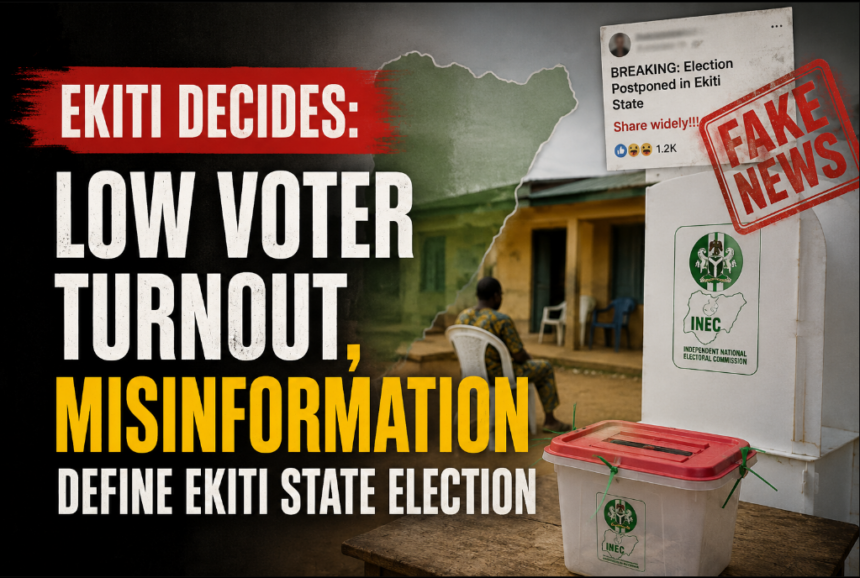
Low Voter Turnout and the Proliferation of False News
INEC, in the build-up to the election, announced that Ekiti State has 1,059,360 registered voters, up from 989,224 in 2022 and 909,585 in 2018. This represents a collection rate of 97.0 per cent, with 97.1 per cent of registered voters having collected their PVCs. However, these figures were not reflected across the 2,445 polling units in the state.
While announcing the election result, INEC said it had accredited 384,940 of the 988,251 registered voters. Out of the 382,109 votes cast, the total valid votes in the election were 375,777. This represents 38.65% of the electorate out of the over one million registered voters, and is the second lowest voter turnout recorded in the state.
This same pattern also reflects in past elections. In 2022, the state recorded the lowest voter turnout for any regular election, with only 36.47 per cent of over 989,000 registered voters participating.
The Nigerian Human Rights Community (NHRC) attributed poor economic conditions and fear of insecurity to this recurring problem.
“Many factors appear responsible for this, including but not limited to poor economic conditions, which affect transportation, fear of insecurity, and dwindling public concern about the quality of democratic dividends,” NHRC noted.
This was not the only challenge during the Ekiti elections. The proliferation of election misinformation also posed a significant problem.
False information found its way to social media spaces during the election. Claims that the Social Democratic Party (SDP) had withdrawn support for its governorship candidate, Peter Obafemi, and adopted incumbent Governor Biodun Oyebanji of the All Progressives Congress (APC) circulated widely. Findings, however, revealed that this information was misleading.
Also, photos of a branded sachet of alcohol were shared, with claims that it was being used to buy votes in the ongoing Ekiti State election. This was misleading, as findings revealed it was used as campaign material by Hon. Adewale Olatunji during the 2025 Ibadan North by-elections.
“ False information created confusion, heightened political tension, and, in some cases, discouraged voters from participating in the electoral process due to fears or the belief that the outcome had already been determined,” said Nurudeen Akewushola, Senior Fact-checker at FactCheckHub.
According to him, false information undermined public trust in the electoral process and increased the burden on electoral authorities, journalists, and fact-checkers to debunk misleading claims in real time.
What Is the Way Out?
As a solution to the recurring low voter turnout, NHRC opined that INEC and political parties need to do more to encourage people to participate in voting, which is one of the most significant civic duties of every Nigerian.
Also, Samuel Agbelusi, an election observer who has covered several elections in Nigeria, cited lack of credibility and harassment as major factors contributing to the decline in citizens’ participation in elections.
“The belief that electorates’ votes do not count and the issue of thug harassment are major concerns during elections,” he said.
He, however, noted that electoral processes should evolve in terms of technology, where citizens can cast their votes without fear and in comfort. He added that INEC needs to step up in the area of transparency, particularly in prosecuting election offenders.
Also, the Nigeria Civil Society Situation Room (Situation Room) encouraged security agencies to strengthen mechanisms for preventing electoral offences, including voter inducement and intimidation.
The organisation urged the National Assembly, INEC, political parties, and civil society organisations to intensify efforts to address declining voter turnout and strengthen public confidence in elections.
“The Ekiti Governorship Election should inform ongoing efforts to strengthen electoral integrity, democratic governance, and citizen participation.”
By Caleb Ijioma