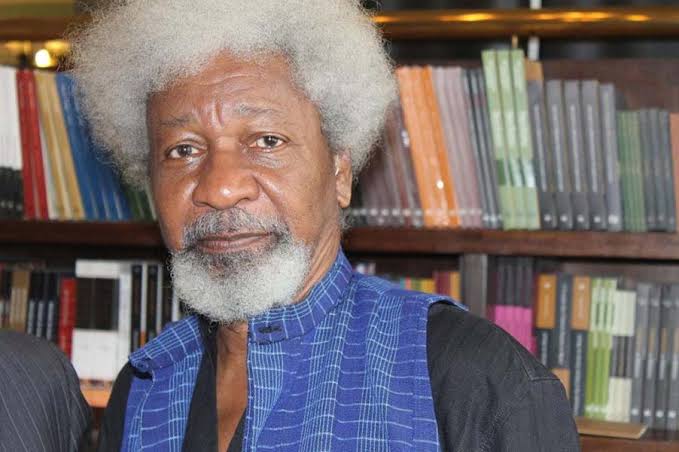
On July 13, 1934, Akinwande Oluwole Babatunde Soyinka was born in the Aké quarters of Abeokuta, the historic capital of present-day Ogun State.
He was born into a family that seamlessly bridged intellectual rigor and social conscience. His father, Mr. Samuel Ayodele Soyinka—affectionately known to colleagues and friends as “Essay”—was the esteemed headmaster of St. Peter’s Primary School in Aké.
His mother, Mrs. Grace Eniola Soyinka, was an industrious trader and a staunch pillar of the local Anglican Church. She hailed from the illustrious Ransome-Kuti family, tracing her lineage back to the region’s pioneering early Christians and activists.
Soyinka’s educational journey began at St. Peter’s Primary School, under his father’s strict and watchful eye. He proceeded to Abeokuta Grammar School for his early secondary education, studying under the tutelage of his uncle, the revered educator and political activist Reverend Israel Oludotun Ransome-Kuti.
In 1946, Soyinka’s academic brilliance earned him a highly competitive scholarship to complete his secondary education at Government College, Ibadan (GCI). After graduating from GCI in 1950, he advanced to University College Ibadan. He later relocated to the United Kingdom, earning a bachelor’s degree in English literature from the University of Leeds in 1957.
Shortly after, he spent formative time as a play reader at the Royal Court Theatre in London, honing a dramatic style that uniquely fused Western structural forms with rich Yoruba mythology and worldview.
Soyinka returned to Nigeria in 1960, precisely as the nation celebrated its independence from British colonial rule. He quickly established himself as a premier cultural leader, founding avant-garde theater companies like The 1960 Masks and writing brilliant, sharp-witted satirical plays such as The Lion and the Jewel and The Trials of Brother Jero.
However, his fierce, unyielding commitment to social justice soon put him at odds with the state. As the Nigerian Civil War (Biafran War) loomed in 1967, Soyinka chose a dangerous path of independent diplomacy. He secretly traveled to Enugu to meet with the Biafran leader, Colonel Odumegwu Ojukwu, in a desperate, heroic attempt to broker peace and avert bloodshed.
The federal military government branded him a traitor for this intervention. Soyinka was arrested and subsequently spent 22 grueling months in solitary confinement. Denied standard writing materials, he stubbornly smuggled in scraps of paper and ink, writing the raw reflections that would later become his profound prison memoir, The Man Died.
Following his release, Soyinka channeled the trauma of his captivity into theatrical masterpieces. He produced works like Madmen and Specialists and his undisputed magnum opus, Death and the King’s Horseman (1975)—a stunning, profound exploration of ritual duty, metaphysical transitions, and the destructive nature of colonial interference.
In 1986, the Swedish Academy made global history by naming Wole Soyinka the first African writer to win the Nobel Prize in Literature. The Academy celebrated him as an artist who, “in a wide cultural perspective and with poetic overtones, fashions the drama of existence.”
Refusing to retire to an isolated ivory tower, Soyinka remained a relentless thorn in the side of oppressive regimes. In the 1990s, he emerged as a fierce, vocal opponent of General Sani Abacha’s brutal military dictatorship, passionately championing the democratic mandate of Chief M.K.O. Abiola.
After publicly criticizing the military regime, Soyinka learned of an imminent plot by the state to assassinate him. In 1994, he staged a dramatic escape from Nigeria on a motorbike, fleeing across the Benin border into exile.
While he was abroad, the Abacha regime charged him with treason and sentenced him to death in absentia. Soyinka finally returned home in 1998 following Abacha’s sudden death, arriving just in time to participate in the arduous restoration of civilian democratic rule in Nigeria.