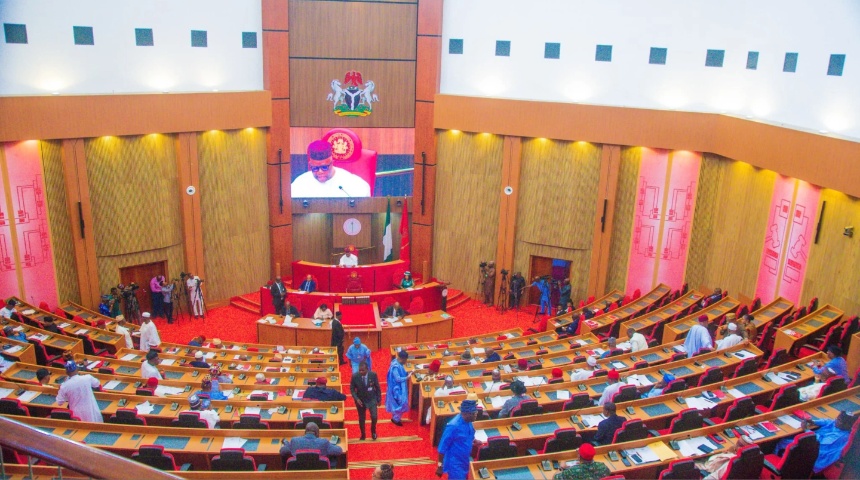
The Senate has passed the Federal Road Safety Corps (Amendment) Bill, 2026, and Nigerians who preach, hawk, or trade inside commercial buses could soon pay N50,000 for it.
The bill cleared plenary on Thursday and has already been transmitted to the presidency for assent. Once President Tinubu signs it, the FRSC Act gets its biggest facelift in years, with fines for a wide range of traffic offences going up by as much as 300 percent.
What exactly did the Senate pass?
Officially, the bill is titled the Federal Road Safety Corps Act (Amendment), 2026 (HBs. 1401 & 1604 – For Concurrence). It was first read on the floor back on July 1, 2026, and after weeks of committee work, senators finally gave it the green light this week.
The headline provision is simple: anyone caught hawking, trading, or preaching inside a commercial vehicle commits an offence. On conviction, that’s N50,000 out of your pocket. Lawmakers say the goal is to cut down on the kind of in-vehicle distractions that pull a driver’s attention off the road, whether that’s a hawker squeezing past seats or a preacher working up a full sermon mid-journey.
It’s not just preachers and hawkers in the crosshairs, though. Motorists who refuse to cooperate with FRSC officials during a roadside breath test, the kind conducted “on reasonable suspicion,” face the same N50,000 fine, six months in prison, or both.
One senator put the thinking behind the bill bluntly during debate: “Our roads have become marketplaces and crusade grounds. This cannot continue. The penalties must hurt enough to change behaviour.”
The bigger fines: what else is changing
Preaching and hawking aren’t the only things getting pricier. The amendment overhauls the entire second schedule of the FRSC Act, which now lists 52 traffic offences and their penalties, some of them raised by up to 300 percent.
Here’s what stands out:
- Disobeying traffic lights, road signs, or pavement markings — now N100,000, regardless of what it cost before.
- Speeding — previously a N5,000 slap on the wrist, now N100,000.
- Reckless driving — N100,000, up to two years in prison, or both.
- Driving under the influence of alcohol or drugs — also jumps from N5,000 to N100,000, or two years’ imprisonment, or both.
- Refusing an FRSC breath test — N50,000, six months’ imprisonment, or both.
- Hawking, trading, or preaching in a commercial vehicle — N50,000.
Other offences on the revised schedule, according to details obtained from the bill, cover things like using a phone while driving, overloading, seatbelt violations, and driving without a valid licence, all of which are getting stiffer penalties, though the exact figures for each haven’t all been made public yet.
Why now?
Nigeria’s roads have had a rough few years. Fatal crashes tied to distracted or reckless driving keep showing up in FRSC’s own data, and the Corps has long argued that its old fine schedule, some of it dating back over a decade, simply isn’t a deterrent anymore. N5,000 for speeding on a Lagos-Ibadan expressway, for instance, was barely worth the paper it was printed on for a lot of commercial drivers.
There’s also the more informal side of the problem: anyone who’s taken a bus between Lagos, Abuja, or Port Harcourt knows the drill. A trader hops on selling groundnuts or phone chargers, or a preacher takes over the aisle for ten minutes with a microphone-less sermon, and the driver’s attention drifts just long enough to matter. Lawmakers clearly decided it was time to put a price on that distraction.
What happens next
The bill isn’t law yet. It still needs the President’s signature before it takes effect, and until that happens, the current, older fines remain in force. But given how far it’s already traveled through the National Assembly, presidential assent looks more a matter of when than if.
Once signed, the impact will land fastest on commercial transport hubs, think Lagos, Abuja, Kano, Port Harcourt, where hawking and impromptu preaching in buses are practically part of the daily commute. Bus drivers, park operators, and passengers alike are going to have to adjust to a much less forgiving traffic regime.
For now, if you’re the praying type or you like to make a little extra selling recharge cards on your commute, you might want to hold off until this bill actually becomes law, and even then, it’s a fine worth avoiding.